
The Autopsy Posts: What Was the Actual Murder Window for the Death of Hae Min Lee?
This is my ninth post about autopsies following my first, second, third, fourth, fifth, sixth, seventh and eighth posts. This post is a final table-setter post for my posts on conclusions 3-5. Before I got to those posts, I wanted to reflect on the timeline presented by the prosecution during closing argument. Prosecutor Kathleen Murphy asserted the following to the jury during her closing argument in the trial of Adnan Syed for killing Hae Min Lee:

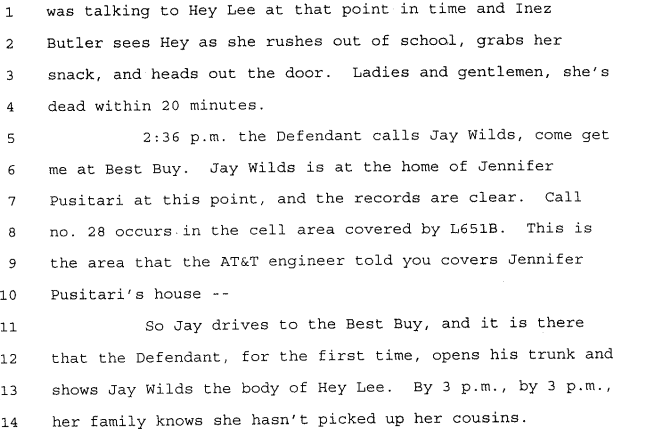
This portion of the closing argument was the source for one of the more memorable moments of the Serial Podcast: In Episode 5, Sarah Koenig and Dana Chivvis try to retrace Hae Min Lee’s movements on the afternoon of January 13, 1999 to determine whether she could have been killed between 2:15 and 2:36* (really 2:35), as claimed by the prosecution. If defense counsel had acted properly, however, this murder window should have been much, much smaller.
At the second trial, Inez Butler-Hendricks testified about seeing Lee at the concession stand after school, leading to the following Q&A (page 20):

That sounds logical enough, given that school ended at 2:15 P.M. In Episode 5, however, Adnan tells Sarah Koenig that students had to wait for the bus loop to clear before they could drive in front of the school and eventually leave school. According to Adnan, this “took about ten to fifteen minutes.” When Sarah and Dana retrace Lee’s steps, this estimate is corroborated, with the bus loop clearing “eleven minutes, thirty eight seconds” after school ends at 2:15 P.M., i.e., at 38 seconds after 2:26.
You would think that Inez knew about the bus loop and that it was impossible that she saw Lee at around 2:15, and…she did know. Here is her statement to police on March 23, 1999:
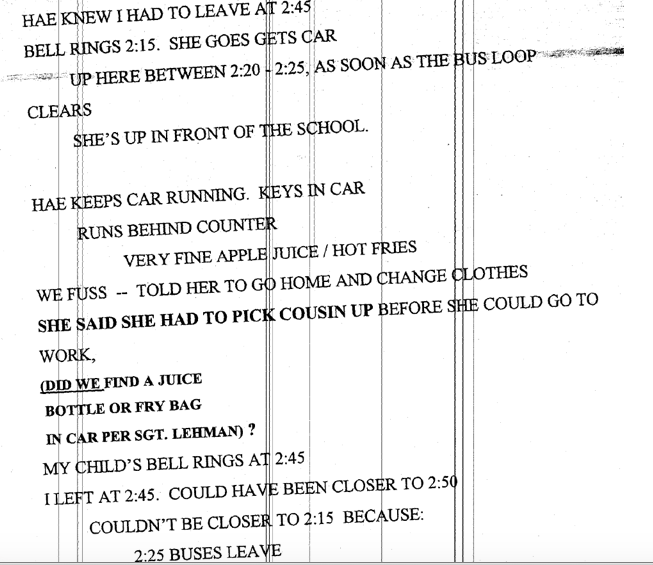
The first question to ask is how Inez testified that she saw Lee at “about 2:15, 2:20” if she knew that the buses left at “2:25,” making it so she couldn’t have seen Lee “closer to 2:15.” The second question is why defense counsel didn’t push her on this issue. Defense counsel must have known the importance of moving back the time at which Inez saw Lee. After all, the prosecution didn’t merely posit the 2:15-2:36 timeline in closing. Here’s the relevant portion of Prosecutor Kevin Urick’s opening statement (page 106):
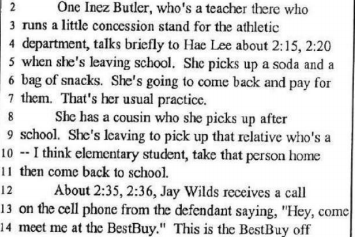
When cross-examining Inez, defense counsel should have had Inez’s prior statement in her hand as well as independent knowledge of when the bus loop cleared, whether from students or through having someone on her team conduct her own dry run like Sarah and Dana. With this information, it would have been clear that Lee couldn’t have interacted with Inez until 2:26 at the earliest. Moreover, Inez’s interview makes it clear that this meeting lasted a few minutes. Apparently, they talked about Lee picking up her cousin. They also “fuss[ed]” about whether Lee should go home and change clothes. According to Inez’s testimony (page 19), Lee was wearing
This creates its own timing issue. If Lee was in “real high black heels,” how long would it have taken her to exit her car, go to the concession stand, get her snack, talk with Inez, and get back to her car? Four minutes? If so, we’re at 2:30. Three minutes? If so, we’re at 2:29. Less? More? If defense counsel properly cross-examined Inez, it’s likely that the start of the murder window would have been pushed back to somewhere around 2:29 or 2:30,** not 2:15.

Let’s now turn to the end of the murder window. This is what led me to write this post. In Episode 5, Sarah and Dana conclude that it was possible but far fetched for Adnan to kill Lee in time to call Jay at 2:36 from Best Buy. This conclusion, however, is not based on their actual experiment. In their dry run, they are able to make the call “twenty-two minutes and two seconds” after the school bell rings at 2:15. In other words, their call is 2 seconds after 2:37. Presumably, Sarah and Dana were speculating that the drive could have gone a little bit more quickly on January 13, 1999. Of course, Sarah and Dana give themselves “a minute and a half in the car for the actual killing part.”
This is a somewhat logical conclusion, but it wasn’t the argument the prosecution presented to the jury during closing argument. According to Prosecutor Kathleen Murphy,
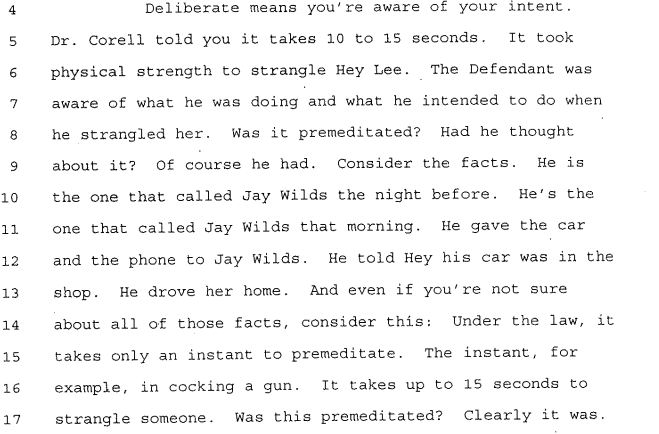
This seemed like a strange argument to me. Everything I’ve been told and read about strangulation indicates it takes 100 seconds (1:40) at a bare minimum to fatally strangle someone. The vast majority of sources place the minimum at 2-3 minutes or more. Did Dr. Korell really claim it only takes 10-15 seconds to fatally strangle someone? No. Here is her testimony from the second trial (page 43) when asked about how long it takes to fatally strangle someone:
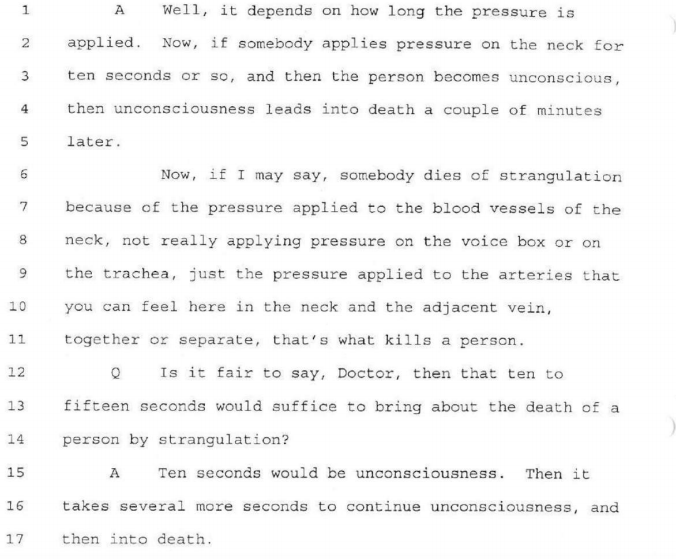
As you can see, Dr. Korell testified that it takes ten seconds or so for the strangulation to knock the victim unconscious, followed by “death a couple of minutes later.” The prosecutor later tried to get Dr. Korell to say that 10-15 second of strangulation can lead to death, but Dr. Korell’s response was simply that 10 seconds produces “unconsciousness,” with that unconsciousness turning into death after some unspecified time. This is the only logical response because no expert is going to tell you that strangulation will cause death in 10-15 seconds.
As I noted before, the earliest estimate I could find for passage of time before death from strangulation was 100 seconds, and it was in testimony that directly refuted death within 15 seconds. From the Deposition of Vincent J.M. Di Maio, M.D., in Lance v. Lewisville Independent School District, 2012 WL 8255325 (E.D.Tex. 2012):
Q. How were you able to tell that it wasn’t from strangulation?
A. Okay. The reason you can tell is really easy. When you talk to the witnesses, they all said that he only had his arm around the neck for like 20 seconds or something like that and then he was fighting, fighting and then he stopped and that’s how you die, is strangulation. It’s an — it’s — it takes a while, okay. And this guy was just struggling and then he just kind of died right there in front of him.
There were two witnesses, you know, one was I think the manager of the bar. The other one was just a plain old person there. And we know the time sequence, because there was telephone calls and the medical examiner got up and said, well, she thought he had only been strangled 15 seconds and you could die from that, and the literature says no. The literature — there’s a series of experiments done in the early 1940s where what they did was they put cuffs around the neck. You know, like a blood pressure cuff?
Q. Uh-huh.
A. And then they expanded it instantly and then they left it on for about the certain amount of time, and based on that, they found out how long a person could get this type of constriction and lose consciousness.
And then in their additional experiments, they left the cuffs on up to a hundred seconds. That’s what, one minute and 40 seconds? And then, of course, the person was obviously unconscious and they took the cuff off and the guy regained — guys regained consciousness in 20 or 30 seconds and walked out of the room in about a minute or two. So they know that constrictions of the blood vessels in the neck up to a hundred seconds is harmless.
Q. Okay. What about beyond that?
A. Well — well, okay. Now beyond that, it’s — you can’t do that experiment.
Q. Okay.
A. But based upon the reaction up to a hundred seconds, it’s generally assumed that with strangulation, not hanging, that if you maintained it for more than two to three minutes, you’re getting to the point where you so deplete the oxygen in the brain that the person will cease respiration. It doesn’t mean they can’t be revived, but they no longer will breathe unless you start CPR.
But that’s the thing: It does take 2-3 minutes to fatally strangle someone, meaning that Lee had to be in the Best Buy Parking lot by 2:32 or 2:33 for the strangulation to start in time for Adnan to call Jay at 2:36. Assuming that defense counsel objected to Murphy’s argument that strangulation can result in death in 10-15 seconds as opposed to the “couple of minutes” stated by Dr. Korell, 2:32 or 2:33 would have been the end (or at least the start of the end) of the murder window.
So, that was the actual window the jury should have been considering at trial: Lee getting in her Sentra at 2:29 or 2:30 after visiting the concession stand, and Adnan starting the fatal act of strangulation in the Best Buy parking lot at 2:32 or 2:33. Inconceivable?
_________________________________
*Keep in mind that Jay never says in any interview or testimony that Adnan called him from Best Buy at 2:36 or even close to 2:36. Instead, he consistently states that Adnan called him at or after 3:40. At the second trial, Jay places the call after 3:45 (page 130).
**Possibly the more important part of Inez’s police statement was that she recalled seeing Lee keeping her Sentra running, with the keys in the car, when she went to the concession stand. Presumably, this means that Lee was driving and that Adnan was not in the car. Given that the prosecution claimed that Lee was in the passenger’s seat when she was killed, you would have to add in additional time for Lee to later pick up Adnan and switch seats.
***100 seconds is slightly under 2 minutes, but it is hard to believe that Adnan would have strangled Lee for the very bare minimum amount of time. After all, the prosecution claimed that Adnan’s EMT training made him acutely aware of how to strangle someone. Surely, he wouldn’t have risked only strangling Lee for the very bare minimum amount of time.
****Keep in mind that Jay said he saw Adnan standing at the external Best Buy pay phone***** when he arrived at the store. This certainly implies to me that Adnan was still standing there after making the call. But wouldn’t that mean that Adnan would have needed to spend time putting Lee in the trunk before calling Jay, making a 2:36 call even less likely?
*****An external pay phone that apparently didn’t even exist.
-CM