
The Autopsy Posts: It’s Exceedingly Unlikely Hae Min Lee’s Hemorrhages Were Caused By Punches Thrown in Her Sentra
I wonder if there was any investigation done to find a weapon used to hit her with? You would think the defense attorney would have hired a P.I. or a forensic expert.
The above was the very first response I got when I started soliciting expert opinions about the lividity evidence in the death of Hae Min Lee. The question was based upon the autopsy report for Lee, which indicated that she had a right occipital subgaleal hemorrhage as well as a right temporalis muscle hemorrhage. The experts I’ve heard from are all in agreement that such hemorrhaging likely was not the result of punches and almost certainly not the result of punches thrown from inside the cozy confines of the 1998 Nissan Sentra. This has allowed me to draw my third conclusion:
It’s possible that the blunt force injuries could have been caused by punches, but it is likelier that they were caused by a weapon or Lee’s head striking some fixed object.
Boxer’s Fracture
Let’s start with some basic anatomy:
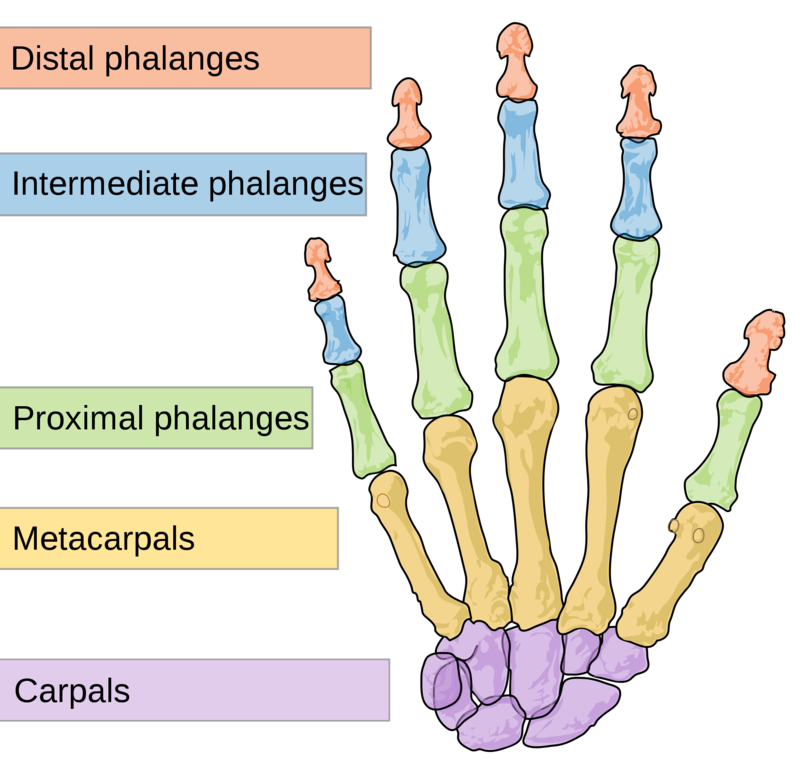
-The metacarpals are long bones in miniature that are connected to the carpals, or wrist bones, at the wrist, and connect from there to the phalanges, or finger bones.
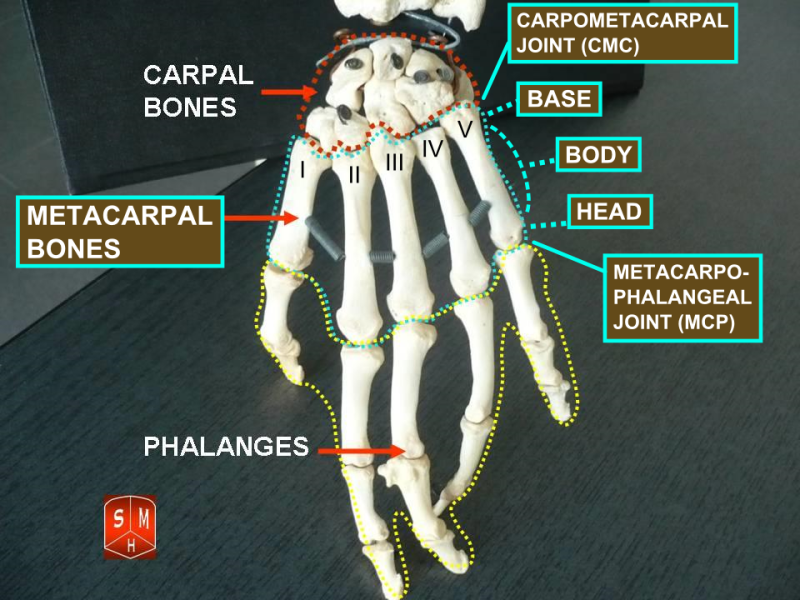
-The phalanges are the bones that make up the fingers of the hand and the toes of the foot….The phalanges are named according to whether they are proximal, intermediate or distal, and according to the finger or toe they are in. The proximal phalanges are those that are closest to the hand or foot. In the hand, the prominent, knobby ends of the proximal phalanx is often called the knuckle.
This takes us to the phenomenon often referred to as Boxer’s Fracture. From the Trooper-Trainee Countermeasures Training Evaluation Manual, as cited in the Affidavit of Dr. C.J. Abraham (in Carty v. Texas Department of Public Safety, 2006 WL 4092756 (E.D.Tex. 2006)):
“For the officer, using a punching technique might be both dangerous and ineffective. Breaking bones of your own hand can be fairly common when punching a hard surface, like the head. Try to punch a coconut! The fracture of the fifth metacarpal bone became so well associated with punching that it is called the ‘boxer’s fracture’. And complications can be serious. An open-hand technique would be safer for the officer, while also being more effective.”
Such fractures happen while punching a hard surface such as a head because the proximal phalanx is flexed down. From the testimony of of Richard C. Barth, M.D., in Goodman v. Bowdoin College, 2001 WL 35962242 (D.Me. 2001):
Usually when you have an injury from punching someone, you fracture the metacarpal neck; and there are certain typical fractures we see. In fact, one of them is called a boxer’s fracture.
And the trauma usually from punching someone is to the metacarpal head because when you punch somebody, your proximal phalanx is flexed down out of the way.*
Such injuries are so associated with punches that experts are often able to conclude to a reasonable degree of medical probability that metacarpal fracturing was caused by punching. From the Deposition of Paul Davidson, M.D. in Rossiter v. Board of County Commissioners of Arapahoe County, 2009 WL 6928624 (D.Colo. 2009):
Q. Can you state to a reasonable degree of medical probability that Mr. Montana’s fracture of his fifth metacarpal was caused by punching?
A. I think based on my experience of seeing similar patients in altercations, to a reasonable degree of medical probability, he fractured it from punching one of his assailants.
The reason that experts are able to make these types of conclusions is that two metacarpals — the 4th (ring finger) and 5th (pinky) metacarpals — are the stress points during a punch, making their fracturing the likely result of punching. From the Deposition of Gary Certain in Ferlito v. The County of Suffolk, 2009 WL 9048629 (E.D.N.Y. 2009):
Q. What is a boxer’s fracture?
A. That is a fracture to the metacarpals.
Q. Which ones?
A. Usually in the area of the 4th and 5th metacarpals. Usually the knuckles in that area extend out during contact and they are the first ones to make contact and stress to these areas or bones usually result in a fracture. It’s known as an offensive injury to prosecutors, as opposed to a defensive injury.
Here is an x-ray of a fracture to the 4th metacarpal bone:
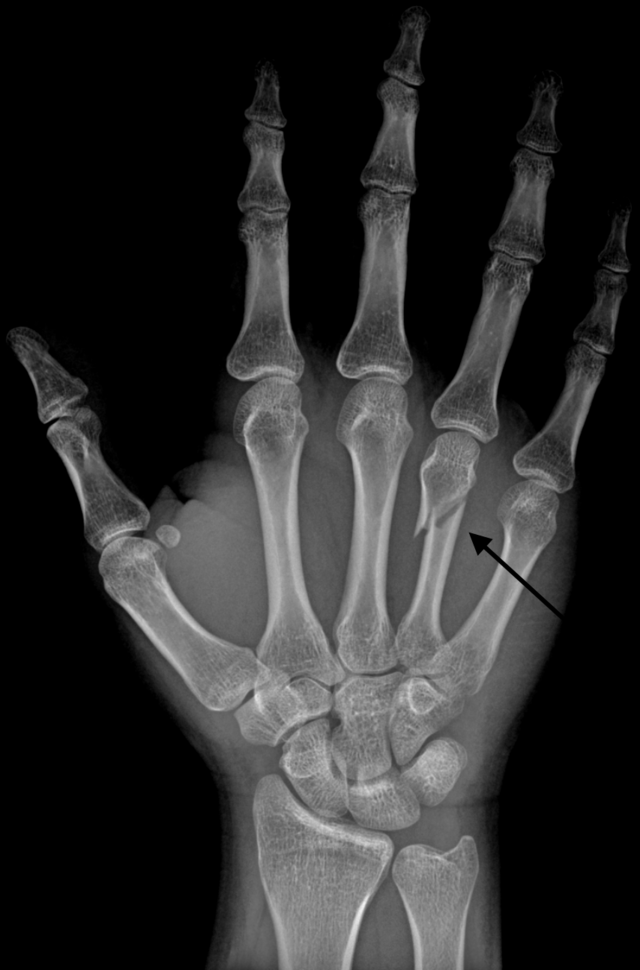
After viewing such an x-ray, in the absence of a plausible explanation to the contrary, a doctor would likely be able to conclude to a reasonable degree of medical probability that the fracturing was the result of punching a hard surface like a head.
Now, this isn’t to say that any punch to the head is going to cause a Boxer’s Fracture. That said, keep in mind the nature of the injuries found in Lee’s head: a right occipital subgaleal hemorrhage and a right temporalis muscle hemorrhage.
As I noted in a prior post, a subgaleal hemorrhage is blood pooling on the skull below the galea aponeurotica, a tough layer of dense fibrous tissue which covers the upper part of the cranium. The amount of force required to produce such a hemorrhage is significant. In another prior post, the causes I listed for such a hemorrhage were (1) a 6-8 foot fall down stairs, leading to the victim’s head striking the basement floor; (2) a victim falling into a pond and striking her head on some object in the pond; (3) car accidents; (4) a victim falling 12 feet while pole vaulting; and (5) a victim falling 6 feet into an empty pool.
As I also noted in a prior post, a temporalis muscle hemorrhage is blood pooling in the temporalis muscle, which is covered by the temporal fascia, a strong, dense layer of fascia (fibrous tissue). Again, the amount of required to produce such a hemorrhage is significant. Each of the example I cited in which victims suffered temporalis muscle hemorrhages involved car accidents.
This gives you some idea of the type of punch that would be required to produce such hemorrhaging. Would such a punch necessarily cause a Boxer’s Fracture? According to my experts, the answer is “no,” but the types of punches that could have caused Lee’s hemorrhages almost certainly would have caused the other associated injuries: bruising and swelling.
Now, of course, none of this is to say that Lee’s injuries couldn’t have been cause by punches to the head. But what it does say is that if Lee’s assailant did cause her hemorrhaging through punches, people in the days after her death should have noticed some injuries to her assailant’s hand.
Can Punches Cause Subgaleal and Temporalis Muscle Hemorrhaging?
According to my experts, punches can cause subgaleal and temporalis muscle hemorrhaging, but it is unlikely. Car accidents are the likeliest cause of such hemorrhages. Previously, I cited an epidemiological study of 64 patients admitted to a hospital with blunt force injuries to the head, and 55 (85.93%) were caused by motor vehicles accidents, 6 (9.83%) were caused by physical assaults, and 3 (4.68%) were caused by falls from height.
The vast majority of the physical assault cases I found in which there was such hemorrhaging involved weapons. See, e.g., autopsy report and autopsy report. I was only able to find two cases of subgaleal hemorrhaging possibly caused by punches. In People v. Jones, 936 N.E.2d 1160 (Ill.App.6th 2010), the defendant punched the victim in the head (possibly) five or more times, causing the victim to spin and fall to the ground. After the victim “fell to the ground, defendant ‘stood over’ [him] and punched him in the head a “couple more times” and kicked him in the head,” possibly multiple times. According to the autopsy report by Dr. Michael Humilier, subgaleal hemorrhages in the victim’s head “were consistent with [the victim] having been kicked or punched in the head.
In DuBose v. State, 977 S.W.2d 877 (Tex.App. 1998), Harris County Assistant Medical Examiner Dr. Marilyn Murr testified that the victim’s injuries, including subgaleal hemorrhaging “would take an extreme amount of force, kicking or a very strong person repeatedly punching.”
Meanwhile, I was only able to find one case in which an expert speculated that a temporalis muscle hemorrhage could have been caused by a punch. According to the Brief of Appellant in Truong v. State, 2014 WL 550983 (Tex.App. 2014), there was evidence that the defendant attacked the victim, and at least one victim testified that the attack was done with a stick. The victim had temporalis muscle hemorrhages, and Medical Examiner William Rohr testified that testified that they “were caused by a strike with an object, a fist or a fall.”
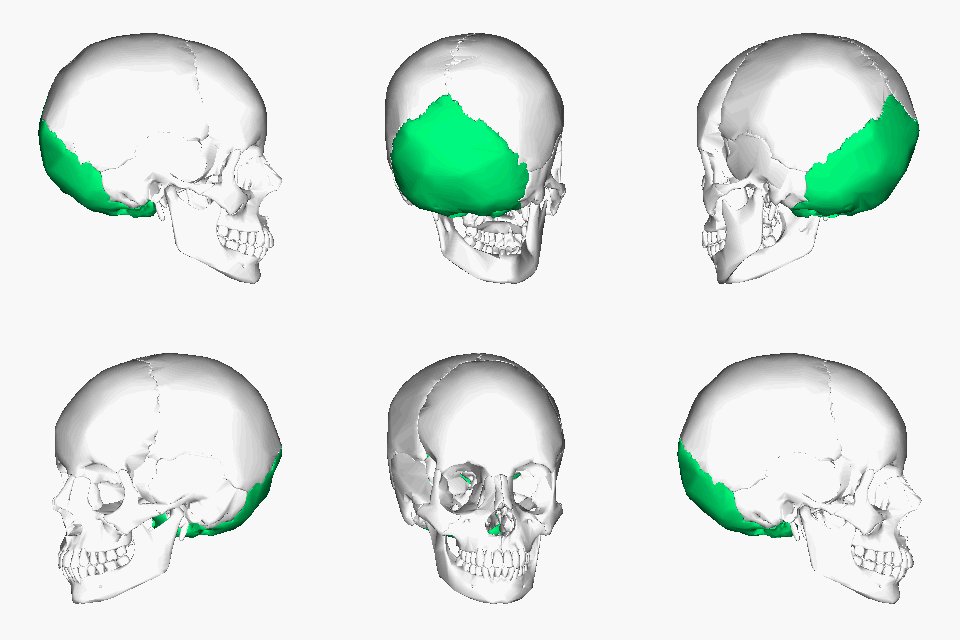

Lee’s hemorrhage would have been in the red region, on the right side of the skull
 The parietal region
When I presented Lee’s autopsy report to an Assistant Medical Examiner, he immediately said without hesitation that “she was probably hit with something in the head multiple times.” The only other logical explanation seems to be that the hemorrhages were caused when Lee’s car was struck by another vehicle, which is an intriguing possibility given the revelation that Lee’s Sentra was taken to a body shop. It is exceedingly unlikely that Lee’s hemorrhages were caused by punches and even less likely that they were caused by punches in her Sentra. Instead, we should be looking for a weapon used to strike Lee in the head multiple times
-CM
______________________________
*Each metacarpal bone has (1) a base, “the portion that attaches to the bones of the wrist;” (2) a shaft, “the long, slender portion of the bone;” (3) a neck, “the portion of the bone that connects the shaft to the head;” and (4) a head, which “form[s] the knuckle of an enclosed fist.” The metacarpal neck and/or head can be the location of a Boxer’s Fracture.
**This theory has its own issues, which I will address in my post on my fifth conclusion.
***I haven’t come across a single case or autopsy in which an occipital hemorrhage was caused by a punch.
****Such a possibility is even less likely if the assailant were 6’0″, compared to the 5’6″-5’8″ Lee.
*****A punch doesn’t require a huge wind up, but even the more moderate wind up required for maximum force would be difficult in the Sentra.