
More on the Hair Analysis in the Adnan Syed Case & Excluding Him as A Source
This is a follow-up to my post about the two hairs recovered from Hae that were a match for neither Hae nor Adnan. In that post, I noted how the State first informed the defense about Sal Bianca’s hair analysis on December 2, 1999. That’s the same day that Bianca filed his report. Here is a copy of that report, which Susan Simpson posted on her blog a while ago:
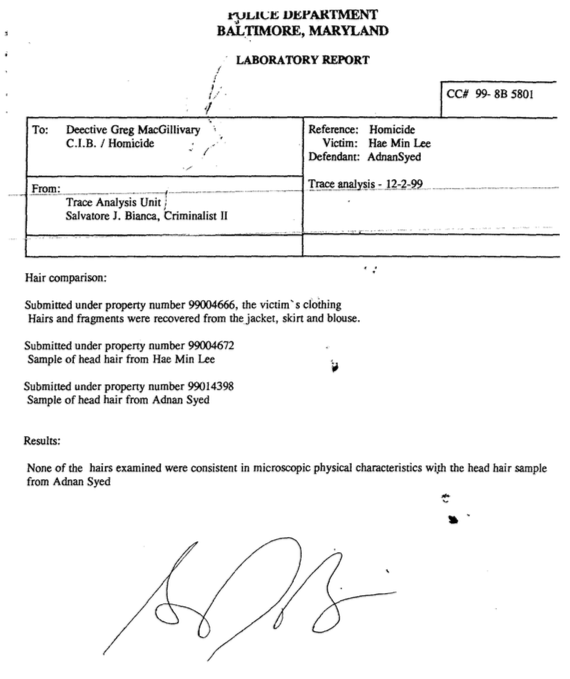
This is the report that I contended that Gutierrez should have used when cross-examining Bianca about his hair analysis. The report makes clear that “[n]one of the hairs examined were consistent in microscopic physical characteristics with the head hair sample from Adnan Syed.” In other words, Adnan could be excluded as the source of any of the hairs found on Hae.
Even if the hairs examined were “consistent in microscopic physical characteristics with the head hair sample from Adnan Syed,” this would not have proven that the hairs came from Adnan. As forensic pathologist Cyril Wecht testified in Steele v. Beard, 830 F.Supp.2d 49, 67 (W.D.Pa. 2011):
Wecht: In my opinion, it is universal, accepted forensic scientific knowledge, that hair identification, gross and microscopic physical characteristics is not exclusive to the rest of the world. It is not fingerprint identification, in other words.
Tershel: And to what degree can you tell that? Is there something of class or something of that nature?
Wecht: Different words are used such as consistent with or compatible to or other words. There are a variety of ways in which you can express it. You can talk about classes and sub-classes and Caucasian and Negro or Mongoloid or pubic hairs versus head hairs or certain colors. You can talk about a lot of things, please understand that, but then, you’re talking ultimately … If I understand you correctly, about whether or not you can say as a fingerprint-person can analyze that it is this individual to the exclusion of any other individual in the world and the answer is no, you cannot do that by the gross and microscopic characteristics of hair. You can make a lot of conclusions and you can make a lot of statements, but you can’t say that it is this individual and cannot be anybody else in the world.
Indeed, according to the FBI’s own website,
When a hair exhibits the same microscopic characteristics as hairs in the known hair sample, a qualifying statement may be added to the report. This statement may read as follows:
Hair comparisons are not a basis for absolute personal identification. It should be noted, however, that because it is unusual to find hairs from two different individuals that exhibit the same microscopic characteristics, a microscopic association or match is the basis for a strong association.
On the other hand, the opposite is clear: If hairs recovered from the victim are inconsistent with hairs taken from the suspect, he can be excluded as the source of those hairs. See, e.g., Respondent’s Brief, People v. Webb, 1992 WL 12024858 (Ca. 1992):
Mr. Levine examined a hair taken from Lori Rainwater’s vulva, and a hair also taken from Anthony Bradley. (RT 4339-42.) The hair from Lori Rainwater was inconsistent with the hair taken from Bradley, so Levine excluded Bradley as the source of the hair. (RT 4343, 4356.)
-CM