
Assessing the LensCrafters Motion for an Ex Parte Subpoena in the Adnan Syed Case
In a prior post, I noted how a law student/clerk was put in charge of subpoenaing the work records from LensCrafters in the Adnan Syed case. In this post, I will go in more depth about the motion for an ex parte subpoena, some of its errors, and what effect those errors might have had.
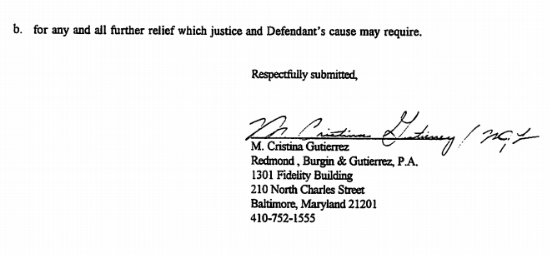
Here is the motion, which was filed under seal:
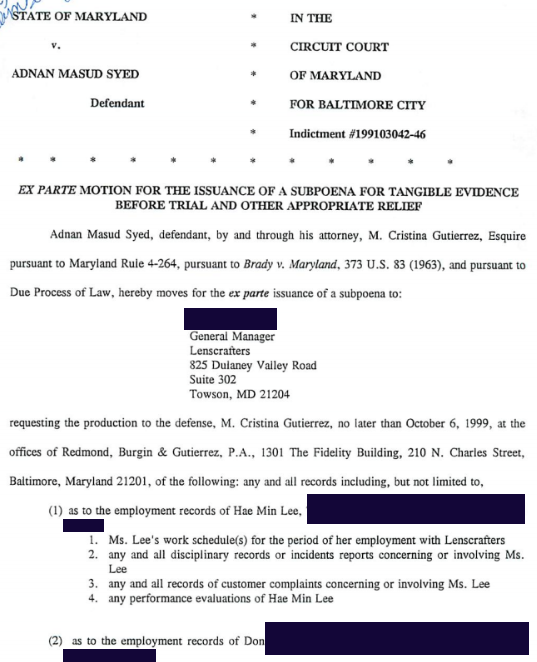
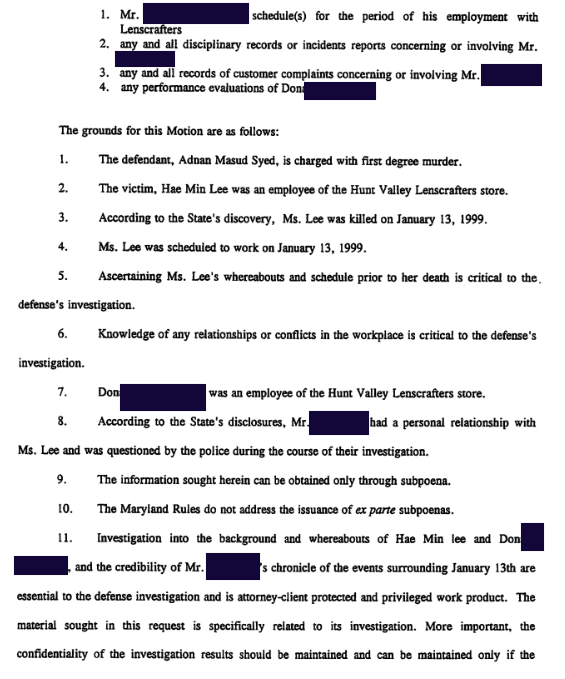
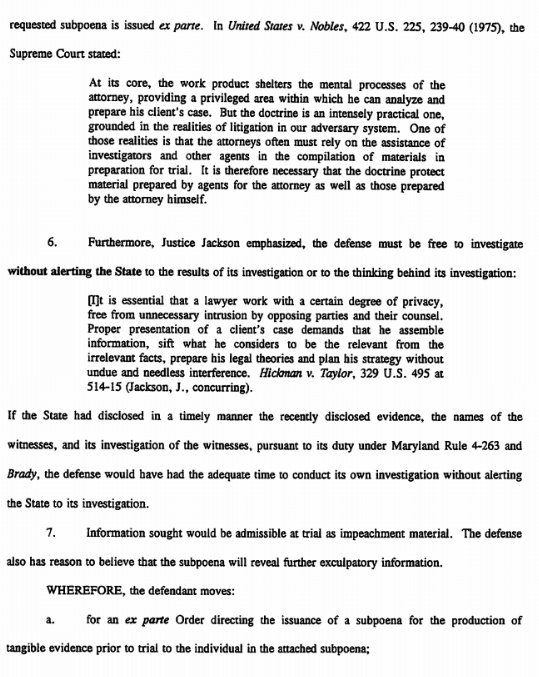
Let’s break things down. First, the motion notes that “[t]he Maryland Rules do not address the issuance of ex parte subpoenas.” In other words, they are not specifically permitted or precluded.” Therefore, the motion cites twice to the Supreme Court’s opinion in United States v. Nobles. That opinion, however, merely deals with the work product privilege generally and makes no reference to ex parte subpoenas.
If the defense was going to cite federal law, why didn’t it instead cite to Federal Rule of Criminal Procedure 17(c), which courts have interpreted as allowing for the issuance of ex parte subpoenas? For instance, in United States v. Beckford, 964 F.Supp. 1010, 1030 (E.D.Va.1997), the court noted that
A motion for issuance of a subpoena pursuant to Rule 17(c) is properly brought ex parte only “[i]n those rare situations where mere disclosure of the application for a pretrial subpoena would (i) divulge trial strategy, witness lists or attorney work-product; (ii) imperil the source or integrity of subpoenaed evidence; or (iii) undermine a fundamental privacy or constitutional interest of the defendant.”
Given that this court was in the same federal judicial circuit as Maryland, it is unsurprising that the United States District Court for the District of Maryland later cited to it in United States v. Smith, 2010 WL 4291953 (D.Md. 2010).
Now, this federal law certainly wouldn’t have been controlling in Adnan’s state case, but it would have been a lot more compelling than citations to a generic Supreme Court case on work product that didn’t speak to the issue of ex parte subpoenas.
This gets to the second problem with the motion. It simply notes that “Information sought would be admissible at trial as impeachment material. The defense also has reason to believe that the subpoena will reveal further exculpatory information.” This probably leaves you asking the same question as me, which is also probably the same question asked by the court: What’s your reason for these beliefs? I have no idea, and I’m sure the court had no idea, whether the defense really thought they had something or was merely engaged in a fishing expedition.
At a minimum, what seems clear is that Gutierrez did have a trial strategy of trying to create reasonable doubt about whether Don might be responsible for Hae’s death. For instance, here is the pertinent portion of her cross-examination of Debbie:
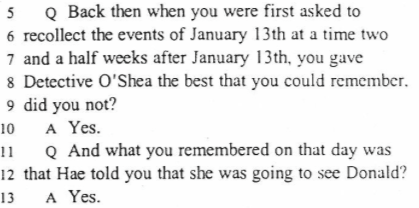
Gutierrez was referencing this January 28th interview with Debbie, in which Debbie did indeed say that Hae told her on January 13th that she was going to see Don.
Given this, and given that the State had given every indication at this point that they were going to present Debbie as the last witness to see Hae alive, why didn’t the defense merely spell out its trial strategy to the court? All it needed to do was to argue that the last witness to see Hae alive said that she was going to see Don, meaning that the defense had a strategy of trying to discredit Don’s alibi. That would seem to be a clear reason for the court to allow an ex parte subpoena.
And maybe the court did allow for an ex parte subpoena, but the fact that Urick somehow got his own copies of the LensCrafters records days later tends to imply that the ex parte subpoena was not approved or that some other type of impropriety occurred. The result was that LensCrafters disclosed to the prosecution but not the defense that the General Manager at the Hunt Valley LensCrafters on January 13th was Don’s mother. This, of course, could have gone to the integrity/source prong of the Rule 17(c) analysis, although the defense was somewhat understandingly unaware of this fact.
What’s less understandable is that the defense was under the misimpression that Hae and Don were both employees of the Hunt Valley LensCrafters at least as late as a few weeks before the originally scheduled trial. I touched upon this a bit in my prior post. Based upon this mistake, which was included in the motion, the defense might have lost out on important information. Seemingly as a result of this error, LensCrafters only produced the work schedule for the Hunt Valley LensCrafters for the week of January 13th, including the schedule for the lab:
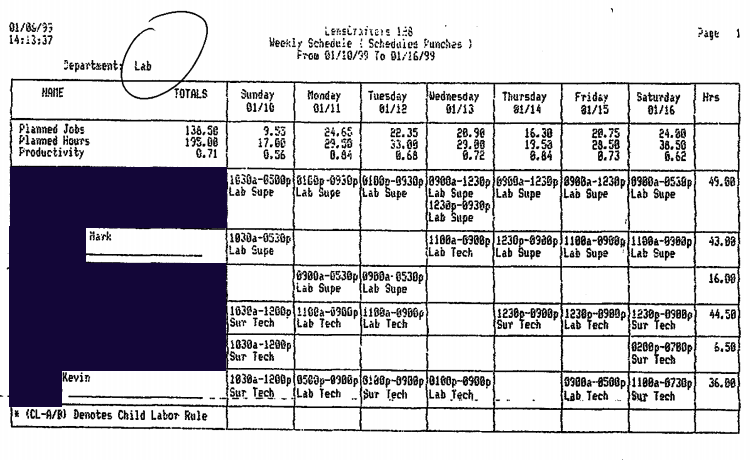
Mark and Kevin are the two candidates for the friend Don would have been subbing for when he worked from 9-6 at the Hunt Valley Store on January 13th.
LensCrafters did not produce the work schedule for the Owings Mills LensCrafters, which is where both Hae and Don worked. This seems important for a couple of reasons. First, the motion itself notes that “the credibility of [Don]’s chronicle of the events surrounding January 13th [is] essential to the defense investigation….” Well, Don’s chronicle of the events in his police statement was that he was told by his father to call the Owings Mills store after arriving home from the Hunt Valley store on January 13th. At trial, Don thereafter testified that he learned about Hae’s disappearance after receiving a call from his lab manager at Owings Mills:
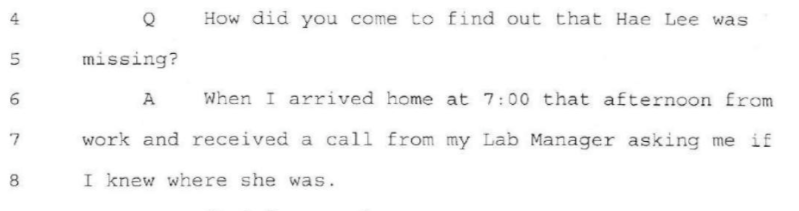
A proper motion likely would have uncovered the identity of this lab manager,* who could have either confirmed or dispelled these versions of events.
Second, a proper motion likely would have led to disclosure of the other employees of the Owings Mills LensCrafter, which was part of the point of the motion; it noted that “[k]nowledge of any relationships or conflicts in the workplace is critical to the defense’s investigation.”
This seems to make a good deal of sense. Given that Hae worked at the Owings Mills LensCrafters a few days before she disappeared, there’s a good chance that one of her co-workers might have known her plans on January 13th or other information pertinent to what happened that day. Outside of Hae’s school friends and family, these co-workers likely would have been the best sources of information about Hae, especially those co-workers who were friendly with Hae. Instead, the only reference we have to a co-worker anywhere is a reference to a co-worker who went out to dinner with Hae at Ruby Tuesday on December 29th after her shift ended at 10:00 P.M. and ordered a shot of cognac. But I’m not even 100% sure he was a co-worker, and I’m not close to 100% sure of his first name, which is all I have.
Again, Gutierrez (and we) could have much more information if the motion had asked for all of the relevant records from both Hunt Valley and Owings Mills. Instead, the motion, which was filed mere weeks before Adnan’s originally scheduled trial, had a key error, depriving the defense of information that could have been helpful (or not) to the defense case.
_____________________
*Who was presumably different from the Owings Mills General Manager.
-CM