
Another Dr. Rodriguez Case, Another Disclosure Issue…and Lividity Evidence
Before becoming the Forensic Anthropologist and Chief Deputy Medical Examiner for the Armed Forces Institute of Pathology, Dr. William Rodriguez was a Deputy Chief Coroner:
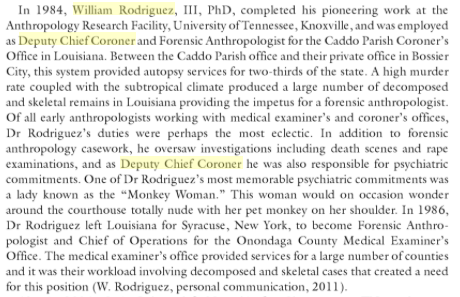
Through this work, Dr. Rodriguez became known as “a time–of–death specialist.” State v. Willie, 559 So.2d 1321, 1334 (La. 1990). It was in this capacity that he was called as an expert witness at the murder trial of Sean Esty, a trial that involved late disclosure of Dr. Rodriguez and conflicting lividity testimony.
According to the United States District Court for the Northern District of Florida in Esty v. McDonough, 2007 WL 1294602 (N.D.Fla. 2007), Esty was charged with first-degree murder in connection with the death of fifteen year-old Lauren Ransey in December 1991.
The State’s theory was that [Esty] murdered Ramsey around midnight on December 22, 2001. [Pathologist Dr. Everett Steven] Havard [performed the autopsy and] opined that Ramsey died twenty-four to thirty-six hours prior to the discovery of her body and that she was stabbed prior to the time the head wounds, which were consistent with a baseball bat, were inflicted….[Esty]’s theory was that Ramsey died much later than midnight on December 22, and that [Esty] had an alibi for the time period in which she died. Defense expert, entomologist Jeffrey Wells, believed the fly eggs found on Ramsey’s body were deposited after the rain ended on December 23; however, he found nothing inconsistent with the body being at the site at midnight on the 22nd…Defense expert Michael Arnall, an associate medical examiner, placed time of death between noon on December 23 and noon on December 24 based on his analysis of lividity, rigor mortis, corneal opacity, greening of the body, and the unhatched fly eggs…However, Arnall stated that his findings were not inconsistent with Well’s findings…In rebuttal, the State presented forensic anthropologist William Rodriguez, who disagreed with Dr. Arnall’s assessment, and testified that he believed that Ramsey’s body was at the site between thirty-six and forty-two hours at the time of its discovery.
After he was convicted, Esty appealed, claiming both that (1) the State acted improperly in failing to list Dr. Rodriguez as a potential witness until four days before trial; and (2) his trial counsel was ineffective based upon failing to challenge Dr. Rodriguez’s testimony.
On the first point, the court acknowledged that “[t]he State listed Rodriguez as a possible witness on July 16, 1992, four days prior to the beginning of Petitioner’s trial, and defense counsel was not aware that Dr. Rodriguez was listed as an expert witness.” That said, the court noted that defense counsel did learn of Dr. Rodriguez at trial, “conducted an extensive and rigorous cross-examination of Rodriguez, and counsel’s ability to thoroughly cross-examine Rodriguez was not materially affected by counsel’s failure to earlier recognize that Rodriguez would be called as a witness.”
Nonetheless, Esty’s appellate counsel claimed that trial counsel’s ability to cross-examine Dr. Rodriguez was hampered by trial counsel relinquishing the services of his own expert witness before Dr. Rodriguez testified. The Northern District of Florida, however, agreed with the Supreme Court of Florida that “[a]ny prejudice appears to be self-inflicted by counsel’s failure to inquire into the nature of this witness’s testimony before relinquishing the services of his own expert witness, and not because of any discovery violation by the State”
Given this finding, you might expect that the Northern District of Florida would have found that trial counsel was ineffective in challenging Dr. Rodriguez’s testimony. There were, however, a few problems with this claim, including the one that I will highlight here. According to the Northern District of Florida,
Rodriguez undermined the credibility of the State’s case when he testified that the State’s pathologist, Havard, made serious mistakes in the conduct of the autopsy as well as in his findings…Rodriguez strenuously disagreed with Havard’s findings regarding the presence of post-mortem lividity, a factor in determining how long a body has been dead…While Havard noted no postmortem lividity, both Rodriguez and defense expert Arnall testified that lividity was clearly present (emphasis added).
In other words, Dr. Rodriguez actually contradicted the State’s pathologist (and agreed with the defense expert) on the lividity evidence, meaning that a rigorous cross-examination of him would have been counterproductive.
What’s interesting about all of this is that Dr. Rodriguez is “a time–of–death specialist,” with specialized knowledge of lividity evidence based in part upon his years as a Deputy Chief Coroner at an office that performed a significant number of autopsies. This is interesting because, as I’ve noted, Dr. Margarita Korell, who performed Hae’s autopsy, was not at Leakin Park for the disinterment of Hae’s body. Conversely, Dr. Rodriguez, who supervised that disinterment, was present for Dr. Korell’s autopsy. According to the autopsy report,
The body was found in the woods, buried in a shallow grave with the hair, right foot, left knee, and left hip partially exposed. The body was on her right side.
This is ostensibly information that came from Dr. Rodriguez, not Dr. Korell.* This is important. You could imagine many forensic anthropologists (bone experts) being unaware of the significance of stating that a body with anterior (frontal) lividity was found on its “right side.” But, given Dr. Rodriguez’s experience and knowledge of autopsies, time-of-death calculations, and lividity, he would have been fully aware that the autopsy’s description of the burial position was inconsistent with its description of the lividity.
As such, if Cristina Gutierrez had asked him about this inconsistency, it could have caused significant damage to the State’s case. But, as with Dr. Korell, Gutierrez never asked about how long it takes for lividity to become fully fixed and what that meant for the State’s timeline.
______________________
*It also potentially could have come from Marlon Aquino, who was present for disinterment and signed the autopsy report as well.
-CM