
Thoughts on the 1st Day of Adnan’s Reopened PCR
Yesterday was the first day of the reopened PCR proceeding in the Adnan Syed case. I wasn’t up in Baltimore, but I got the gist of what happened over social media. As a result, I recorded some audio for last night’s special minisode of Undisclosed. Unfortunately, I recorded my segment during a tornado warning, so it seems like there were some resulting glitches. So, here are my thoughts a bit more fleshed out.
The State’s Claim About the Asia/Library Alibi Conflicting With What Adnan Told Police

As I noted yesterday, precedent from across the country indicates that it is unreasonable for an attorney to fail to contact a prospective alibi witness without first having someone on her team contact the witness to determine her reliability and viability. The State is apparently trying to claim that lack of contact was justifiable based upon the fact that the Asia/library alibi conflicts with the story that Adnan told police: that he remained at school until track practice.
This argument, however, is neither new nor accurate. In its Brief of Appellee (page 21), the State argued as follows:
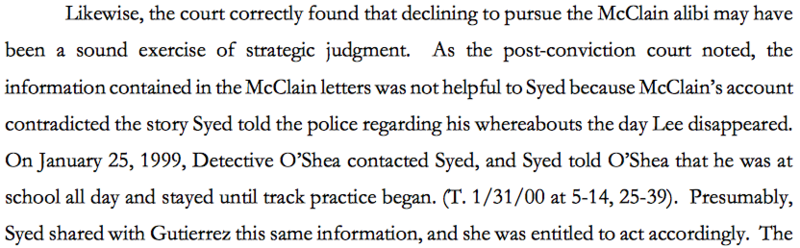
The problem is that these arguments aren’t supported by the record. Pages 5-14 in the January 31st transcript contain unrelated testimony by Officer Adcock. Pages 25-39 do contain testimony by Detective O’Shea, but he never testifies that Adnan told him he remained at school until track practice began. Here’s the most relevant portion of his Q&A (pages 25-26):
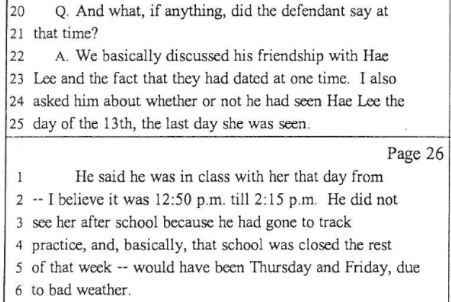
This testimony is consistent with the relevant portion of Detective O’Shea’s police report:
On 01/25/99 the assigned went to Adnan Syed’s residence and I was informed by a woman that Adnan was in school. I received a phone call from Adnan later that day. Adnan said he was in class with Hae Lee on 01/13/99 from 1250 to 1415 hours. Adnan went to track practice after school and he did not see Hae Lee leave. Adnan said school was closed due to bad weather on 01/14 and 01/15.
Therefore, as far as I can tell, there is no documentary evidence supporting the proposition that Adnan told the police that he remained at school until the start of track practice.
Furthermore, even if he did, there are two responses. First, Krista submitted an Affidavit (Exhibit 2) indicating that a Woodlawn student saying that he was “at the high school” could have meant that he was at the physical school campus or at the adjacent library. Also, when asked yesterday by Adnan’s attorney about whether the library was considered part of the school’s campus, Asia apparently responded, “Oh yeah!”
Second, even if Adnan initially told the police a different story, that wouldn’t obviate the need for defense counsel to contact Asia McClain. For an example, consider this post, in which I discuss a case in which the defendant initially told the police that he was at an arcade during a robbery/murder and was later reminded by a friend that he was actually helping someone move at that time.
The State’s Claim About Adnan’s E-mail Address & Password Being in the Defense Files
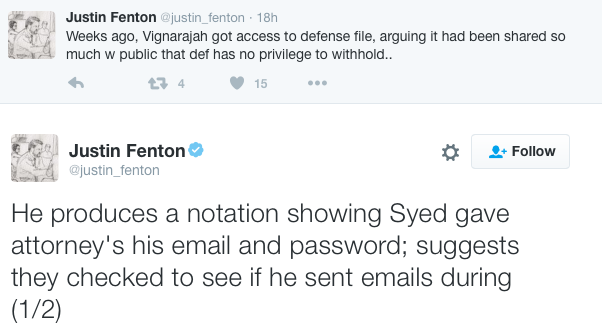
The Deputy Attorney General is clearly trying to make the argument that he has uncovered some type of smoking gun. In reality, these notes have been out there for years. About six to be specific. In Adnan’s initial 2010 Petition for Postconviction Relief, these notes were the very first exhibit. They were the notes taken by one of Gutierrez’s law clerks when he visited Adnan in prison on July 13, 1999.
The question isn’t whether Gutierrez’s team had his e-mail address and password. The initial question is whether anyone checked the e-mail account, and the secondary question is whether checking the account could have caused Gutierrez to write off Asia McClain without contacting her.
Obviously, we don’t know the answer to the initial question. There’s certainly nothing in the defense files indicating that such a search was done. We do, however, know the answer to the second question. Adnan’s story is that he was checking his e-mail when he started talking to Asia. As such, it would be completely unsurprising that the defense team found nothing useful in Adnan’s e-mail. What exactly could the defense have found that would have precluded the possibility that Adnan saw Asia in the library on January 13th? I can’t think of anything other than an e-mail somewhere in Adnan’s account that told a different story. But that makes the e-mail no different than any hypothetical source of information in this case.
The State’s Claim About Gutierrez’s Preparation of an Alibi Defense
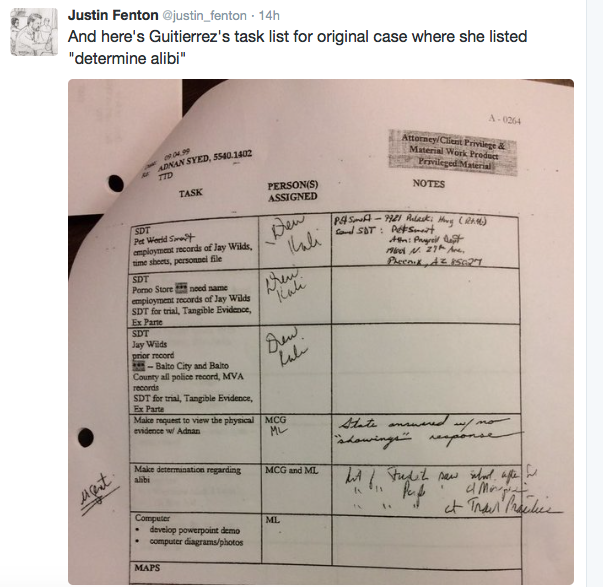
The Deputy Attorney General ostensibly used this task list to establish that Gutierre vigorously prepared an alibi defense. Well, first, we already know that Gutierrez presented an alibi defense from this alibi notice. The question is how vigorously Gutierrez prepared that defense.
There are three things listed next to the alibi defense box. The third references the track alibi. We now know that Gutierrez’s investigation of this track alibi consisted of a law student creating a memo from a partial list of track teammates listed in the yearbook and Gutierrez sending a subpoena for the most important track teammate to the wrong location based upon an error by that student.
The second references the Mosque alibi, and Rabia has said that the Mosque witnesses listed on the alibi notice came from Adnan’s family, with many if not most of these people never being contacted by the defense team.
The first references students who saw Adnan after school. You do the math.
Sequestration
The State successfully moved to sequester Rabia from the courtroom because it might call her as a witness, despite the fact that Rabia already testified at the initial PCR proceeding. Then, the State spent most of the morning successfully objecting to testimony on the ground that it covered territory already covered at the initial PCR proceeding:

So, which is it? Rabia was initially listed on the defense witness list, but she was removed before the start of testimony. I was asked to write an argument about sequestration. I don’t know whether it will be presented because the goodwill of the judge has been key to this case being reopened and reconsidered, but here is the argument:
Rule 5-615 Sequestration Argument
Maryland Rule of Evidence 5-615 states in relevant part that
Except as provided in sections (b) and (c) of this Rule, upon the request of a party made before testimony begins, the court shall order witnesses excluded so that they cannot hear the testimony of other witnesses.
In Tharp v. State, 763 A.2d 151 (Md. 2009), Todd Tharp’s co-defendant in a murder case was tried separately. At the co-defendant’s trial, Tharp’s attorney was initially on the defense witness but was later removed. Despite the fact that Tharp’s attorney was removed from the witness list, the judge ordered him removed from the courtroom with any factual findings or proffer by the State.
On appeal, the Court of Appeals of Maryland disagreed with this decision, concluding that “If Tharp’s attorney effectively was removed from the witness list, he became a member of the public and findings would have to be made, [FN14] as in the Addy case,[1] before he could be banned from the courtroom.” Id. at 164.” In the accompanying footnote, the Court of Appeals noted the importance of such a requirement:
Excluding even just some of the public is considered to be a closure of the courtroom and may affect a defendant’s right to a public trial. See, e.g., Watters v. State, 328 Md. 38, 42, 612 A.2d 1288, 1290 (1992), cert. denied, 507 U.S. 1024, 113 S.Ct. 1832, 123 L.Ed.2d 460 (1993) (finding that a defendant’s Sixth Amendment right to a public trial had been violated when the defendant’s family members and possibly some press had been excluded from the courtroom while permitting in the courtroom prospective jurors, witnesses, and courtroom personnel); Walker v. State, 121 Md.App. 364, 373, 709 A. 2d 177, 180-81 (1998) (clearing the court only of the defendant’s family members while allowing other members of the public to remain and finding that such an exclusion without proper findings violated the defendant’s Sixth Amendment right to a public trial), cert. denied, 351 Md. 5, 715 A.2d 964 (1998).
According to the Court of Appeals, the reason for requiring a proffer by the State and findings by the court is “[t]o ensure that one party is not given an inordinate amount of power over the other party in the sequestration of witnesses and to ensure that a defendant is provided with a public trial….” Pursuant to this point, it should be noted that, this morning, the State had several sustained objections to testimony about Gutierrez’s declining performance in the late 1990s on the ground that this was already covered at the first PCR proceeding. Rabia was already called at the first PCR proceeding and asked everything about her involvement.
Finally, Justin could move to designate Rabia as “a person whose presence is shown by a party to be essential to the presentation of the party’s cause, such as an expert necessary to advise and assist counsel” under Rule 5-615(b)(4), which would preclude her sequestration.
[1] The Addy case is Addy v. Texas, 849 S.W.2d 425 (Tex.App.1993).
-CM