
A Quick Take on Judge Welch’s Opinion Granting Adnan Syed a New Trial
Today, Judge Martin Welch granted Adnan a new trial. Judge Welch reached this conclusion by finding that “trial counsel’s…failure to challenge the reliability of the cell tower location evidence violated [Adnan]’s right to effective assistance of counsel[.]” This alone was enough to grant Adnan a new trial.
Judge Welch also found that trial counsel acted unreasonably by failing to contact prospective alibi witness Asia McClain, thus satisfying the first prong of the ineffective assistance of counsel test. That said, Judge Welch found that Adnan failed to prove prejudice, i.e., that contacting Asia would have created the reasonable probability of a different outcome at trial.
I will have much more about Judge Welch’s opinion in future posts, but I wanted to shoot out a quick post about this last conclusion because there’s a recent Supreme Court opinion that seems directly on point.
Back in March, I did a post about the Supreme Court’s new opinion in Wearry v. Cain, which was about the the intersection among shaky State’s witnesses, an alibi, and prejudice. You can read the facts of the case in my prior post, and here is the key quote:
The State’s trial evidence resembles a house of cards, built on the jury crediting Scott’s account rather than Wearry’s alibi….The dissent asserts that, apart from the testimony of Scott and Brown, there was independent evidence pointing to Wearry as the murderer….But all of the evidence the dissent cites suggests, at most, that someone in Wearry’s group of friends may have committed the crime, and that Wearry may have been involved in events related to the murder after it occurred. Perhaps, on the basis of this evidence, Louisiana might have charged Wearry as an accessory after the fact….But Louisiana instead charged Wearry with capital murder, and the only evidence directly tying him to that crime was Scott’s dubious testimony, corroborated by the similarly suspect testimony of Brown.
Now, let’s take a look at why Judge Welch concluded that Adnan was not prejudiced by trial counsel’s failure to contact Asia McClain:
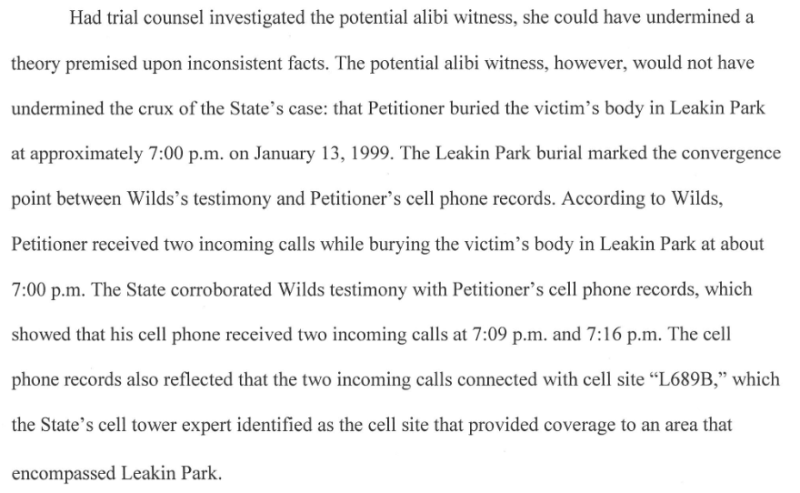
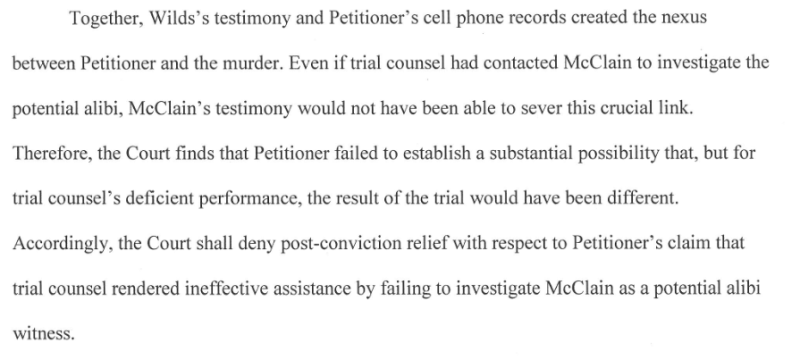
In other words, while Asia would have hurt the State’s case, she wouldn’t have severed the crucial link among (1) Jay’s testimony about receiving 2 calls at about 7:00 P.M. while Adnan and he buried Hae’s body in Leakin Park; (2) the incoming calls to Adnan’s cell phone and 7:09 and 7:16 P.M. that pinged tower L689B; and (3) Hae’s body being found in Leakin Park.
As Wearry notes, however, this nexus, even if accurate, would merely tend to establish that Adnan was involved in Hae’s burial. This would perhaps be sufficient to support an accessory after the fact conviction but not a murder conviction.
It’s unsurprising that Judge Welch didn’t cite to Wearry and seemingly reached a conclusion that contradicts its reasoning. Wearry was handed down after the reopened PCR proceeding, so it wasn’t briefed or argued. But if the State appeals the cell tower ruling, you can bet that Justin Brown will cross-appeal on the Asia/ineffective assistance of counsel claim and cite to Wearry on this issue.
Of course, it’s entirely possible that the State doesn’t appeal Judge Welch’s opinion. It’s extremely well researched and written as well as filled with citations to pertinent caselaw. And now, the Supreme Court has given Justin Brown one more vital piece of caselaw that could be used in the event of an appeal.
-CM