
Assessing Judge Welch’s Conclusion That Adnan Didn’t Waive His Cell Tower/IAC Claim
In discussing Judge Welch’s opinion granting Adnan a new trial, I have placed a lot of emphasis on substantive caselaw regarding ineffective assistance of counsel, alibi witnesses, and cell tower pings. But a trial that ended three days before the Doors appeared on “The Ed Sullivan Show” might be more important than any of that.
Ottway Leon Curtis, Sr. was convicted of first degree murder on September 14, 1967, in the Circuit Court for Prince George’s County. After Curtis’s direct appeal was unsuccessful, he filed a petition for postconviction relief, which claimed, inter alia, that “his constitutional rights were violated by ‘the trial court’s failure to allow and/or call three or more doctors to testify’ as to his sanity.” After this petition was denied, Curtis filed a second PCR petition alleging ineffective assistance
based on the trial attorney’s failure to request a jury instruction on alibi, failure to request an instruction that voluntary intoxication could reduce first degree murder to second degree murder, failure of trial counsel to object to hearsay testimony of certain witnesses, and failure of counsel to request an instruction on the defense of “diminished capacity.”
In response, the State claimed that Curtis had waived these claims by not raising them in his first PCR petition. As support, it cited to Article 27, Section 645A(c)* of the Maryland Code, which stated in pertinent part that
an allegation of error shall be deemed to be waived when a petitioner could have made, but intelligently and knowingly failed to make, such allegation…in a prior petition…actually instituted by said petitioner, unless the failure to make such allegation shall be excused because of special circumstances. The burden of proving the existence of such special circumstances shall be upon the petitioner….[T]here shall be a rebuttable presumption that said petitioner intelligently and knowingly failed to make such allegation.
The Court of Special Appeals bought the State’s arguments that (1) Section 645A(c) required Curtis to prove “special circumstances” to defeat the State’s claim of waiver; and (2) Curtis did not prove “special circumstances.” The Court of Appeals of Maryland disagreed. It held that
This interpretation of s 645A(c) by the State and the Court of Special Appeals is manifestly erroneous. The first paragraph of subsection (c) declares that, for purposes of the Post Conviction Procedure Act, “an allegation of error shall be deemed to be waived when a petitioner could have made, but intelligently and knowingly failed to make, such allegation” in a prior proceeding. The test for “waiver” which the Legislature contemplated was clearly the “intelligent and knowing” failure to raise, not the failure of counsel or an unknowing petitioner to raise an issue. The first paragraph of subsection (c) goes on to provide that where there is a knowing and intelligent failure to raise an issue previously, the failure “shall be excused because of special circumstances,” with the burden being upon petitioner to prove the existence of special circumstances. Thus, the matter of “special circumstances” only becomes pertinent where there is an intelligent and knowing failure of the petitioner to previously raise an issue. Where the record affirmatively shows that there was not an intelligent and knowing failure to raise, there is nothing to “excuse,” and the presence or absence of “special circumstances” has no relevance.
In other words, if a petitioner (like Curtis or Adnan) can establish that he did not intelligently and knowingly fail to raise an issue involving a fundamental right (like the right to effective assistance of counsel), that petitioner does not need to prove “special circumstances” to raise the issue in a subsequent PCR petition.
As Judge Welch noted, the Court of Appeals of Maryland later fleshed out this test McElroy v. State:
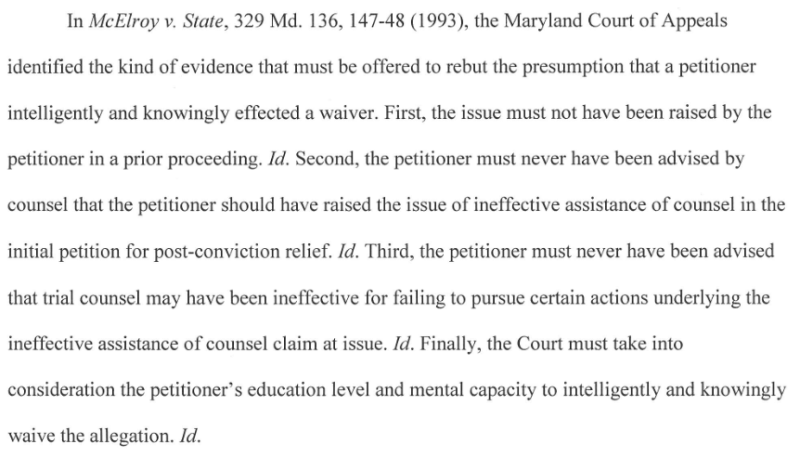
Applying this test, Judge Welch made several factual findings in support of his conclusion that Adnan did not intelligently and knowingly waive his claim that trial counsel was ineffective for failing to cross-examine the State’s cell tower expert with the AT&T disclaimer:
1. He had never previously raised the disclaimer issue;
2. He was never previously advised that trial counsel may have been ineffective for failing to use the disclaimer
3. He was arrested before graduating from high school and had never completed his high school education.
Now, what’s the likelihood that the Court of Special Appeals will reverse these factual findings? According to the dissenting opinion in McElroy, “[a]n appellate court is required to defer to such findings on review unless clearly erroneous.” And what about Judge Welch’s legal conclusion? Although he didn’t cite it, there was an opinion less than a year ago by the Court of Appeals of Maryland finding that a defendant didn’t intelligently and knowingly waive a claim of ineffective assistance of counsel. In State v. Smith, 117 A.3d 1093 (Md. 2015), the court held that
Contrary to the State’s argument, Curtis and its progeny teach that Smith’s claim at issue here—that her plea was not knowing and voluntary—is not among those claims that can be waived merely by inaction. Instead, our case law teaches that, because Smith’s claim implicates a fundamental right, she is entitled to have that claim litigated for the first time in a coram nobis action so long as she is able to rebut the presumption that she “intelligently and knowingly” waived the claim by failing to raise it at an earlier juncture.
Therefore, unless the Court of Special Appeals finds that Judge Welch’s factual findings were clearly erroneous or is able to distinguish a fairly similar recent case from Maryland’s highest court, Judge Welch’s waiver conclusion seems likely to withstand scrutinty
_____________________________
*In 2001, Section 645A(c), was recodified as Section 7-106 of the Maryland Code of Criminal Procedure.
-CM