
The Kulbicki Case Shows How COSA Could Excuse Any Possible Waiver of Adnan’s IAC/Cell Tower Claim
In a post of July 13th, I noted that Maryland Court Rule 8-131(a) provides that
The issues of jurisdiction of the trial court over the subject matter and, unless waived under Rule 2-322, over a person may be raised in and decided by the appellate court whether or not raised in and decided by the trial court. Ordinarily, the appellate court will not decide any other issue unless it plainly appears by the record to have been raised in or decided by the trial court, but the Court may decide such an issue if necessary or desirable to guide the trial court or to avoid the expense and delay of another appeal.
I then noted how, pursuant to Jones v. State, 843 A.2d 778 (Md. 2004), even if the Court of Special Appeals of Maryland finds that Adnan waived his cell tower/IAC claim, it could still excuse that waiver and affirm Judge Welch’s order granting Adnan a new trial based upon the claim. Notably, something very similar was done in Kulbicki v. State, 99 A.3d 730 (Md. 2014).
Kulbicki is the case in which James Kulbicki ultimately claimed that he received the ineffective assistance of counsel based upon his trial counsel’s failure to properly challenge the Comparative Bullet Lead Analysis (CBLA) done in his case. Kulbicki, however,
did not argue that his attorneys were ineffective for failing to challenge the State’s CBLA evidence before the Court of Special Appeals and the intermediate appellate court did not address the issue. Ineffective assistance of counsel with respect to the CBLA evidence, moreover, was not addressed in Kulbicki’s brief before us; during oral argument, however, after the State argued that the admission of CBLA evidence was not a due process violation because Kulbicki’s attorneys should have been able to test the flawed assumptions upon which CBLA was based at trial, questions were raised by the Court regarding ineffectiveness of counsel.
In other words, Kulbicki initially made a Due Process argument and only subsequently made an ineffective assistance of counsel (IAC) claim based upon a new argument made by the State. According to the Court, this meant that it would exercise its authority to hear Kulbicki’s IAC claim under Rule 8-131(a):
While, ordinarily, we will not reach an issue that has not been argued by the parties, we retain discretion to do so. See Rule 8-131. In Braxton v. State, 123 Md.App. 599, 633, 720 A.2d 27, 43 (1998), our brethren on the Court of Special Appeals opined that Rule 8-131 confers discretion to consider an issue “not raised by the parties on appeal,” including in instances when the issue was “discussed at oral argument.”
Now, let’s turn to Adnan’s appeal. Like Kulbicki, Adnan did not initially claim that his trial counsel was ineffective for failing to properly challenge the cell tower pings. In its appellate brief on the Asia/IAC issue, however, the State raised a new argument that it had never previously made at trial or on appeal. Here’s how Justin Brown put it in his Supplement to Motion to Re-Open Post-Conviction Proceedings on behalf of Adnan Syed.:
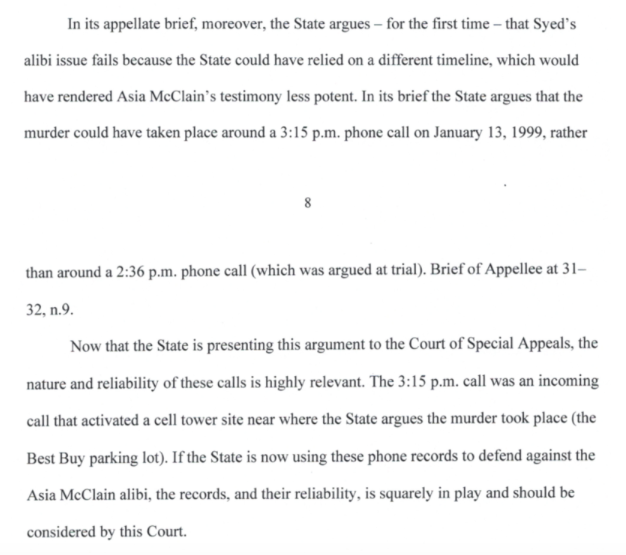
You can see the analogy here: Just as in Kulbicki, Adnan didn’t initially make an IAC claim, and, just as in Kulbicki, the State arguably made a new argument on appeal that opened the door for the defense to respond by making an IAC claim. Therefore, just as in Kulbicki, the court could decide that, even if the defendant waived his IAC claim, it will exercise its discretion under Rule 8-131 and hear the IAC claim.*
_________________
*The opinion of the Court of Appeals of Maryland in Kulbicki, of course, was ultimately reversed by the Supreme Court, but it was reversed on substantive grounds, not on procedural/waiver grounds.
-CM