
A First Take on the State’s Conditional Application for Limited Remand

From the State’s Conditional Application for Limited Remand
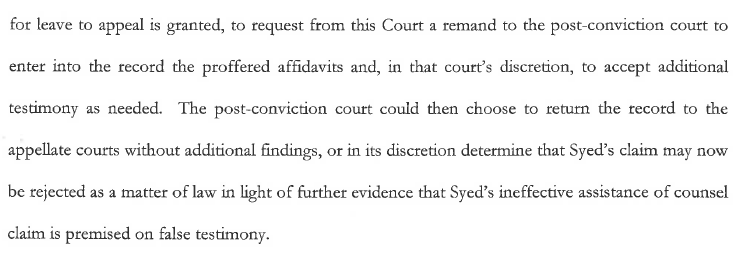
Today, the Maryland Attorney General filed a “Conditional Application for Limited Remand.” That application is based upon the allegation that Asia McClain told two sisters back in 1999 that she was going to fabricate an alibi to assist Adnan Syed. Given that Deputy Attorney General Thiru Vignarajah has a history of overpromising and underproducing in this case, there is reason to view this assertion with skepticism. After all, back in February, Vignarajah promised that
1. Attorney Billy Martin would testify that Cristina Gutierrez performed reasonably at Adnan’s trial(s);
2. Officer Steve would testify that Adnan was not at the Woodlawn Public Library on January 13, 1999; and
3. FBI Special Agent would testify that the AT&T disclaimer did not apply to the Leakin Park pings.
Of course, Martin never testified, Officer Steve did not say anything close to what Vignarajah claimed he would say, and Officer Steve’s testimony went over like the Hindenburg.
I can’t tell whether Vignarajah is overpromising this time, but I can tell that he has underproduced with regard to precedent that would support yet another remand.
As the State notes in the language that led this post, the Court of Appeals of Maryland concluded in Alston v. State, 40 A.3d 1028 (Md. 2012), that only the defendant and not the State can file a motion to reopen a postconviction proceeding under Section 7-104 of the Maryland Code of Criminal Procedure. I previously posted about the Alston case in a prior post, and it arguably creates an insurmountable obstacle for the State.
You might recall that the Court of Special Appeals of Maryland did not remand to Judge Welch along with a mandate that he receive Asia’s testimony. Instead, it remanded so that Adnan could file a motion to reopen under Section 7-104, which, if grated, would allow him to present Asia’s testimony and other evidence. That’s the procedure set forth by Maryland’s Uniform Postconviction Procedure Act.
Undeterred, the State has, in essence, asked the Court of Special Appeals of Maryland to circumvent this procedure and force its new evidence into the record.
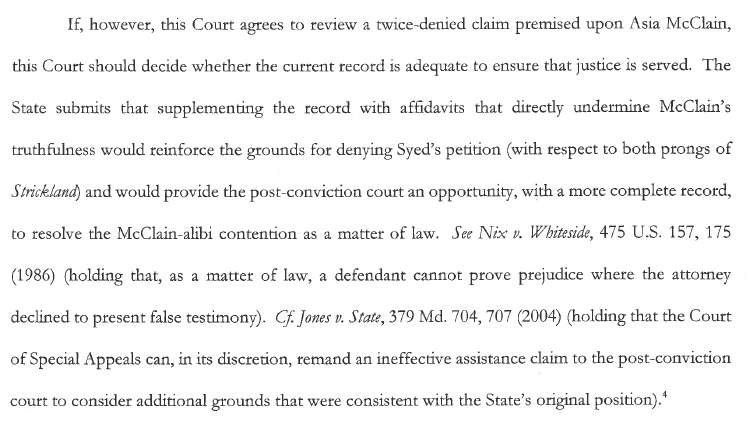
I wrote about the Jones v. State in this post. It’s the case in which the Court of Appeals of Maryland interpreted Maryland Court Rule 8-131(a), which provides that
The issues of jurisdiction of the trial court over the subject matter and, unless waived under Rule 2-322, over a person may be raised in and decided by the appellate court whether or not raised in and decided by the trial court. Ordinarily, the appellate court will not decide any other issue unless it plainly appears by the record to have been raised in or decided by the trial court, but the Court may decide such an issue if necessary or desirable to guide the trial court or to avoid the expense and delay of another appeal.
In other words, Rule 8-131(a) allows a party to belatedly raise a new issue that it initially failed to raise. As I noted in my post, the Court of Special Appeals of Maryland could thus use Rule 8-131(a) to find that Adnan was entitled to belatedly make his new cell tower/IAC claim, even if it finds that he waived that claim.
The interesting thing about Jones is that the Court of Special Appeals in that case actually applied Rule 8-131(a) so that the State could raise a new claim that it had initially failed to raise regarding whether a hearsay exception applied. According to the Court of Special Appeals:
The cases cited above elucidate for us that, in a criminal case, the State can be found to have waived a valid claim, even if the waiver leads to the reversal of a conviction. On the other hand, when the State fails to raise an important argument, an appellate court ordinarily has discretion to review the record or the trial judge’s ruling in its effort to reach a sound result. Similarly, the appellate court generally retains discretion to consider an argument that is belatedly raised.
In light of the importance of the issue presented with regard to the co-conspirator exception, we have determined, in the exercise of our discretion, that a remand is appropriate, so that the parties will have an opportunity to fully litigate before the post-conviction court the question of whether Gutrick’s statement was admissible under the co-conspirator exception to the hearsay rule.
So, you can see the State’s logic: COSA remanded in Jones, so it should also remand here. This argument, however, misses the point of both Rule 8-131(a) and Jones. The point is that the Rule and the case are all about excusing a party’s failure to raise a legal argument, such as Gutierrez’s failure to challenge the cell tower evidence. This is in large part because, as the Jones court noted, COSA “generally retains discretion to consider an argument that is belatedly raised.” (emphasis added).
The sisters’ proposed testimony, however, is not a new argument, it is simply new evidence related to an existing argument that his already been litigated twice. And COSA retains no discretion to receive new evidence. As such, if new evidence is to be received, it has to be based upon a motion to reopen. But the State can’t file a motion to reopen, meaning the State doesn’t have a leg to stand on.
-CM