
Court of Special Appeals Will Only Review Judge Welch’s Decision to Reopen For Abuse of Discretion
Today, Steve Klepper made a great point about the State’s appeal in the Adnan Syed case:
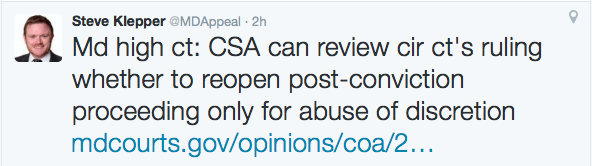
Let’s break down exactly what this means.
On May 18, 2015, the Court of Special Appeals of Maryland issued an order remandeing Adnan’s appeal back to Judge Welch on the Baltimore City Circuit Court so that Adnan could file a motion to reopen his postconviction review proceeding under Section 7-104 of the Maryland Code of Criminal Procedure. According to that order, “[i]n the event that the circuit court grants a request to re-open he post-conviction proceedings, the circuit court, may, in its discretion, conduct any further proceedings its deems appropriate.”
On June 30, 2015, Justin Brown filed his motion to reopen with Judge Welch. Thereafter, on August 24, 2015, Justin Brown followed up a Supplement to Motion to Re-Open Post-Conviction Proceedings, which also asked Judge Welch to consider the cell tower issue. Subsequently, on November 6, 2015, Judge Welch exercised the discretion given to him by the Court of Special Appeals and granted Adnan’s motion to reopen with regard to both the Asia claim and the cell tower claim. Finally, Judge Welch granted Adnan’s motion for a new trial on the cell tower issue on June 30, 2016.
The State then filed an Application for Leave to Appeal (ALA) with the Court of Special Appeals. One of the arguments it made was that Judge Welch improperly granted Adnan’s motion to reopen with regard to the cell tower issue. This is where Klepper‘s tweet comes into play. According to the case he cited, State v. Adams-Bey, Jr., the Court of Special Appeals reviews decisions to reopen postconviction proceedings pursuant to an “abuse of discretion” standard.
So, what does that standard mean? According to the Court of Appeals of Maryland in Alexis v. State,
“[o]ne of the more helpful pronouncements on the contours of the abuse of discretion standard comes from Judge…Wilner’s opinion in North v. North…,” when he was the Chief Judge of the Court of Special Appeals….In North, Judge Wilner explained:
“Abuse of discretion”…has been said to occur “where no reasonable person would take the view adopted by the [trial] court,” or when the court acts “without reference to any guiding rules or principles.” It has also been said to exist when the ruling under consideration “appears to have been made on untenable grounds,” when the ruling is “clearly against the logic and effect of facts and inferences before the court,” when the ruling is “clearly untenable, unfairly depriving a litigant of a substantial right and denying a just result,” when the ruling is “violative of fact and logic,” or when it constitutes an “untenable judicial act that defies reason and works an injustice.”…
Judge Wilner observed that a “certain commonality [exists] in all these definitions”: “the notion that a ruling reviewed under an abuse of discretion standard will not be reversed simply because the appellate court would not have made the same ruling.”…Rather, “[a] court’s decision is an abuse of discretion when it is ‘well removed from any center mark imagined by the reviewing court and beyond the fringe of what that court deems minimally acceptable.’”
In other words, it’s pretty tough for the State to prove an “abuse of discretion” by a judge. Moreover, I would say that it’s especially tough for the State to make that case in this case because COSA seemingly gave Judge Welch the equivalent of a blank check: “[T]he circuit court, may, in its discretion, conduct any further proceedings its deems appropriate.” That’s tantamount to COSA saying that Judge Welch could do whatever he wanted.
Now, it’s important to note that Adams-Bey, Jr. only applies to Judge Welch’s decision to grant Adnan’s motion to reopen on the cell tower issue. It doesn’t apply to Judge Welch’s legal conclusion that Gutierrez was ineffective in failing to use the AT&T disclaimer to challenge the cell tower evidence. On the other hand, this same “abuse of discretion” test does apply to Judge Welch’s factual conclusions, such as his conclusion that Special Agent Chad Fitzgerald’s testimony was inconsistent and underwhelming.
-CM
s