
Justin Brown Submits a Reply to the State’s Bail Arguments in the Adnan Syed Case
Today, Justin Brown filed a Reply in Support of Motion for Pretrial Release in the Adnan Syed case. This Reply answers the State’s Response to Motion for Release, which itself answered Adnan’s Motion for Release Pending Appeal. The Reply clams that the State’s Response was erroneous in three regards.
1. Adnan’s Conviction is Vacated, and the Court Can Order His Release
In its Response, the State claimed that the “stay” entered by the Circuit Court meant that (1) Adnan’s conviction was no longer vacated; and (2) Adnan could not be released during the pendency of the appeal in his case. In his Reply, Brown notes that the State’s first claim is contradicted by Weston Builders & Developers, Inc. v. McBerry, LLC, where the Court of Special Appeals of Maryland held that “a ‘stay’ does not trigger a universal freeze of the status quo;” it just freezes the execution of judgment. For purposes of Adnan’s case, this means that the “stay” of Adnan’s case only put the remedy — a new trial — on hold, not the order/judgment vacating Adnan’s conviction. Therefore, contrary to the State’s claim, Adnan’s conviction no longer stands.
This ties into the State’s second claim, which Justin notes is contradicted by Section 7-109(b)(2) of the Maryland Code of Criminal Procedure, which provides that
If the Attorney General or a State’s Attorney states an intention to file an application for an appeal under this section, the court may:
(i) stay the order; and
(ii) set bail for the petitioner.
As Justin notes, this subsection makes clear that the court can “stay” the order granting a defendant a new trial and set bail, which also makes clear that the order is not erased by the “stay.” By way of contrast, the State’s reading of the subsection requires the word “or” between (i) and (ii). In other words, as “Schoolhouse Rock” teaches, “and” is a conjunction that allows a court to “stay” an order and set bail while “or” is a disjunction which would require the court to choose between a “stay” and bail.
2. The Court May Consider the Strength and Weakness of the State’s Evidence
After noting that the State cited “a non-existent rule,” Justin cites to Maryland Rule 4-216(e)(1)(A), which provides that the judge shall take into account, inter alia, the following when deciding whether to release a defendant:
(A) the nature and circumstances of the offense charged, the nature of the evidence against the defendant, and the potential sentence upon conviction….
The State tried to claim that this subsection did not allow Maryland judges to consider the strength/weight of the State’s evidence. Justin counters that the phrase “nature of the evidence” means what it says, which is that the judge must consider the strength/weight of the State’s evidence. To drive this point home, he cites Schmidt v. State, where the Court of Special Appeals of Maryland noted that “[w]hether the victim and the accused were acquaintances or total strangers may affect the nature and strength of the evidence against the accused.” In other words, in assessing the nature of the evidence against the accused, the court considered the strength of that evidence as well. Therefore, the same analysis should be done in Adnan’s case.
3. Unlike Cher, the State Can’t Turn Back Time
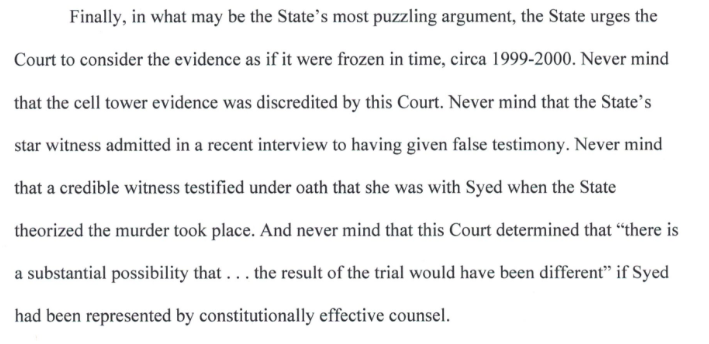
In its Response, the State claimed that the court shouldn’t consider new evidence like the lividity evidence and new evidence that undermines Jay’s claims. In this case, I’ll let Justin’s Reply speak for itself:
-CM