
My 1st Take on the State’s Brief of Appellant in the Adnan Syed Case
Today, the State filed its Brief of Appellant in the Adnan Syed case. As I noted in my post last Wednesday, my biggest question was whether the State would cite to any cases other than Maryland. v. Kulbicki on the issue of whether Cristina Gutierrez was ineffective in failing to use the AT&T disclaimer to cross-examine the State’s cell tower expert. In this post, I will discuss one of the two cases that the State cited.
That case is United States v. Berkowitz, 927 F.2d 1376 (7th Cir. 1991). Berkowitz is a case out of the Seventh Circuit, which covers Illinois, Indiana, and Wisconsin. As a result, Berkowitz is persuasive precedent, which the Court of Special Appeals of Maryland could apply or ignore.
In Berkowitz, Marvin Berkowitz was convicted of obstruction of justice and stealing government property. After he was convicted, he appealed, claiming that he received the ineffective assistance of counsel. At trial, the prosecution’s contention was that Berkowitz stole a number of files from a United States Attorney’s Office in Chicago. At trial, however, Berkowitz
testified that a number of the documents found at the time of his arrest were his own, not the government’s, thus casting (or attempting to cast) doubt on the government’s contention about how many documents he took.
This defense, however, was unsuccessful, and, on appeal, Berkowitz claimed that this was because his trial counsel, William Huyck was ineffective based upon failure to properly examine the documents before trial. The Seventh Circuit pretty easily turned this argument aside, concluding that
The only evidence Berkowitz cites concerning Huyck’s preparation is a statement in a new trial motion, prepared by Huyck, that he did not seek copies of the records the government had seized. But the motion states only that Huyck did not ask for copies; it does not state that Huyck did not inspect the government exhibits. Furthermore, there are indications in the record that Huyck spent considerable time reviewing records and preparing for trial.
In the State’s brief in the Adnan Syed case, the State cites this last line in support of its claim that Cristina Gutierrez rendered effective assistance of counsel with regard to the cell tower evidence:
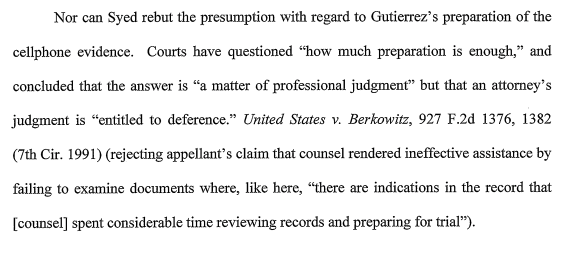
So, what, according to the State are the “indications in the record that [Gutierrez] spent considerable time reviewing [the cell tower] records and preparing for trial”? According to the State:
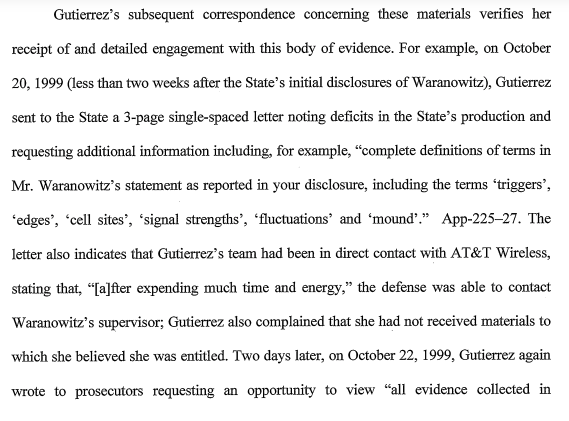
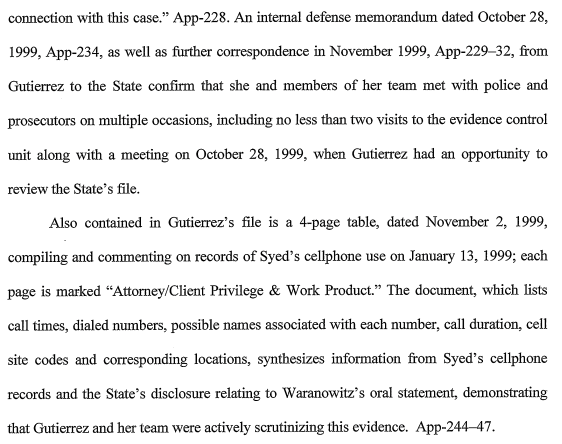
The problem with this line of argument is that it is based on assumptions. Gutierrez was “noting deficits in the State’s production…” Gutierrez “complained that she had not received materials…” “Gutierrez had an opportunity to view the State’s files.”
But did she actually review the key cell tower evidence and exhibits? Luckily for the defense, we have a clear answer to this question. And that’s because it was the basis for the mistrial being declared at Adnan’s first trial. I did a whole post on this back in October 2015.
The mistrial was declared because a juror overheard the judge at Adnan’s first trial call Gutierrez a liar. And he called her a liar because Gutierrez said that she had not read or even seen the cell phone records in the case. In response, the judge called Gutierrez a liar. Gutierrez took umbrage to this label and responded that she was telling the truth. According to Gutierrez, she had not read the cell phone records because…she just didn’t care:
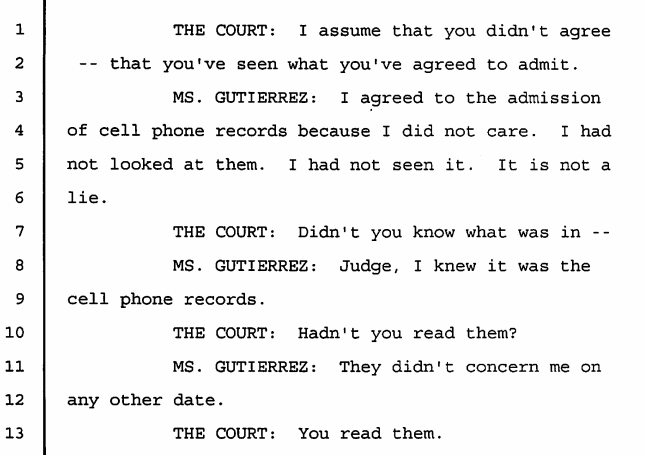
Notably, this exchange took place in December 1999, after all of the events cited by the State. And this exchange clearly reveals that Gutierrez hadn’t even bothered to look at the cell phone records in the case. Now, as Gutierrez noted, it’s possible that other members of her team looked at the records, which might explain some of the writings referenced by the State. But Gutierrez herself never read them.
Therefore, Adnan’s case is the antithesis of Berkowitz. Unlike in that case, where the record indicated that trial counsel spent considerable time reviewing the records, in Adnan’s case, the record indicates that Gutierrez didn’t look at the cell phone records at all.
-CM