
Refuting the State’s Claim That Gutierrez’s Strategy Was to Undermine All Cell Records
According to the State’s Brief of Appellant in the Adnan Syed case:
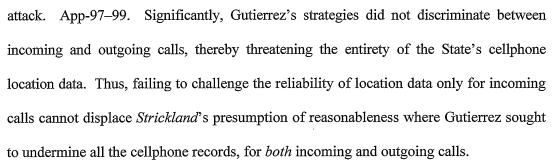
This is probably the most facially compelling argument in the State’s brief. It is well established that appellate courts will find ineffective assistance based upon omissions and not based upon choices, assuming that those choices involve some modicum of strategy. Judge Welch found that Cristina Gutierrez’s failure to use the AT&T disclaimer to cross-examine the State’s cell tower expert was an omission warranting a new trial.
Conversely, in its brief, the State tries to recharacterize Gutierrez’s decision as a choice based upon strategy. The AT&T disclaimer, of course, stated that

The State’s contention, then, is that Gutierrez’s strategy was to attack the reliability of all pings and that use of the AT&T disclaimer would have tended to confirm the reliability of incoming pings. But there’s a huge problem with this argument.
As first reported in the Route Talk episode of Serial, the prosecution only used calls that pinged four cell towers as evidence of the location of Adnan’s cell phone on January 13, 1999 “[b]ecause the rest of them, didn’t really help their argument.” As the testimony of the State’s cell tower expert makes clear, these were the calls that pinged towers (1) L654C; (2) L689B; (3) L655A; and (4) L608C:
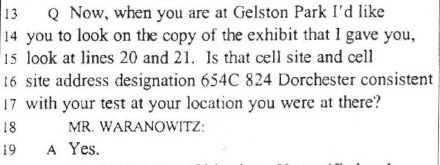
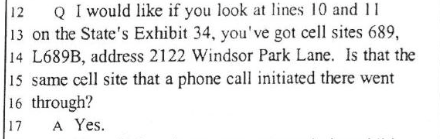
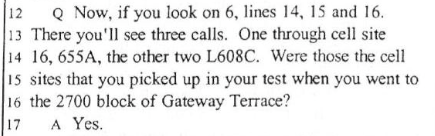
The references to lines 10-11, 14-16, and 20-21 are references to the numbered calls on Adnan’s call log:
As you can see, the calls on lines 10-11, 14-16, and 20-21 were all incoming calls, including the “Leakin Park pings” on lines 10-11.
In other words, the State only used incoming pings as evidence of cell phone location at trial and did not use outgoing pings as evidence of cell phone location at trial because those pings did not match Jay’s description of where those calls occurred (e.g., The Nisha Call). Thus, there would be no reason for the defense to want to challenge the reliability of outgoing pings. Those pings contradicted Jay’s story, meaning that the defense would have preferred that those pings be reliable for determining location.
On the other hand, the State claimed that the incoming pings corroborated Jay’s stories about (1) where he went after he dropped off Adnan at track practice; (2) where Adnan and he went after track practice; and, most importantly (3) the burial in Leakin Park in the 7:00 hour. It was those pings that the State defense wanted to attack, and the AT&T disclaimer was clearly the best way to attack them. And, more importantly, to the extent that the disclaimer would have tended to establish the reliability of outgoing pings for determining location, this fact would have helped and not hurt the defense.
-CM