
Was the “Come & Get Me” Call the Linchpin on the State’s Case Against Adnan?
Having focused on the State’s Brief of Appellant in the Adnan Syed over the last two weeks, I wanted to turn my attention to the upcoming Brief of Appellee, which is scheduled to be filed by March 29th. In addition to responding to the State’s Brief of Appellant, the Brief of Appellee will also allege that Judge Welch erred in his ruling on the Asia/ineffective assistance claim. Specifically, the defense will argue that (1) Judge Welch correctly concluded that trial counsel acted unreasonably in failing to contact Asia McClain; but that (2) Judge Welch incorrectly concluded that this error was not prejudicial, i.e., does not undermine our confidence in the jury’s verdict.
Judge Welch found that the failure to contact Asia McClain was not prejudicial based upon two interrelated points: (1) the State’s presented a relatively weak theory as to the time of Hae’s murder; and (2) contacting/calling Asia as an alibi witness would not have undermined the crux of the State’s case, which was the convergence between Jay’s testimony about Hae’s burial and the Leakin Park pings. Here was Judge Welch’s discussion of the first of these points:
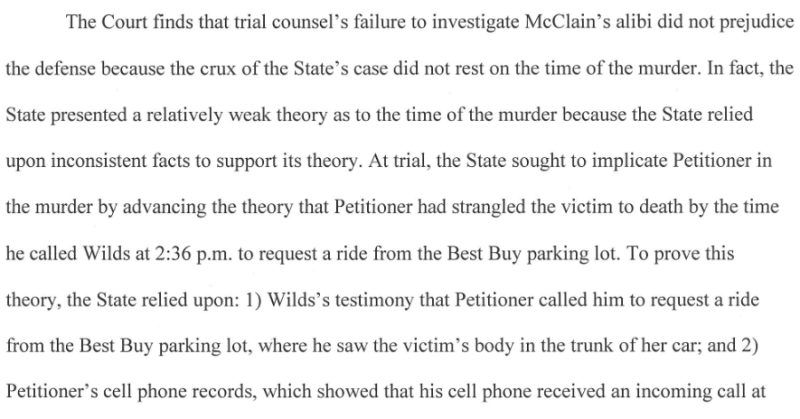
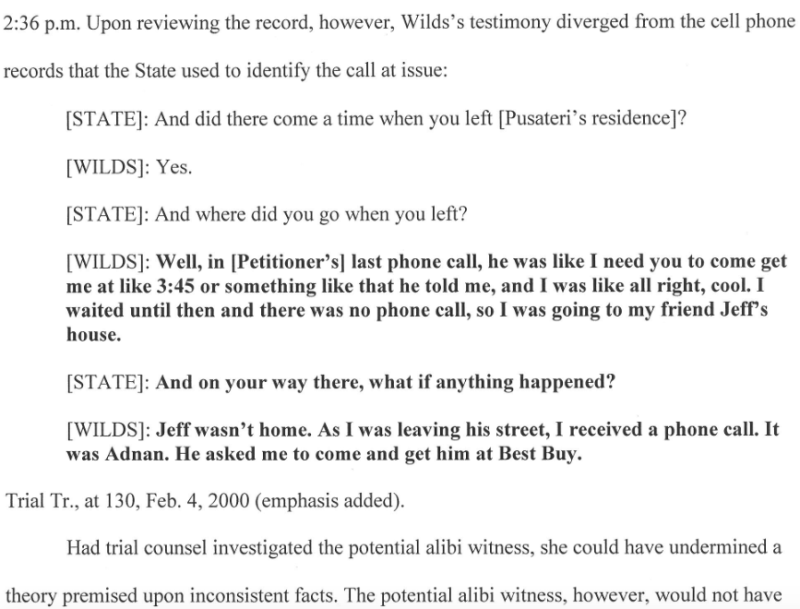
I generally agree with Judge Welch part of his analysis: The State presented a relatively weak theory as to the time of Hae’s murder because it was a theory premised upon inconsistent facts. As I’ve noted before, though, I don’t necessarily see how this cuts against a finding of prejudice. Specifically, in In re Parris W., Maryland’s highest court found prejudice under similar circumstances, concluding that:
Given the distance between Ms. Cary’s home and the place where [the victim] was assaulted, and given the uncertainty surrounding the time of the assault, Ms. Cary’s testimony alone may have been enough to create reasonable doubt in the mind of the hearing judge had she been available to testify.
On the other hand, I understand Judge Welch’s point that the theory that Hae was killed by 2:36 P.M. was weak and based upon inconsistent facts. Therefore, one argument is that evidence contradicting this weak theory — the Asia alibi — shouldn’t undermine our confidence in the jury’s verdict because the jury probably didn’t put much stock in the State’s “time of death” argument.
But I think we should look at the case from a different perspective. For me, the key point is that the “come and get me” call was the linchpin of the State’s case. The State’s broader theory of the case was that Adnan was guilty of first-degree murder based upon kidnapping by fraud. Specifically, the State sought to prove that Adnan planned to loan Jay his car and cell phone so that he could ask Hae for a ride and then call Jay on his phone to pick him up after killing Hae at the end of the ride. Here’s prosecutor Kathleen Murphy describing this theory to the jury during closing arguments:
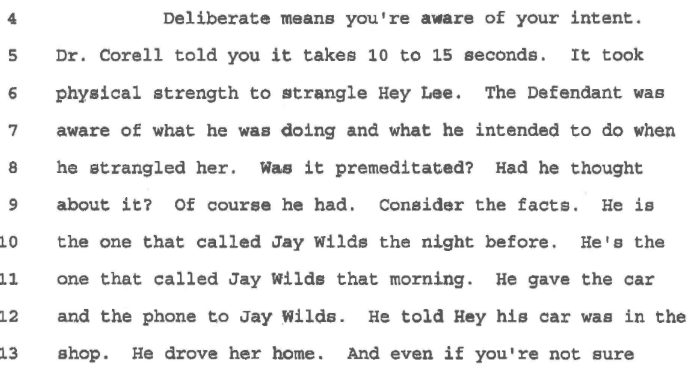
Of course, for this theory to work, there had to be a “come and get me” call on Adnan’s call log that made sense. But when you cross-reference Adnan’s call log with Jay’s testimony about the “come and get me” call occurring around 3:45 P.M., an immediate problem arises: There was no incoming call to Adnan’s cell phone between 3:15 P.M. and 4:27 P.M.
Therefore, the State seemingly had three options with regard to the “come and get me” call: (1) claim that it was the 4:27 P.M. call; (2) claim it was the 3:15 P.M. call; or (3) claim it was the 2:36 P.M. call. There’s not really a need to address the first option. A 4:27 P.M. “come and get me” call makes no sense given the sequence of events described by Jay, and the State made no attempt to argue this alternate timeline on appeal. Conversely, the State did try to argue the second option, that it could have shifted the “come and get me” call to the 3:15 P.M. call if Asia had testified at trial. But Judge Welch clearly explained in his opinion why such a shift wouldn’t have made sense:
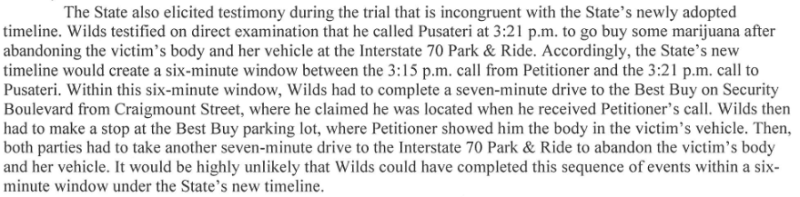
So, this explains why the State went with option 1 3: It had no other options. It needed a “come and get me” call to Adnan’s cell phone to prove its theory of the case, and the 2:36 P.M. call was the only call that made any sense. Unfortunately for the State, Asia’s alibi covers a 2:36 P.M. call.
Judge Welch’s conclusion was that the State presented a weak/inconsistent theory on this point, meaning that an alibi witness wouldn’t have moved the needle much for the jury.
My response is that the State did present a weak/inconsistent theory on this point, but also, as noted, that this point was the linchpin of the State’s case. If there wasn’t a workable “come and get me” call to Adnan’s cell phone, the jury shouldn’t have been able to agree with the State’s kidnapping by fraud theory of the case. If you pull out that linchpin, the State’s case falls apart, which is why the defense has a pretty good prejudice argument on appeal.
-CM