
Does the Law of the Case Doctrine Make or Break the State’s Case? (Part One)
Adnan’s ineffective assistance/cell tower might all come down to something known as the law of the case doctrine, and I have to admit that I’m not entirely sure how the court will rule on the issue. In its Reply Brief and Appendix of Cross-Appellee, the State claims not only that the Court of Special Appeals’s remand order was limited to the Asia/alibi issue but that the remand order had to be limited to the Asia/alibi issue based upon the law of the case doctrine. Here’s the pertinent portion of the State’s Reply Brief:
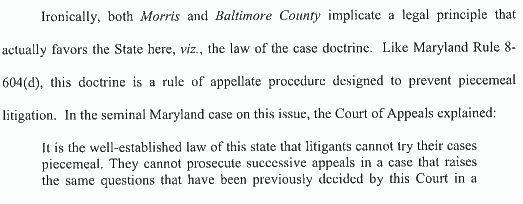
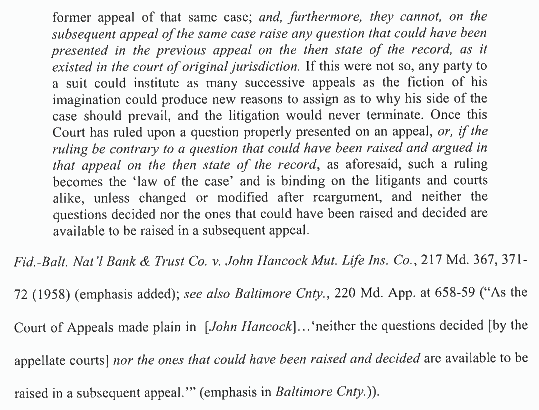
So, does the State have a winning argument on this issue?
I think the key case here is Trimble v. State, 849 A.2d 83 (Md. 2004). In Trimble, James Trimble was sentenced to death after being convicted of rape, murder, and a double kidnapping. He then lost on direct appeal and brought a PCR petition, claiming that he was not properly advised of his right to be sentenced by a jury. The Court of Appeals of Maryland ultimately remanded the case so that the trial court could change his sentence to life imprisonment.
Trimble later filed a motion to have the victim’s body exhumed for DNA testing, and the trial court denied the motion. The Court of Special Appeals then followed suit, treating the motion as a motion for a new trial based on newly discovered evidence. Trimble subsequently filed a request for the appointment of counsel to assist him in obtaining DNA testing. The Court of Special Appeals responded as follows:
As the State points out, no matter was pending before the trial court when Trimble filed his motion for the appointment of counsel. Trimble indicated in his motion that he wanted counsel to assist him in investigating the possibility of obtaining DNA testing. The circuit court had already denied Trimble’s motion to have the victim’s body exhumed for DNA testing, however, and this Court has affirmed that ruling. Under the law of the case doctrine, “once an appellate court rules upon a question presented on appeal, litigants and lower courts become bound by the ruling, which is considered to be the law of the case.” Scott v. State, 379 Md. 170, 183, 840 A.2d 715, 723 (2004).
Meanwhile, in the Scott case, the Court of Appeals of Maryland held that
the Court of Special Appeals erred in its conclusion that Judge Matricciani was bound by Judge Smith’s denial of Scott’s motion to correct an illegal sentence because the two judges were “colleague[s] of coordinate jurisdiction.”…It is for this reason that the doctrine of the law of the case does not apply.
In Maryland,…generally, the “law of the case doctrine is one of appellate procedure.”…Under the doctrine, once an appellate court rules upon a question presented on appeal, litigants and lower courts become bound by the ruling, which is considered to be the law of the case….Here, however, there have been no appellate rulings in Scott’s case with respect to whether Scott’s sentence was illegal; rather, one circuit court judge followed the reasoning of another circuit court judge in the same case. Therefore, the law of the case doctrine is inapplicable.
So, what does this all mean? I think it means that the law of the case doctrine does not apply in Adnan’s case. Why? As I’ve noted before, Maryland Rule of Criminal Procedure 7-106(a)(1)(ii) states that
(a) For the purposes of this title, an allegation of error is finally litigated when:
(1) an appellate court of the State decides on the merits of the allegation:….
(ii) on any consideration of an application for leave to appeal filed under § 7-109 of this subtitle
Meanwhile, Maryland Rule of Criminal Procedure 7-109 covers Applications for Leave to Appeal (ALAs), with 7-109(b)(3) and 7-109(b)(4) covering ALAs by the State:
(3) If the application for leave to appeal is granted:….
(ii) the Court of Special Appeals may:
1. affirm, reverse, or modify the order appealed from
2. remand the case for further proceedings.
(4) If the application for leave to appeal is denied, the order sought to be reviewed becomes final.
In other words, the Court of Special Appeals did not rule on the question presented on appeal in Adnan’s case, which it could have done by denying the State leave to appeal (a tacit affirmance) or affirming, reversing, or modifying Judge Welch’s order granting Adnan a new trial. Therefore, (1) the Court of Special Appeals did not “rule[] upon a question presented on appeal;” and (2) Judge Welch’s order did not become final. Instead, the Court of Special Appeals remanded the case back down to Judge Welch for further proceedings. Therefore, like in Scott, there was no appellate ruling in the case, the law of the case doctrine did not apply, and Judge Welch was not bound by his prior order denying Adnan a new trial.
But does that just mean that Judge Welch could change his ruling on the Asia/alibi issue, or does it also mean that Judge Welch could hear the cell tower claim? I will get to this issue in my next post.
-CM