
The Case Against Adnan Syed, Redux
In its Reply Brief and Appendix of Cross-Appellee, the State has a section titled, “Syed Cannot Establish Prejudice in this Case.” This is, in effect, an updated version of Episode Six of Serial: “The Case Against Adnan Syed.” Essentially, the State uses this section of its Reply Brief to set forth its best evidence against Adnan, other than the cell tower pings, in an attempt to prove that trial counsel’s failure to use the AT&T disclaimer wasn’t prejudicial. The problem for the State, though, is that its recitation of facts seemingly proves the opposite.
Accomplice Testimony
Before I get to the State’s two bullet points, I need to start by noting that the State’s heading is a misnomer. In Maryland, an accessory after the fact is not an accomplice. Indeed, the State was able to avoid early disclosure of Jay’s police statements to the defense by specifically arguing that Jay was not being charged/prosecuted as an accomplice.
Claim #1

This is generally true, but it ignores the fact that Jay has changed his story on all four of these points: (1) where/when Adnan shoed him Hae’s body; (2) whether Jay assisted Adnan in digging a grave; (3) whether Jay assisted Adnan in burying Hae’s body; and (4) what implements were using in digging the grave (two shovels or a shovel and a pick) and how they were disposed. I think most or all of these contradictions were laid bare at trial, with the obvious one being the switch in trunk pop location from Jay’s initial claim (strip off of Edmondson Avenue) in his first interview.
Claim #2

Although there are some issues with this claim, it’s generally true. But this is merely evidence that indicates that Jay has some knowledge of the crime or at least its aftermath, not evidence that directly incriminates Adnan.
Corroboration
Claim #1
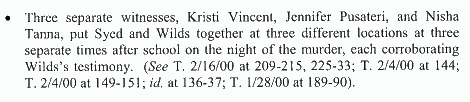
The State is correct that Kristi/Cathy placed Adnan and Jay together at her place at a time that would have been after track practice. This does indeed corroborate Jay’s testimony.
I’m presuming that the State is claiming that Jen placed Jay and Adnan together in Leakin Park because the next bullet point says that she also met Adnan and Jay at a parking lot. Notably, none of the State’s citations to the transcript are citations to testimony by Jen. Perhaps that’s because Jen never testified that Jay and Adnan were in Leakin Park together. On page 169 of the 2/16/00 transcript, Jen testified as follows about who answered one of her Leakin Park calls:
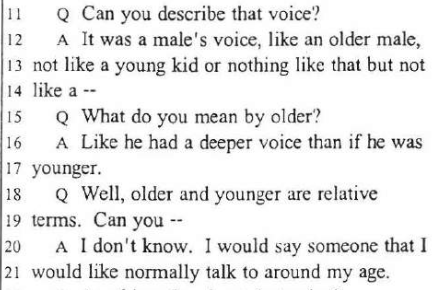
In other words, legally speaking, Jen was not able to authenticate Adnan’s voice, and in fact, she said that she spoke to someone who sounded like “an older male.”
Nisha, of course, did not place Jay and Adnan together on January 13th. She did testify that there was one time when Adnan called her while visiting Jay at his job at the adult video store and put Jay on the phone. But Nisha testified that this call could have occurred ay time between the New Year’s party until the day of Adnan’s arrest. And, of course, Nisha’s testimony about the location of this call did not corroborate Jay’s claim that this call occurred while Adnan and he were going to the Forest Lake Golf Course to score weed.*
Claim #2
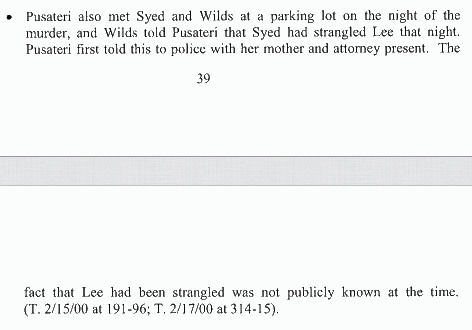
As with the Nisha claim, this claim cuts directly against the State’s corroboration argument. Jen did indeed testify that she met Jay and Adnan at the mall parking lot. The problem for the State is that this directly contradicts Jay’s testimony that Adnan dropped Jay off at his house, which is where Jen picked him up without ever seeing Adnan:
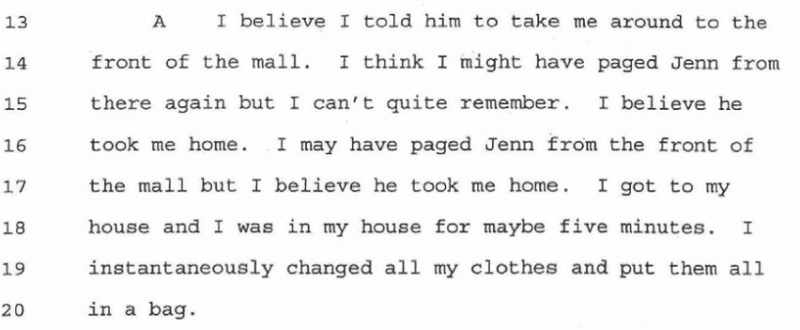
So, that’s all the corroboration that the State has for Jay outside of the Leakin Park pings: (1) Cathy corroborates Jay’s claim that Adnan and he went to her place after track practice; (2) Jen was unable to authenticate Adnan’s voice and thus could not corroborate Jay’s claim that they were in Leakin Park together; (3) Nisha can’t put Jay and Adnan together on January 13th and contradicts Jay’s claim about the site of the 3:32 P.M. call, even assuming that’s the call in question; and (4) Jen contradicts Jay’s claim that Adnan dropped Jay off at his house without Adnan ever seeing Jen.
Forensics
Claim #1

This is true, but as Serial noted:
The defense argued, ‘well, you can’t put a timestamp on fingerprints, they could’ve been six week-old fingerprints or six month-old fingerprints, there’s no way to tell.’ And Adnan had ridden in and driven Hae’s car many times, all their friends said so. The ripped out page showed a whole lot more than just Leakin Park. In fact, it showed their whole neighborhood, the school, the malls, probably ninety percent of where they most often drove. And that page didn’t have Adnan’s prints on it. His palm print was only on the back cover of the book. Plus, thirteen other, unidentified prints turned up on and in the map book. None of them matched Adnan, or Jay. So, the prints weren’t exactly conclusive.
Plus, I’m not really sure of the State’s theory here. Are they claiming that Adnan was wearing and not wearing gloves at different points during the crime, which explains why his palm print was on the back cover of the map book but none of his prints were on the torn out page? Overall, this piece of forensic evidence seems pretty meaningless.
Claim #2

If you’re wondering how this memo was admitted, you might recall that, as we discussed on Undisclosed, it was the defense who introduced this memo to establish that the State honed in on Adnan too early in the investigation and put on the blinders with regard to other leads or exculpatory evidence. Therefore, the memo was not, and could not have been, admitted to prove the truth of the matter asserted in the memo.
Of course, there’s also the fact that, despite the State’s claim, the anonymous caller never mentioned Hae. Also, I’m pretty sure that there’s evidence somewhere that Adnan made this statement before he started dating Hae. And then, the State also conveniently doesn’t mention the fact that the anonymous caller said that Yaser said that Adnan said he would dump the car into a lake, which doesn’t match up with where Hae’s car was found.
Claim #3

Again, this is not forensic evidence. Indeed, the State doesn’t even explain in this bullet point why this evidence is relevant at all. Adnan called Yaser twice on January 13th. Yaser’s phone records show that he answered neither call.
And…that’s it. The long and short of the State’s forensic evidence against Adnan is the palm print on the map book, with the other evidence they cite not being forensic evidence. On the other hand, we have the hairs found on Hae that weren’t a match for Hae or Adnan, the lack of evidence in Adnan’s car tying him to the crime, the lack of evidence that Hae was ever in her trunk, etc.
Deviations in Syed’s Story
Claim #1
True.
Claim #2
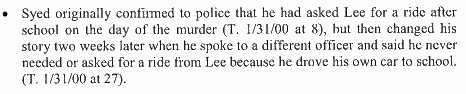
The State is talking about Detective O’Shea’s interview with Adnan on January 25th followed by the interview of Adnan by Detectives Ritz and MacGillivary on February 26th. I would label the State’s claim misleading. Here’s the actual quote from the notes from the second interview: “On 13 January, 1999, he had occasion to be at school (Woodlawn Senior High), however, he doesn’t remember the events that occurred in school that day.” First, this says nothing about Adnan’s recollection of what happened after school, like track practice, which seems to be the point of contention. Second, saying that Adnan remembers going to school on January 13th but doesn’t remember “the events that occurred in school” is very different from saying that Adnan “had no memory at all of the day….”
Claim #3

First, how is this a “deviation[] in Syed’s story? Adnan never said that he called Hae after January 13th, so how could there be a deviation/contradiction on this point? Second, why is the State citing to Adnan’s testimony from the PCR proceeding in 2012? The State’s argument is that the jury had enough evidence to convict Adnan even without the cell tower pings. Even if Adnan’s testimony at the PCR proceeding in 2012 could be construed as a “deviation,” it has no bearing upon the jury’s deliberations back in 2012.
Motive/Preparation
I’m not going to address each of these bullet points individually. The motive bullet points deal with Hae and Adnan breaking up and Hae subsequently starting to date Don. This is all true as far as it goes, although, of course, the State doesn’t mention Don’s testimony about his cordial interaction with Adnan while they were both looking at damage to Hae’s car**:
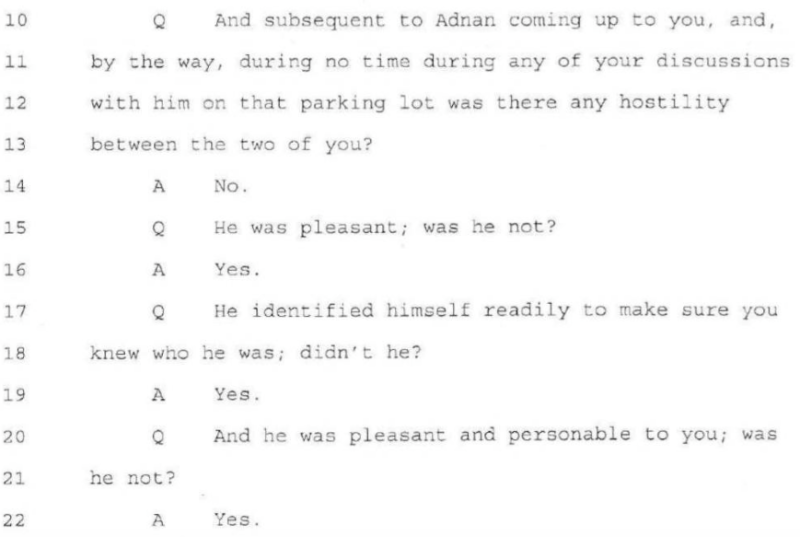
And then, the preparation bullet points deal with Adnan getting his cell phone the day before Hae disappeared and asking Hae for a ride on the day she disappeared.
Conclusion
So, the State’s case against Adnan consisted of (1) the possible motive of the breakup; (2) Jay’s changing and contradictory stories; (3) three witnesses who mostly contradicted Jay’s claims; (4) almost non-existent forensic evidence; and (5) Adnan asking Hae for a ride on January 13th and then giving somewhat inconsistent accountings of that day/the ride request in different police interviews.
Therefore, other than a possible motive and scant forensics, we have #2, #3, and #5. As Judge Welch noted in his opinion with regard to #1 and #2, the State presented a pretty weak case about the actual murder that was based upon inconsistent facts. Instead, it was the burial that was “the crux” of the State’s case because it “marked the convergence point between Wilds’s testimony and Petitioner’s cell phone records.” But, of course, the State is now trying to prove the strength of its case without the Leakin Park pings.
Thus, that leaves us with #5. And here’s the problem for the State: In its Reply Brief, the State acknowledges that evidence related to the supposed ride was “a gap,” “a wrinkle,” and “a flaw” in its case. Here’s the State’s discussion of the issue:
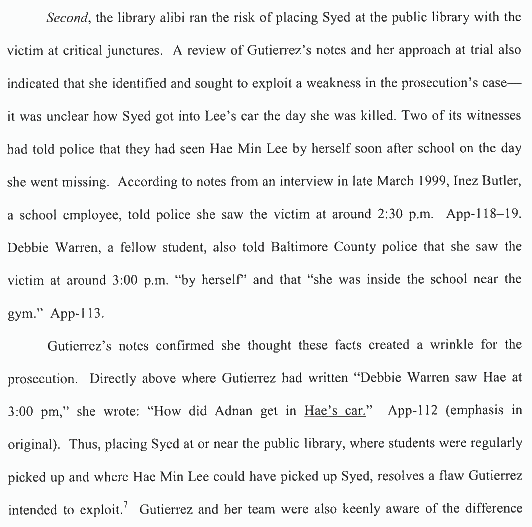
The State is, of course, right on this point. Inez Butler testified that she saw Hae leaving school in a hurry, with no indication that she saw Adnan. Debbie testified that she saw Hae without Adnan at about 3:00 P.M., at a time when Hae would have needed to head directly to Campfield to pick up her cousin. Indeed, in one of her statements, Debbie even said that Hae told another student — “Takera” — that she didn’t have time to give her a ride because she had to get to Campfield:

And, while the State doesn’t mention her, Becky, a defense witness, also gave testimony that widened this “gap” in the State’s case. Becky, who had heard about the ride request earlier in the day, saw Hae at the end of school, cryptically saying she had to leave because she had somewhere she need to be, without further explanation:
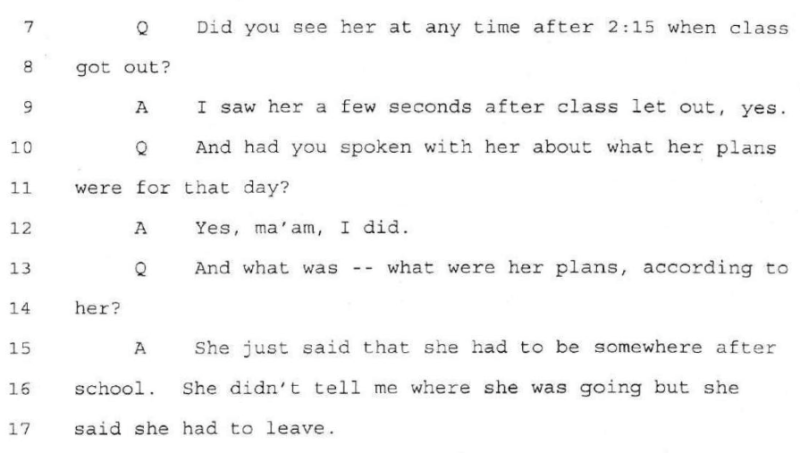
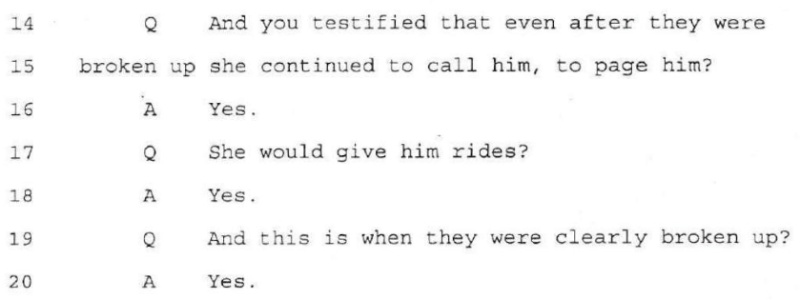
At trial, Becky doesn’t mention Adnan being present for this conversation, which is consistent with the testimony by Inez Butler and Debbie. Or, if we believe Becky’s police statement, Adnan was present, with Hae telling Adnan she couldn’t give him a ride because she had “something else to do.” Either way you slice it, Becky adds to the question of whether Adnan actually got a ride from Hae. Becky also testified that Adnan continued to get rides from Hae, even after their final breakup and even when he had his car at school, making Adnan’s ride request on January 13th seem less odd:
So, when you add everything up, there’s not much to the State’s case. Jay’s story is contradictory and contradicted. There are almost no forensics. There are some oddities with Adnan’s ride request, but the State acknowledges “a flaw” in this part of its case. Given all of this, it’s really hard to see how the Leakin Park pings weren’t hugely important to the State’s case.
_______________________________
*And, of course, Jay didn’t have the adult video store job or any job as of January 13th.
**There’s a question about whether Hae and Don were dating or at least officially dating at the time of this interaction, but it was certainly presented to the jury as the old boyfriend meeting the new boyfriend.
-CM