
Oral Arguments in the Adnan Syed Case and the Importance of Opening Statements/Closing Arguments
Last night, we debuted our Undisclosed episode about the oral arguments in the Adnan Syed case. For me, possibly the most interesting part of the oral arguments was the back-and-forth regarding how much weight the judges should give to closing arguments from trial in assessing the prejudice caused by Cristina Gutierrez’s failure to contact prospective alibi witness Asia McClain. In other words, given that Asia offered credible testimony at the PCR hearing about seeing Adnan at the Woodlawn Public Library until about 2:40 P.M., how important was it that the State claimed in closing that Adnan had killed Hae before making the “come and get me” call from Best Buy at 2:36 P.M.?
Here’s Thiru Vignarajah arguing the point at oral arguments, with questions coming from Judge Kathryn Grill Graeff and then Judge Alexander Wright, Jr.:
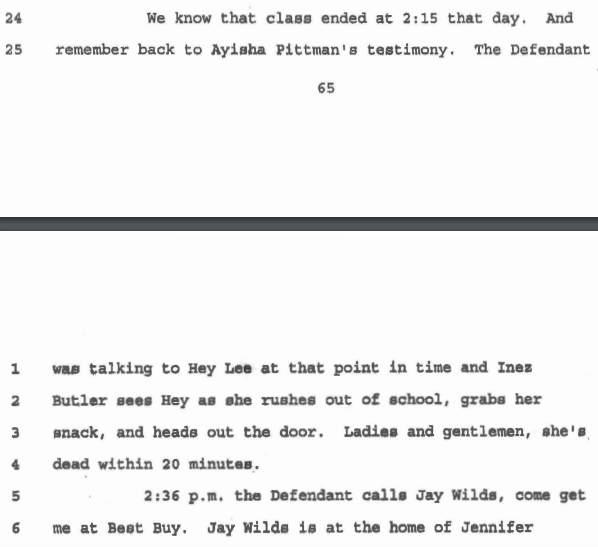
Now, one important thing to note from this clip is that the State acknowledged that the State used this crime timeline in both their opening statement and closing argument at trial. From the State’s opening:
And from the State’s closing:
Let’s start with the law. First, it is black letter law that opening statements and closing arguments are not evidence. See, e.g., State v. Lawson, 886 A.2d 876 (Md. 2005). Second, however, it is equally clear that, under Maryland law, both opening statements and closing arguments are hugely relevant for a prejudice analysis.
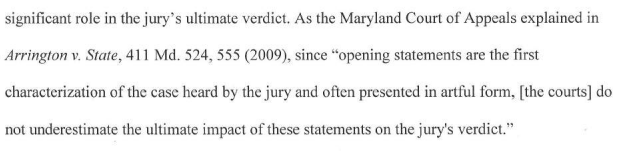
Judge Welch noted the importance of opening statements in his opinion granting Adnan a new trial:
Maybe even more importantly, as I’ve noted before, the Court of Appeals of Maryland concluded in Ware v. State, 702 A.2d 699 (Md. 1997), that prejudice “‘is best understood by taking the word of the prosecutor…during closing argument.'” And, as I noted in last night’s Undisclosed episode, the Court of Appeals reached this conclusion by quoting the Supreme Court’s opinion in Kyles v. Whitley.
Therefore, legally speaking, I expect the Court of Special Appeals to place great emphasis on both the State’s opening statement and closing argument at trial in assessing the likely prejudice caused by Cristina Gutierrez’s failure(s).
Let’s now turn to the facts. According to the state, the State’s crime timeline wasn’t important because “that was a passing reference to the best theory the State had.” First, I think that Judge Wright’s follow-up question about the State trying to synch the evidence and Adnan’s call log was important. We know that the State had a big blow-up of that call log in the courtroom and spent the trial trying to map Adnan’s day by filling in that call log. Second, and this gets back to the State’s own words, the 2:36 P.M. call as the “come and get me” call was indeed the best theory that the State had.
The State’s case was based upon Adnan loaning Jay his car and phone so that he (1) would have an excuse to ask Hae for a ride; and (2) could call Jay on his cell phone to come and get him after the crime. But Jay testified that this call came at 3:45ish, despite the fact that there was no incoming call to Adnan’s cell phone between 3:15 and 4:27 P.M. And Judge Welch himself thoroughly explained (in footnote 9) why the 3:15 P.M. call wouldn’t work as the “come and get me call” given the number of intervening events Jay claimed occurred between that call and that call he made to Jenn at 3:21 P.M.
Now, ultimately, Judge Welch concluded that the State’s timeline was so convoluted and contradictory that it couldn’t have been what the jurors used to convict Adnan. But I think that was the wrong conclusion. I think that both the judges’ questions and the State’s responses during oral arguments make it likely that the Court of Special Appeals will view this differently. Simply put, if the State’s case was only held together by a timeline that was contradicted by much of its evidence and testimony, then surely an alibi witness who refuted that timeline is enough to create the reasonable probability of an acquittal (or, as was noted during oral arguments, a hung jury). In other words, if Asia would have prevented the jurors from believing the State’s “best” version of its weak timeline, how confident can we be that the jurors would have reached the same result in the face of her testimony?
-CM