
Assessing the State’s Claim of “Overwhelming” Evidence in the Adnan Syed Case in Light of Wearry v. Cain
Maybe the most important exchange from the recent oral arguments in the Adnan Syed case was this one:
With her question, Judge Graeff clearly appears to be referencing the Supreme Court’s recent opinion in Wearry v. Cain, which (1) was issued after the reopened PCR proceedings in Adnan’s case; and (2) was cited by the defense in its Brief of Appellee/Cross-Appellant to the Court of Special Appeals. Wearry was the case in which the Supreme Court found that strong evidence of a defendant’s involvement in post-murder events should not prevent a court from finding prejudice based upon evidence that undermines the State’s theory of the actual murder itself.
This conclusion is, of course, hugely relevant to Adnan’s case given that Judge Welch concluded that (1) Cristina Gutierrez unreasonably failed to contact prospective alibi witness Asia McClain; but that (2) the “crux” of the State’s case was the intersection between Jay’s testimony about the burial and the Leakin Park pings.
Those pings are part of what the State has claimed is “overwhelming” evidence of Adnan’s guilt, which it asserts should prevent the Court of Special Appeals from finding that the failure to contact Asia McClain was prejudicial, or undermines our confidence in the jury’s verdict. The State laid out this evidence in its Reply Brief and Appendix of Cross-Appellee.
In a prior post, I assessed the overall strength of this evidence in a general sense. In this post, I will assess this evidence under the Wearry v. Cain standard. In other words, I will assess whether the evidence actually supports the State’s theory as to how Adnan murdered Hae or merely shows that Adnan might have been involved in post-murder events.
Forensics
One type of evidence the State discusses in its Reply Brief is “forensics”:
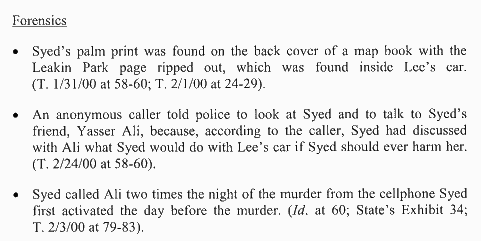
First, the State’s argument about the palm print makes clear that the State is trying to use it to show that Adnan tore out the page covering Leakin Park so that he could figure out how to drive there and/or figure out where in the park to bury the body in the 7:00 hour. Of course, like the Leakin Park pings, this has to do with a post-murder event — the burial — and not the actual murder itself.
Second, the anonymous call was also primarily about the burial because it dealt with what Adnan allegedly told Yasser what he would do with Hae’s car if he hurt her. Now, you could also say that this has some bearing on the issue of whether Adnan killed/harmed Hae, but it’s important to reiterate that the memo about the anonymous call was quadruple hearsay introduced (by the defense) to establish the State’s flawed investigation and not to prove the truth of the matter asserted.
Third, the calls to Yasser were at 6:59 P.M. and 10:02 P.M. Therefore, it’s tough to see how they have any bearing on the actual murder. The State seemingly tried to imply at trial that Adnan might have confessed to Yasser during one or both of these calls, but they produced no evidence to support this claim.
Therefore, none of the “forensics” evidence links Adnan to the actual murder.
Corroboration
A second type of evidence the State discusses in its Brief is “corroboration” evidence:
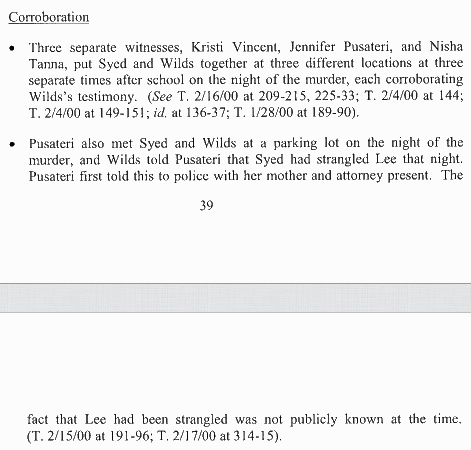
First, Kristi/”Cathy” testified about Jay and Adnan coming to her place in the 6:00 P.M. hour and helped establish the State’s claim that Adnan and Jay left in a hurry after the Officer Adcock call to bury Hae. Jenn testified about calling Adnan’s cell phone in the 7:00 P.M. hour and talking to someone whom she wasn’t allowed to identify as Adnan, ostensibly when Adnan and Jay were burying/about to bury Hae’s body. Both of these calls go to the State’s theory of the burial and not the State’s theory of the murder.
By way of contrast, “The Nisha Call” does go to the murder itself. Of course, it’s debatable the extent to which Nisha really corroborates Jay, but her testimony is clearly more pertinent to the actual murder than the testimony by Cathy or Jenn. And that’s a problem for the State because it shows the prejudice in Cristina Gutierrez not contacting/calling Asia McClain.
Jay testified that he didn’t get the “come and get me” call from Adnan until after 3:45 P.M., which would make the 3:32 P.M. call to Nisha irrelevant for proving Adnan’s guilt if the jurors believed this timeline. Alternatively, as Judge Welch explained in his opinion, if the State tried to claim that the 3:15 P.M. call was the “come and get me” call, Jay’s entire narrative of the ensuing events and calls, including “The Nisha Call” wouldn’t make any sense.
This is why the State had to argue that the 2:36 P.M. call was the “come and get me” call; it was the only version of the call that allowed for Jay’s narrative, including “The Nisha Call” to make any sense. As a result, the prejudice based upon the failure to contact/call Asia is clear. If, as Judge Welch found, Asia would have credibly testified to seeing Adnan in the library until about 2:40 P.M., Adnan would have an alibi for the State’s best timeline, and it’s unclear how “The Nisha Call” would have had any meaning without that timeline.
Second, Jenn’s testimony about seeing Adnan and Jay at the parking lot later that night not only contradicts Jay’s version of events but also clearly deals with an event that happened well after the murder.
Therefore, the only corroboration evidence that actually helped prove the State’s theory of the murder was Nisha’s testimony, and Asia’s testimony would have been hugely helpful in undermining the importance of Nisha’s testimony.
Accomplice Testimony
A third type of evidence the State discusses in its Brief is accomplice testimony:
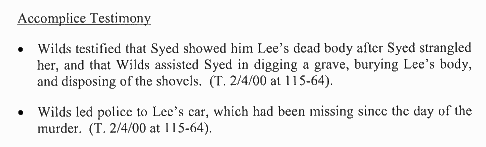
First, Jay’s testimony about digging the grave, burying Hae’s body, and disposing of the shovels deals with post-murder events that could prove Adnan’s guilt as an accessory after the fact but not the murderer. Conversely, Jay’s testimony about Adnan showing him Hae’s body is pretty central to proving that Adnan murdered Hae. But the problem for the State is that this is possibly the weakest part of Jay’s story. We all know that Jay has switched his story about the trunk pop innumerable times and admitted at trial that his initial story about the trunk pop was a lie rather than a mistake.
Second, the fact that Jay led the police to Hae’s car only directly establishes Jay’s involvement, and it only tends to establish that he had some involvement in dumping Hae’s car, not involvement in the murder. To the extent that the car discovery corroborates Jay’s story about Adnan’s involvement, it only corroborates his claim about Adnan being involved in dumping Hae’s car, not his claim about Adnan being the murderer.
Therefore, the only “accomplice” testimony referenced by the State that proves the murder is the weakest part of Jay’s story.
Motive
A fourth type of evidence the State discusses in its Brief is motive evidence:
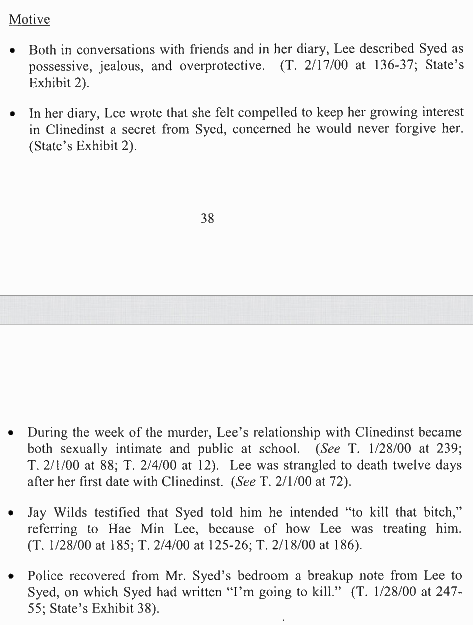
I think everyone who has followed this case recognizes that there are flaws with the way that the State characterizes this motive evidence as well as countervailing evidence that tends to cut against this evidence. That said…sure. Hae and Adnan had somewhat recently broken up, and therefore Adnan had a motive to harm Hae. But, of course, “[a]s motive is ordinarily not an element of the crime charged, evidence of motive does not establish guilt.” Chandler v. State, 329 A.2d 430 (Md.App. 1974).
Therefore, motive evidence is evidence that can explain other evidence establishing a defendant’s guilt, but it is not evidence of guilt itself.
Preparation
A fifth type of evidence the State discusses in its Brief is motive evidence:
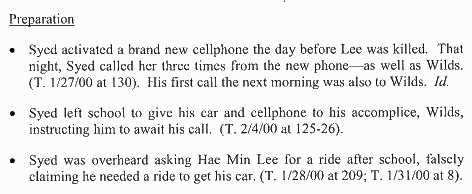
First, I don’t believe that the State posited at trial that the three calls to Hae were preparation for murdering her. Maybe the State wanted the jurors to infer that he was trying to ask Hae for a ride during these calls, but I don’t think any evidence supported this inference. That said, taking the other part of this first claim and combining it with the State’s second claim, the State did put forth the theory that Adnan called Jay, visited him during school on January 13th, and left him his car and his phone so that he could call him later in the day.
But, as with the trunk pop, this was another problem for the State and one that would have been exacerbated with Asia’s testimony. As Judge Welch noted, Jay testified that the “come and get me” call came after 3:45 P.M. while the State claimed that it was the 2:36 P.M. call on Adnan’s call log. This led Judge Welch to conclude that the State had a weak theory as to the time of the murder because it was based upon inconsistent facts. Therefore, Judge Welch concluded that this “come and get me” timeline was weak, as compared to the Leakin Park pings, which were the “crux” of the State’s case. Wearry seems to foreclose Judge Welch’s latter conclusion, but his former conclusion still stands: The State’s story about Adnan loaning Jay his car and phone and calling him on the afternoon of January 13th was weak and inconsistent.
This is again where Asia comes into play. If we believe Jay’s 3:45ish timeline, his entire narrative, including “The Nisha Call,” falls apart. If we believe the State’s 2:36 timeline, Asia’s testimony provides a strong alibi.
This takes us to the State’s third claim, which ties into the last category of evidence discussed by the State.
Deviations in Syed’s Story
The last type of evidence the State discusses in its Brief consists of deviations in Syed’s story:
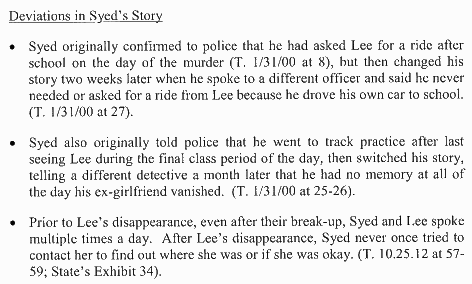
The State’s first and second claims tie back to its third claim in the “preparation” category; all three deal with Adnan asking Hae for a ride and subsequently changing his story about that ride request and what he did after school. Again, there are reasons to question the State’s characterizations. Beyond that, though,…sure. Along with “The Nisha Call,” this is the strongest evidence against Adnan that, along with motive, helped to corroborate Jay’s otherwise weak claims about the “come and get me” call and the trunk pop.
But again, this is where Asia would have been huge. The State presented an easy to swallow narrative/timeline for the jurors: Adnan asked Hae for a ride on the morning of January 13th, Aisha saw Adnan and Hae together at the end of school at about 2:15 P.M., and Inez saw Hae leaving school in a hurry between 2:15 and 2:20 P.M. Therefore, the obvious implication is that Adnan got his requested ride from Hae and killed her at the end of that ride.
Asia’s testimony would have cast an entirely different light on this narrative/timeline. With Asia’s testimony, Inez now makes it look like Adnan didn’t get a ride from Hae, who left school well before Adnan was done talking with Asia at the library. Moreover, the jurors didn’t just have to rely on Inez; they could also rely on defense witness Becky, who testified that Hae told her in the minutes after school ended that she had to leave right away because she had somewhere else to be.
And while the State will claim that Debbie testified that Hae was still at school at 3:00 P.M., a pivot to this timeline would create additional complications for the State. At trial, the State claimed that Hae was supposed to pick up her cousin at 3:00 P.M., if not earlier. Given this fact, how could Hae have given Adnan a ride under the Debbie timeline? Indeed, Debbie even said in her police statement that she told “Takera” that she didn’t have time to give her a ride because she had to pick up her cousin. And the Debbie timeline creates the same problems for “The Nisha Call” and Jay’s narrative that are created by a 3:15 P.M “come and get me” call. Simply put, the Debbie timeline doesn’t seem feasible, which is probably why the State didn’t go with it at trial.
Finally, the State’s third claim in the “deviations” section doesn’t go to the issue of whether Adnan murdered Hae. One might (or might not) infer from Adnan’s lack of calls to Hae after her disappearance that he knew that she was dead. But he would have that knowledge even if he were only involved in her burial and not her murder.
Conclusion
If we actually distill the State’s claim of “overwhelming” evidence to the evidence about the murder itself, we are left with (1) motive; (2) Jay’s testimony about the “come and get me” plan and the trunk pop; (3) the ride request and Adnan’s shifting stories about it; and (4) “The Nisha Call.”
Motive evidence isn’t evidence of the crime. Jay’s testimony about the “come and get me” plan and the trunk pop were probably the weakest parts of his story. And while the ride request and “The Nisha Call” were arguably stronger parts of the State’s case, they were also parts that would have been damaged the most by Asia testifying as an alibi witness. Therefore, I feel pretty strongly that the Court of Special Appeals won’t find lack of prejudice based upon failure to contact/call Asia McClain.
-CM