
The Case That Could Change the Course of Criminal Law: George Alvarez & the Right to Evidence of Actual Innocence
For some unknown reason, my Twitter account has been suspended since yesterday morning. I don’t know whether the two are connected, but, just before it was suspended, I was tweeting about what might end up being the most important case of my career, and I’d like to give it some more attention here. I’m not an attorney for George Alvarez, but I am writing an amici curiae (friend of the court) brief on his behalf to the Supreme Court.
In 2005, George Alvarez was a 9th grade, special education student. He was arrested on suspicion of committing misdemeanor burglary of a motor vehicle. Jail Officer Nelson W. Mendoza later wrote the following report on what happened at the Brownsville Detention Center after the arrest.
ON THIS DAY AT APPROXIMATELY 2115 A MALE SUBJECT BY THE NAME OF ALVAREZ, GEORGE WAS BROUGHT INTO CITY JAIL FOR THE CHARGE OF BURGLARY OF MOTOR VEHICLE X 2 AND WHILE IN CELL 101 ALVAREZ WAS OBSERVED BANGING PHONE RECIEVER AND WAS THEN MOVED TO CELL #114 IN THE PROCESS OF TRANSFERING HIM HE BECAME VIOLENT WITH D.O ARIAS #4831-MENDOZA #5950- SALINAS #5989. WHILE IN STRUGGLE I D.O MENDOZA PLACED MY KNEE OVER HIS BACK WHILE TRYING TO PLACE HANDCUFFS ON INDIVIDUAL TO REGAIN CONTROL TO SUBDUE HIM AND WAS PLACED IN CELL #114 WITH SHACKLES AND HANDCUFFS. NO FURTHER ACTION TAKEN BY THIS D.O.
Alvarez would later plead guilty to assaulting a peace officer. Four years into Alvarez’s eight year sentence,
video footage came to light that prosecutors had never gathered from police officers, and thus never shown to the grand jury. The footage showed no such attack. Instead, the guard could be seen placing Alvarez in a choke hold and eventually a head lock while the young man flailed beneath him. His hands and arms were pinned down, nowhere near the guard’s throat. The Texas Court of Criminal Appeals found Alvarez to be “actually innocent” of the charges.
Alvarez, who could not read or write well prior to his incarceration, “couldn’t even read his own innocence ruling when he received it in prison.” See Appellee’s Response to Appellant City of Brownsville’s Brief, 2016 WL 7449286 (5th Cir. 2016).
Alvarez later brought a civil action against the City of Brownsville, claiming a violation of his due process rights under Brady v. Maryland, which held that the State has an affirmative obligation to disclose material exculpatory evidence to defendants. This might make you think that this was an easy case for Alvarez based on the State’s failure to disclose evidence of his actual innocence. And yet, on September 18th, the United States Court of Appeals for the Fifth Circuit issued an en banc (the entire bench) opinion denying Alvarez relief.
Why? In United States v. Ruiz, the United States Supreme Court held that defendants have no right to material impeachment evidence before they plead guilty. Impeachment evidence is evidence that calls into question the credibility of a witness. So, let’s say that an innocent defendant is charged with first-degree murder based largely on an eyewitness picking him out of a lineup. In order to avoid the possibility of being convicted after trial and receiving the death penalty, the defendant enters into plea agreement, pursuant to which he will plead guilty in exchange for a sentence of life imprisonment with the possibility of parole.
Unbeknownst to the defendant, the eyewitness told the police that he is nearsighted and wasn’t wearing glasses on the night of the murder. Or he might admit that he had taken LSD on the night of the murder. Or he might be a confidential informant. Let’s say that this information wasn’t disclosed to the defendant before he pleaded guilty and that he learns of this information ten years into his sentence. He can’t establish a Brady violation because the Ruiz Court held that there is no pre-plea right to material impeachment evidence.
Since Ruiz, a number of courts have extended Ruiz to hold that defendants have no pre-plea right to substantive evidence of innocence. Assume a murder victim scratches his killer during the struggle that leads to the victim’s death. The innocent defendant enters into a plea agreement to avoid the death penalty and later learns that pre-plea DNA testing on epithelial cells under the victim’s fingernails excluded him as the source of those cells. He can’t establish a Brady violation. The same would go for a defendant who pleads guilty to a murder without the knowledge that the State suppressed the statements of two eyewitnesses who said the murderer was a foot taller and a different race than the defendant. And the same would go for George Alvarez, who was deprived of video evidence that he was the victim rather than the perpetrator of an assault.
Now, other courts disagree with this logic, but take a look at how the concurrence in the Alvarez case dealt with these cases:
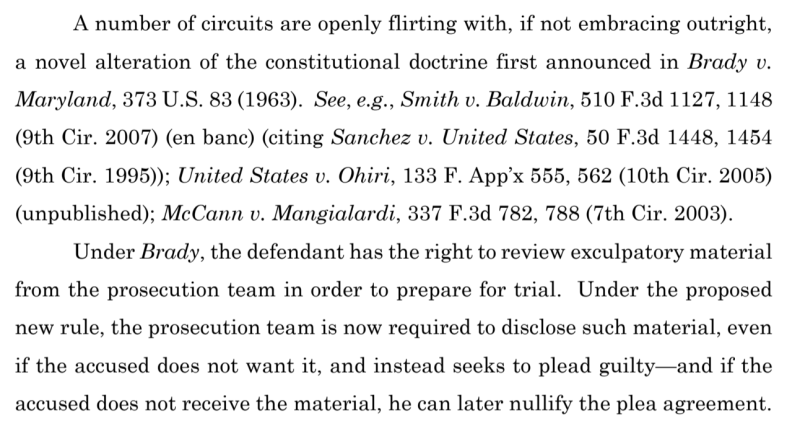
I simply can’t make any sense of this logic. What innocent defendant doesn’t want evidence that proves his innocence? Yes, defendants in these circumstances often forego a trial in favor of a plea agreement, but that is because they aren’t aware of the evidence of their innocence, not because they’re uninterested in such evidence.
There’s a very important statistic in the American criminal justice system, and it relates to the death of the jury trial. Due to a variety of factors including prosecutorial overcharging and underfunded public defender offices,* about 95% of criminal cases in this country that end in a conviction are the result of guilty pleas. And this is why the George Alvarez case is so huge.
If the Supreme Court takes Alvarez’s case, three results are possible: the Supreme Court finds that (1) there is no pre-plea right to any Brady evidence; (2) there is a pre-plea right to substantive evidence of innocence but still no pre-plea right to material impeachment evidence; or (3) there is a pre-plea right to material substantive evidence and material impeachment evidence (repudiating Ruiz). Simply put, if scenario 1 unfolds, it means that approximately 95% of criminal defendants will have no right to evidence of their innocence. It’s hard to imagine the stakes being higher.
And that’s because innocent people do plead guilty. As I note in my work-in-progress, “A Right to Prove Innocence After Pleading Guilty,”
The first DNA exoneree in this country was a man with a sub-70 IQ who pleaded guilty to avoid the death penalty, and a total of 139 out of 315 (44.1%) DNA and non-DNA exonerees in 2015 and 2016 had been convicted after guilty pleas.
And so, that’s why I’m writing an amici curiae brief in the George Alvarez. Some of the arguments in it come from my forthcoming article, “Plea Agreements As Constitutional Contracts,” but I also think that I’ve uncovered something about the history of the Brady doctrine that could be a game changer. I’m going to be circulating the brief to other law professors this week for feedback, and then I will post more about it on this blog.
___________________
*About 80% of defendants (and 90% of capital defendants) are indigent and represented by overworked public defenders. “The numbers of cases assigned to these attorneys is shocking. In New Orleans, for example, 60 public defenders are responsible for approximately 20,000 cases annually. In Kansas City, Missouri, public defenders’ caseloads include 80 to 100 cases per week.”
-CM