
While the Court of Appeals Ruled Against Adnan Syed, It Also Revealed That the Maryland Courts Have No Confidence in His Trial or Conviction
On one level, today’s 4-3 ruling by the Court of Appeals of Maryland in the Adnan Syed case is devastating…because it means that Adnan does not get a new trial…for now. But when we review what the Maryland courts have ruled in his postconviction proceeding, a pretty extraordinary picture emerges.
To prove ineffective assistance of counsel, a defendant must establish both (1) deficient performance; and (2) prejudice.
Deficient Performance
To demonstrate deficient performance, appellant must prove “that his counsel’s acts or omissions were the result of unreasonable professional judgment and that counsel’s performance, given all the circumstances, fell below an objective standard of reasonableness considering prevailing professional norms.”…With the benefit of hindsight, however, it is all too easy to mistake a sound but unsuccessful strategy for incompetency, and for this reason we “indulge a strong presumption that counsel’s conduct falls within the wide range of reasonable professional assistance.”…It is thus appellant’s burden to overcome the dual presumptions that the allegedly deficient act or omission was the result of trial strategy and that the strategy was a sound one. Cirincione v. State, 705 A.2d 96 (Md.App. 1998)
Simply put, it’s really tough to overcome these dual presumptions and even many errors by trial counsel and not deemed deficient performance. The vast majority of defendants can’t prove even one instance of deficient performance. Adnan proved two: (1) that trial counsel was deficient in failing to contact prospective alibi witness Asia McClain; and (2) trial counsel was ineffective in failing to use the AT&T disclaimer to cross-examine the State’s cell tower expert. Specifically, nine of the Maryland judges who heard the alibi claim found deficient performance vs. only two who did not. Meanwhile, the only judge to rule on the merits of the cell tower claim — Judge Welch — found deficient performance with regard to the AT&T disclaimer.
Prejudice
In regard to the second, “prejudice” prong, “[t]he defendant must show that there is a reasonable probability that, but for counsel’s unprofessional errors, the result of the proceeding would have been different. A reasonableprobability is a probability sufficient to undermine confidence in the outcome.” Shortall v. State, 183 A.3d 820 (Md.App. 2018) (quoting Strickland v. Washington).
Now, this is where we get the big disagreement among the Maryland judges. In his opinion Judge Welch found that the State presented a weak/contradictory timeline of the murder and that many of the cell tower records contradicted the testimony by Jay Wilds. This led him to conclude that the “crux” of the State’s case was the Leakin Park pings:
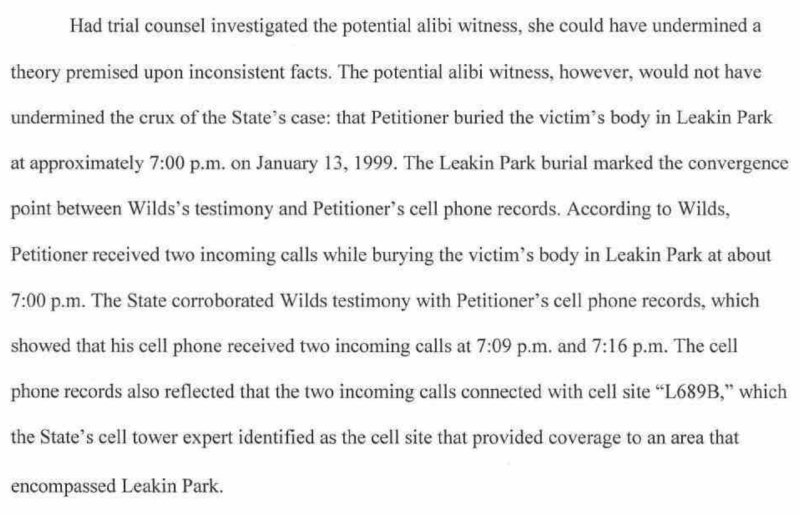
This, of course, led to his two conclusions: (1) it was prejudicial to fail to use the AT&T disclaimer, which fundamentally undermined the Leakin Park pings; and (2) it was not prejudicial to fail to contact Asia McClain.
Of course, a majority of the Court of Appeals of Maryland disagreed in its opinion, finding that the “crux” of the State’s case was the murder and not the Leakin Park pings:
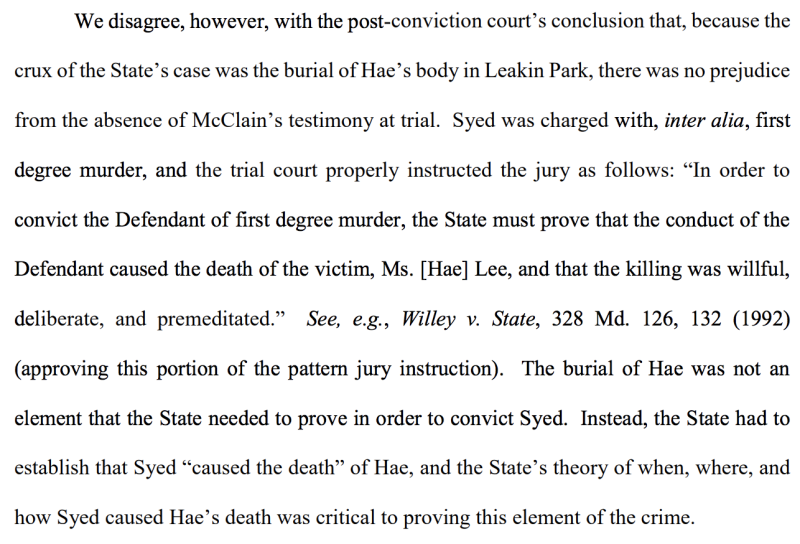
In turn, this led the judges to conclude that the failure to contact Asia McClain was prejudicial. Those judges, however, did not need to decide whether the failure to use the AT&T disclaimer was prejudicial because it found that the issue was waived.
Finally, today, the four judge majority of the Court of Appeals of Maryland agreed with Judge Welch that the Leakin Park pings were the “crux” of the State’s case against Adnan:
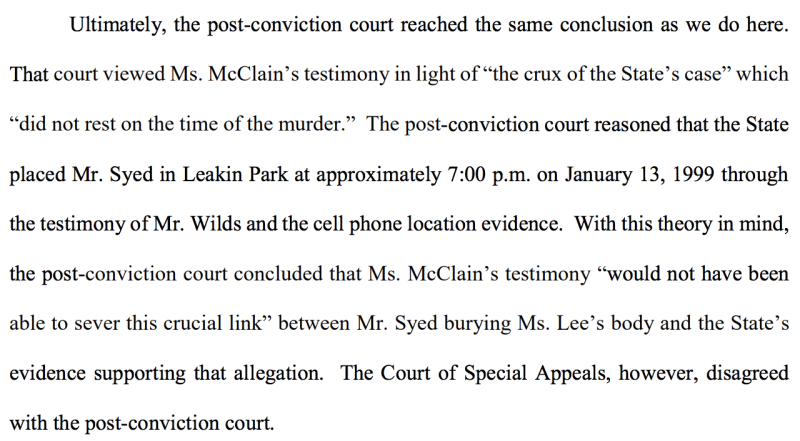
This led the court to reach the same conclusion as Judge Welch with regard to prejudice: because the Leakin Park pings were the “crux” of the State’s case against Adnan, the failure to contact Asia McClain could not be prejudicial. Finally, like the Court of Special Appeals, the Court of Appeals found the cell tower claim waived.
Conclusion
So, as things stand, Maryland judges have held that Adnan’s trial counsel rendered Constitutionally deficient performance in the two areas that were possibly the “crux” of the State’s case. That’s what 9/11 judges ruled on the alibi issue and 1/1 judges ruled on the cell tower issue. And then, 6 judges found the “crux” of the State’s case was Leakin Park pings and 5 judges found the “crux” of the State’s case was the murder. The latter 5 judges all found prejudice and that the failure to contact Asia undermines our confidence in the verdict. Of the former 6 judges, only 1 ruled on the prejudice issue in connection with the cell tower claim…and he found that failure to use the AT&T disclaimer was prejudicial and undermined our confidence in the verdict.
In other words, Adnan was failed at least twice at trial, and those failures went to both of the aspects of the State’s case that could be considered the “crux.” And the only reason Adnan is not getting a new trial…now…is that the Court of Appeals has concluded that he was failed again on appeal, which led to waiver of his cell tower claim.
And, as I noted earlier today, this is why Adnan still has a great shot at relief…eventually. Today’s opinion was all about giving deference to Judge Welch with regard to his substantive findings on the alibi claim, which were that Adnan was not prejudiced because the Leakin Park pings were the “crux” of the State’s case. Seemingly, this would mean that the Court of Appeals would give great deference to Judge Welch on his substantive findings on the cell tower claim. Simply put, if the Court of Appeals agrees that the Leakin Park pings are the “crux” of the State’s case, how could the failure to use the AT&T disclaimer not be prejudicial.
Now, all Adnan needs is a way to get his cell tower claim back before the court. And, as I noted earlier, I think he has such a way. The State might have won the battle today, but I think the defense still wins the war. Stay tuned.
-CM