
The DNA Report in the Adnan Syed Case
Yesterday, it was revealed that there was DNA testing done in the Adnan Syed case last year. Specifically, the State tested twelve pieces of evidence that were found on or around Hae Min Lee. Here is the report on that testing by the Forensic Sciences Division of the Baltimore Police Department:
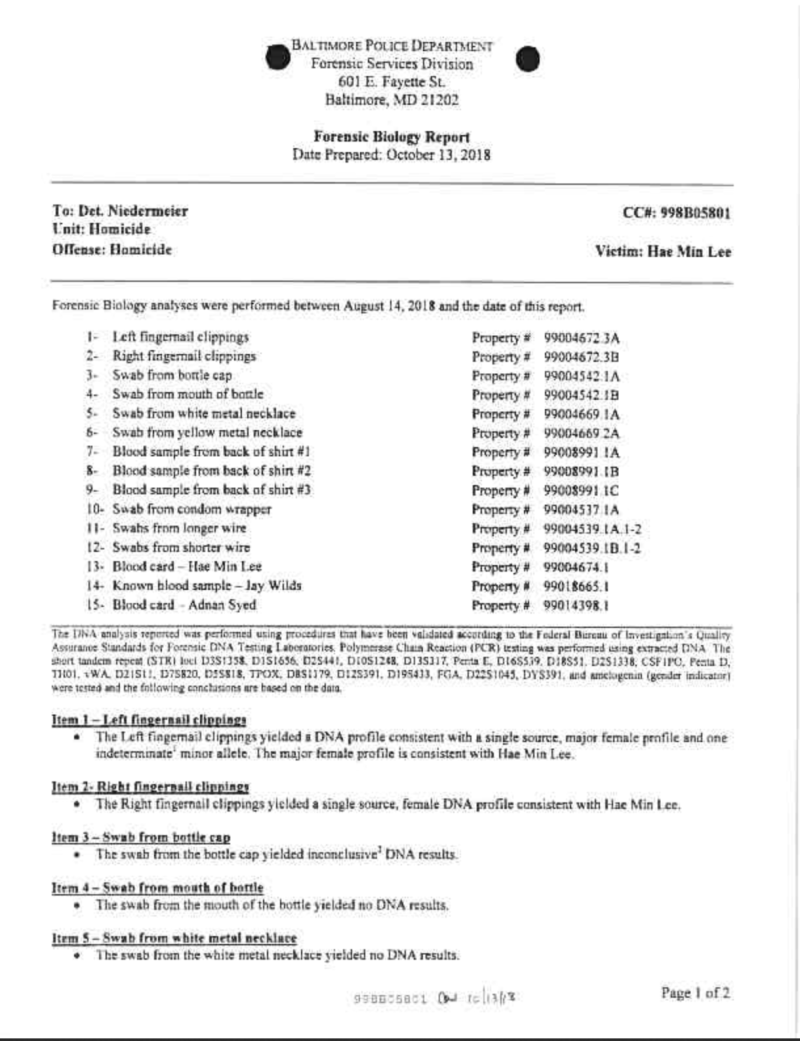
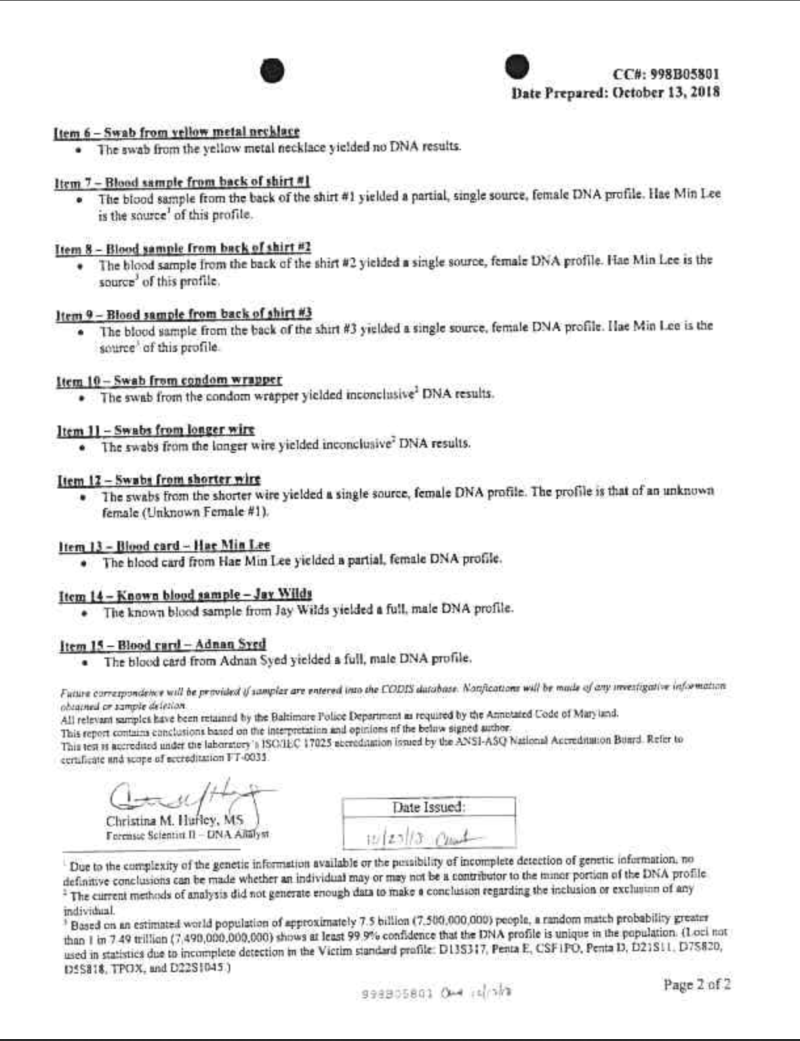
So, what does it all mean?
As we’ll discuss on Monday’s episode of Undisclosed, the DNA report raised many more questions than it answered. But it does tell us two important things:
The Shorter Wire
First, swabs from Item 12, the “shorter wire,” yielded “a single source, female DNA profile. The profile is that of an unknown female (Unknown Female #1).” Given that they were able to conclude that Hae Min Lee was the source for other DNA profiles on other evidence, it seems safe to conclude that this other female was not Hae Min Lee.
While this report refers to the tested evidence as a “shorter wire,” its property number makes it look like the Inventory Sheet from February 9, 1999 referred to it as a rope:
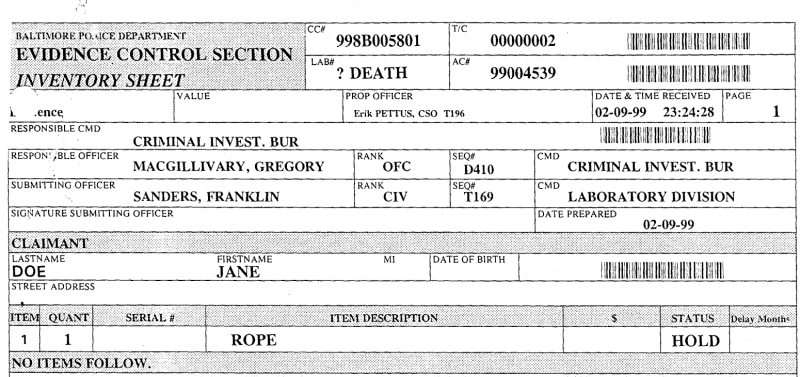
That said, the photo of the “longer wire” and “shorter wire” does make them like like wires as opposed to ropes, but who knows?

Given that this was a case of apparent manual strangulation (with the hands) as opposed to ligature strangulation (with a rope, cord, etc.), it would not appear that this rope/wire/cord would have been the murder “weapon.” That said, it’s fairly easy to imagine the rope/wire being (1) something used in some way to transport the body; or (2) something someone involved in the transportation/burial simply left behind.
The possible connection between the rope/wire and Hae is quite obvious, which is in all likelihood why it was tested. The brandy bottle (also tested) and the rope/wire were about eight and five inches away from Hae’s body, which was about 127 feet deep in Leakin Park behind some rough terrain. Meanwhile, all of the other evidence collected was roadside.
There’s also the fact that they were able to get a DNA profile from the rope/wire almost 20 years later, which makes it likely that it couldn’t have been exposed to the elements much longer than Hae’s body. This means that the rope/wire was likely deposited during the burial or in the six weeks before her body was discovered (although it’s possible that it could have been deposited earlier).
I’m not certain whether the DNA profile has been run through any databases or what else can be done with it. But, if we’re able to get a match at some point, it could point us in the direction of the killer, someone who helped the killer with the body, or someone connected to the killer. It’s also significant that we have evidence so closed to Hae’s body that has a DNA profile that is not a match for Hae or Adnan.
Evidence of Exclusion
Second, none of the other tested pieces of evidence produced a DNA profile that was a match for Adnan. Such evidence of exclusion is no doubt exculpatory, but how exculpatory is it? On Undisclosed, we covered the case of Ronnie Long, a North Carolina man who has been in prison for 43+ years based upon an alleged burglary and sexual assault. He recently had oral arguments in the Fourth Circuit on his claim that the State committed a Brady violation based on failing to disclose that they had tested about the same number of pieces of crime scene evidence and couldn’t find a connection between Long and the crime scene/victim.
The North Carolina courts found that this evidence was exculpatory given the nature of the attack in a confined space and the likelihood that there would have been some forensic evidence tying Long to the crime scene. Of course, given that the State claims that Adnan killed Hae in the close confines of her Nissan Sentra, the same reasoning would apply. But the Supreme Court of North Carolina in the Ronnie Long case split 3-3 (with one judge abstaining) over whether this evidence was material, i.e., likely would have changed the outcome at trial. The federal district court later found lack of materiality, and this is the decision the Fourth Circuit is currently reviewing.
So, yes, evidence of exclusion is exculpatory…but how exculpatory? Should Adnan’s case end up in federal court, the opinion in Ronnie Long’s case could be controlling authority given that Maryland is in the Fourth Circuit.
The Two Hairs
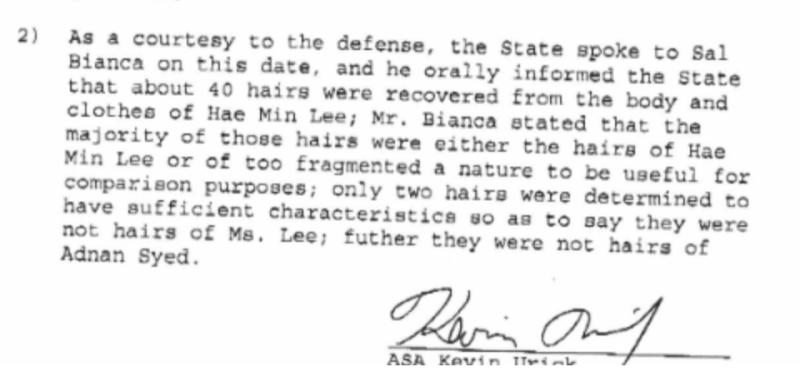
There’s one final similarity between the cases of Adnan Syed and Ronnie Long. In Ronnie’s case a “suspect hair” was recovered from the victim’s body that was not a match for Ronnie Long. Meanwhile, as I’ve previously noted, there were two hairs recovered from Hae Min Lee’s body that did not belong to Hae or Adnan:
Conclusion
So, overall, we have (1) no evidence linking Adnan to the crime/scene body; (2) a rope/wire found five inches from the body that yielded a DNA profile that is a match for some unknown person; and (3) three two hairs recovered from Hae’s body that are not the hairs of either Hae or Adnan.
This evidence is exculpatory, but how exculpatory? By itself, it’s not enough for an exoneration. But, it could lead to evidence that could produce an exoneration. And it could be used in combination with other evidence such as lividity, Kristi’s class schedule, Jay’s Interceprt interview, etc. to support a petition for writ of actual innocence in Maryland or to support a Schlup actual innocence gateway claim in federal court (which is how Ronnie Long’s case is currently being considered. We’ll likely all know more after watching Episode Four of “The Case Against Adnan Syed.”
-CM