
Possible Next Steps in the Adnan Syed Case
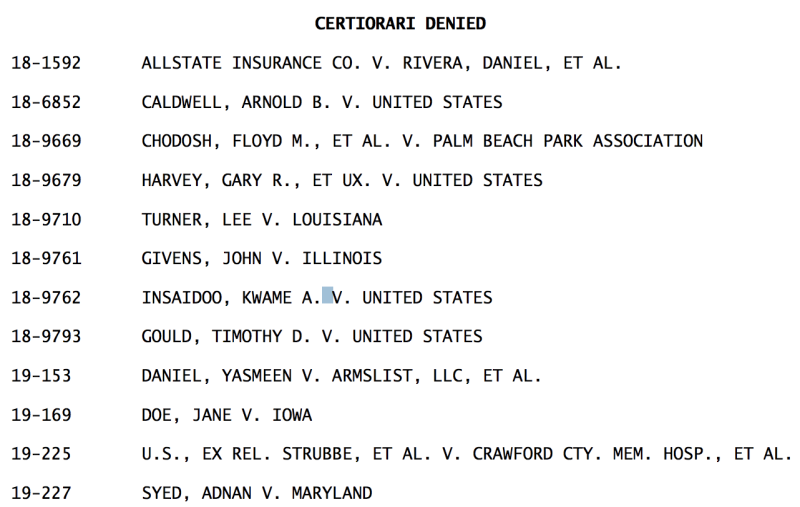
Today, the United States Supreme Court denied certiorari in the Adnan Syed case, meaning that the Court will not hear his appeal from the 4-3 opinion of the Court of Appeals of Maryland denying him a new trial:
So, what are possible next steps in Adnan’s case?
Ineffective Assistance of Postconviction Counsel
You might recall that all the way back in 2016 when Judge Martin Welch granted Adnan a new trial, it was not based upon his alibi claim. Instead, it was based upon his claim that his trial counsel was ineffective based upon failure to cross-examine the State’s cell tower expert with the AT&T disclaimer which stated that:

Indeed, Judge Welch did not grant Adnan relief on his alibi claim because
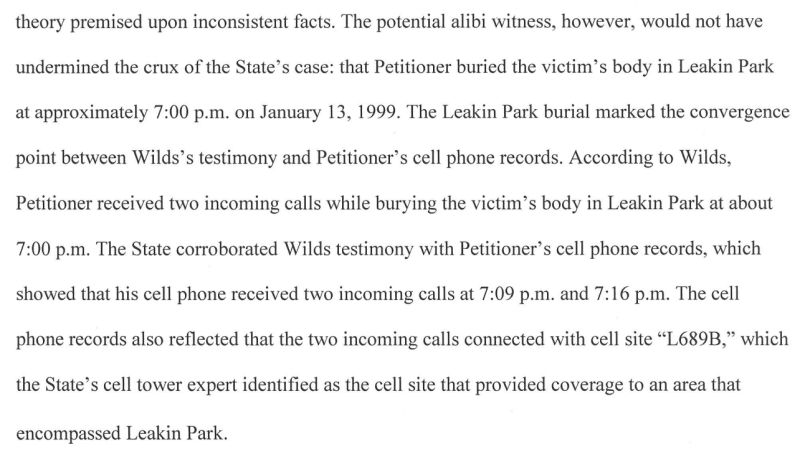
In its 4-3 opinion denying Adnan relief, the Court of Appeals of Maryland agreed with Judge Welch, holding that
Ultimately, the post-conviction court reached the same conclusion as we do here. That court viewed Ms. McClain’s testimony in light of “the crux of the State’s case” which “did not rest on the time of the murder.” The post-conviction court reasoned that the State placed Mr. Syed in Leakin Park at approximately 7:00 p.m. on January 13, 1999 through the testimony of Mr. Wilds and the cell phone location evidence.
So, what happened with Adnan’s cell tower claim? Judge Welch acknowledged that postconviction counsel did not include the claim in Adnan’s initial PCR petition. But Judge Welch found that the claim involved a fundamental right that had to be knowingly and intelligently waived and that Adnan, who was arrested before he had finished high school, did not knowingly waive the complex cell tower claim. Neither the Court of Special Appeals nor the Court of Appeals disputed this factual finding, but both found that the cell tower claim was waived because Adnan’s first PCR petition included claims of ineffective assistance of counsel in the first PCR petition but did not include the cell tower claim. And, because of this waiver finding, neither court disputed Judge’s Welch’s substantive conclusion that failure to use the AT&T disclaimer at trial was ineffective assistance of counsel. So, where does that leave us?
The Court of Appeals of Maryland has found that ineffective assistance of postconviction counsel is grounds for reopening a postconviction proceeding. Gray v. State, 879 A.2d 1064 (Md. 2005). And the test for determining whether to reopen a postconviction proceeding is whether the defendant can “establish that postconviction relief would have been granted but for the ineffective assistance of…postconviction counsel.” Harris v. State, 862 A.2d 516 (Md. 2004).
Such a claim in Adnan’s case is remarkably straightforward. He would claim that
(1) the Court of Appeals of Maryland found that I waived my cell tower claim because my postconviction counsel did not include it in my first PCR petition; and
(2) if my PCR counsel included the cell tower claim in my first PCR petition, I would have been awarded a new trial, as established by Judge Welch’s opinion granting me a new trial.
Usually, an ineffective assistance of postconviction counsel is speculative. Here, there’s already been a hearing (with expert witnesses) and a ruling on the merits of the cell tower claim before the higher court found waiver. Moreover, in its ruling against Adnan’s alibi claim, the Court of Appeals agreed with Judge Welch that the crux of the State’s case against Adnan was the Leakin Park pings, which involved the incoming calls that would have been undermined by the AT&T disclaimer.
In theory, this should be about as much of a slam dunk claim as you can get, but, as we’ve just seen, Maryland has just deviated from courts across the country in handling ineffective assistance of counsel/alibi claims, so you never know.
Federal Habeas Petition
Alternatively, Adnan could file a petition for writ of habeas corpus in federal district court. This petition would claim that the Court of Appeals violated clearly established federal law in denying him relief on his ineffective assistance/alibi claim. Unfortunately, the period of limitation for filing such a claim has long since passed. Therefore, to get into federal court, Adnan would have to use what’s known as the Schlup actual innocence gateway. Under Schlup, evidence of actual innocence serves as a gateway for consideration of otherwise waived claims. To satisfy this gateway and get relief, Adnan would have to prove
(1) actual innocence, i.e., that evidence (e.g., the AT&T disclaimer, Jay’s Intercept interview) exists which makes it so that no reasonable juror could find him guilty beyond a reasonable doubt; and
(2) that the Court of Appeals of Maryland’s ineffective assistance alibi ruling violated clearly established federal law as expressed in cases such as Montgomery v. Petersen, 846 F.2d 407 (7th Cir. 1988), and Griffin v. Warden, Maryland Correctional Adjustment Center, 970 F.2d 1355 (4th Cir. 1992).
So, what’s the likelihood of success under this route? It’s tough to say. Usually, actual innocence claims are pretty tough to prove, but (1) Charles Ray Finch, whose case we covered on Undisclosed, recently won on his actual innocence clam in the Fourth Circuit; and (2) Ronnie Long, whose case we also covered on Undisclosed, is currently having his actual innocence claim considered by the Fourth Circuit. There’s certainly a bunch of new evidence that has undermined the case against Adnan Syed, but “actual innocence” is a high hurdle.
While I think this is a weaker basis for relief than the cell tower claim, it might make some sense to bring it first because, timing-wise, such a habeas petition couldn’t be brought after bringing the cell tower claim in state court.
State Actual Innocence Claim
Adnan could also bring an actual innocence claim in Maryland state court under Section 8-301 of the Maryland Code of Criminal Procedure. This is not a gateway claim; it’s a straightforward actual innocence claim. And there is precedent for such a claim being successful. I previously blogged about Seward v. State, which involved an alibi as part of the defendant’s successful actual innocence claim.
Petition for DNA Testing
Adnan can also bring a petition for DNA testing under Section 8-201 of the Maryland Code of Criminal Procedure. As seen in the HBO series, the shorter wire found near Hae Min Lee’s body yielded “a single source, female DNA profile. The profile is that of an unknown female (Unknown Female #1).” It’s not clear what more has been done/could be done with that wire, but a petition for DNA testing could answer those questions (and hopefully other questions about the case).
Parole Petition
Two days ago, a Baltimore Sun article noted that Maryland has begun granting parole to juvenile lifers after decades of inaction. According to the article,
Navarus Mayhew, 42, is scheduled to be released this month after 24 years in prison for first-degree murder, robbery and gun charges. Robert Davis, 54, who served 37 years for first-degree felony murder and handgun charges has been recently released, a Maryland Department of Public Safety and Correctional Services spokesman said Thursday. Shawn Delco Goodman, 42, will likely be released in December after 27 years behind bars for first-degree murder and robbery charges, according to Maryland Parole Commission records.
Adnan will be 42 and will have served 24 years in 2023. Technically, I think he’s eligible for parole in 2024. Could Adnan claim he is innocent and still receive parole? On Undisclosed, we recently covered the case of Cyrus Wilson, who was soon thereafter paroled despite maintaining his innocence.
-CM