
Why the Alternate Suspect Having the Opportunity to Kill Hae Min Lee is Critical
At the hearing on the joint motion to vacate Adnan Syed’s murder conviction, Becky Feldman from the Baltimore City State’s Attorney’s Office said something fairly extraordinary. Her statement was in regard to one of the alternate suspects in the case. Here were the details on the suspect from the joint motion:
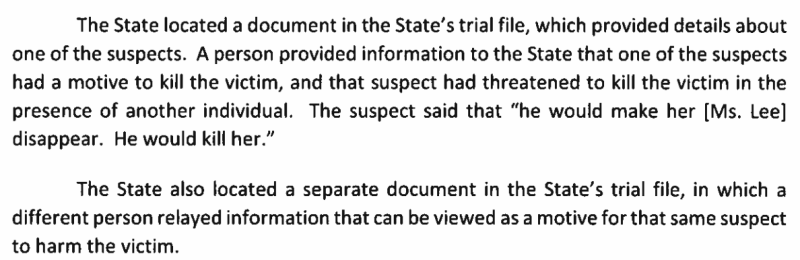
At the hearing, though, Feldman went further, stating that this alternate suspect had motive, means, and opportunity to kill Hae Min Lee. I first got this detail from the update episode of the Serial Podcast (at about 8:30). A journalist who was at the hearing then confirmed that Feldman had said these exact words: “Suspect had motive opportunity and means to commit this crime.”
This is a shocking statement and one that raises strong suspicion that this alternate suspect killed Hae. Why?
Motive, means, and opportunity are the Holy Trinity of criminal prosecutions. They’re the way the prosecutor proves her case beyond a reasonable doubt. Motive “is why one committed the crime, the inducement, reason, or willful desire and purpose behind the commission of an offense.” The prosecution technically doesn’t have to prove motive, but it can be tough to convince the jury that the defendant killed the victim for no apparent reason at all.
When a suspect had the means to commit a crime, it means she had the ability to kill the victim. The best way to define means is through its opposite. First, a suspect might lack the physical means to commit the crime. For example, a suspect with quadriplegia would be unable to strangle a victim. Second, there might be no evidence tying the suspect to the murder weapon. If a victim is fatally shot with a 9mm gun, the prosecution would fail to prove means if the suspect is under the legal age to buy a gun and there is no evidence tying him to such a gun. On the other hand, a suspect with the physical means and access to something like the murder weapon would have the means to commit the murder. Because Hae Min Lee was manually strangled, any suspect with functioning hands and arms would have the means to commit the murder.
This takes us to opportunity. Notably, opportunity is not simply about the lack of impossibility that the suspect committed a crime. For example, assume that the alternate suspect lived about 30 miles away from Woodlawn High School and did not have an alibi for January 13, 1999. At that alternate suspect’s trial, the prosecution could not claim that the suspect had the opportunity to commit the crime simply because it’s possible that he could have come into contact with Hae Min Lee. Instead, opportunity requires some degree of contact or access around the time of the crime. As far as we know, the last thing we know about Hae Minn Lee on January 13, 1999 is that she was driving away from Woodlawn High School. This means that for Feldman to say that the alternate suspect had the opportunity to kill Hae Min Lee, there must be evidence that he had contact with her or was in/around Woodlawn High School on the afternoon of January 13, 1999.
A few examples suffice to establish this point:
-In finding that there was motive, means, and opportunity in Simons v. State, 1996 WL 469364 (Minn.App. 1996), the Court of Appeals of Minnesota found that there was “evidence of appellant’s means and opportunity to commit the crime, including the fact that appellant was home on the day of the fire, had sole access to the house, and always locked the house doors;”
-In Floyd v. Meachum, 907 F.2d 347 (2nd Cir. 1990), a case involving unauthorized use of a car, “the prosecutor claimed that Floyd’s access to the car keys provided the opportunity.”
-In Mascho v. Commonwealth, 2016 WL 2636706 (Va.App. 2016), the Court of Appeals of Virginia held that “Although appellant did not have exclusive access to the trailer, he had the means, motive, and opportunity to take these items.”
It’s perhaps best to show what is meant by opportunity by looking at a case finding it was not proven. In State v. Hayden, 711 S.E.2d 492 (N.C.App. 2011), the defendant was convicted of first degree murder in the shooting death of William Miller. In finding that the prosecution had failed to prove opportunity beyond a reasonable doubt, the Court of Appeals of North Carolina found as follows:
In order for this Court to hold that the State has presented sufficient evidence of defendant’s opportunity to commit the crime in question, the State must have presented at trial evidence not only placing the defendant at the scene of the crime, but placing him there at the time the crime was committed. See, e.g., Pastuer, 205 N.C.App. at ––––, 697 S.E.2d at 386 (holding insufficient evidence of opportunity was presented where the State presented physical evidence, including the victim’s blood on the defendant’s shoe and the defendant’s fingerprints at the crime scene, because it presented no evidence “that defendant was seen around [the victim]’s home or in her car any time” near the time of the murder); State v. Scott, 296 N.C. 519, 522, 251 S.E.2d 414, 416–17 (1979) (holding insufficient evidence of opportunity was presented where the State presented testimony that the defendant’s fingerprint was on a box that had only been seen being handled by the victim’s family, but also testimony that the box could have been handled by the defendant at a time other than the time of the crime, because the State was required to present “substantial evidence of circumstances from which the jury can find that the fingerprints could only have been impressed at the time the crime was committed”) (citation and quotations omitted). Cf. State v. Lowry, 198 N.C.App. 457, 470, 679 S.E.2d 865, 873 (2009) (holding that “(1) defendant’s being in possession of the victim’s car shortly after the probable time of her death, (2) defendant’s also having possession of other property (jewelry and an ATM card) belonging to the victim that would have likely been taken at the time of the victim’s death, (3) defendant’s familiarity with the victim’s house and access to the house [in] the days before the murder, and (4) defendant’s effort to eliminate evidence by wiping down the car and his flight when confronted by police” constituted sufficient evidence of opportunity); State v. Cutler, 271 N.C. 379, 381, 384, 156 S.E.2d 679, 681, 682 (1967) (holding sufficient evidence of opportunity was presented where the State presented evidence that, on the day of the murder, a truck similar to defendant’s was seen at the victim’s house, which was the scene of the crime, before and after the body was discovered, its interior covered in human blood of two different types; on that day, the defendant went to the home of a relative 500 yards from the victim’s home and was described as drunk and “ bloody as a hog” with a large gash on his head; after the murder, the defendant was found by police wearing bloody clothing; and the defendant was found in possession of a knife with both human blood and a hair deemed “ similar” to the chest hair of the victim on it).
In the case sub judice, taking the evidence in the light most favorable to the State, the only evidence presented at trial as to defendant’s opportunity to commit the crime in question was from defendant’s 1998 statement, made 26 years after the murder, that he was briefly in a spot two miles away from the scene of the crime. No evidence was presented at trial placing defendant at the scene of the crime, much less placing him there at the time the crime was committed. As such, we cannot hold that the State presented sufficient evidence of defendant’s opportunity to commit the crime in question.
So, simply put, the State has evidence that the alternate suspect had contact with Hae on January 13, 1999 and/or was at/around Woodlawn High School on that date. This means that he’s a very strong suspect.
I would also say that this revelation fits well with the theory I had since November 2014. Both Becky and Aisha (via Krista) say Hae said she couldn’t give Adnan a ride after school on January 13, 1999 because something came up and she had “something else” to do before picking up her relative. It has been, and continues to be, my theory that the person who changed Hae’s plans is the person who killed her. And I now believe this was the same person who had motive, means, and opportunity to kill her.
-CM