
Tenth Circuit Finds Seals by Tribal Governments Don’t Satisfy the Requirements of Rule 902(1)
Federal Rule of Evidence 902(1) provides that:
The following items of evidence are self-authenticating; they require no extrinsic evidence of authenticity in order to be admitted:
(1) Domestic Public Documents That Are Sealed and Signed. A document that bears:
(A) a seal purporting to be that of the United States; any state, district, commonwealth, territory, or insular possession of the United States; the former Panama Canal Zone; the Trust Territory of the Pacific Islands; a political subdivision of any of these entities; or a department, agency, or officer of any entity named above; and
(B) a signature purporting to be an execution or attestation.
As the recent opinion of the Tenth Circuit in United States v. Walker, 85 F.4th 973 (10th Cir. 2023), makes clear, seals by tribal governments don’t satisfy the requirements of Rule 902(1).
An issue in the Walker case was whether the victim was Native American. The prosecution offered two items to prove this point. The first was the victim’s Certificate of Degree of Indian Blood Card:
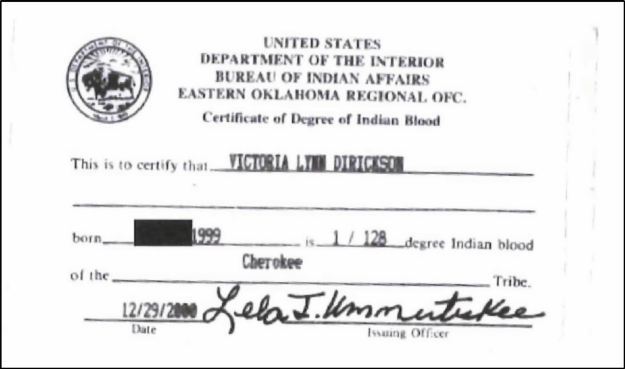
According to the court, the “card contained both ‘a seal purporting to be that of’ a ‘department’ of the United States—the Department of the Interior, at top left—and ‘a signature purporting to be an execution or attestation,’ at bottom right. Fed. R. Evid. 902(1)(A), (1)(B). The card was therefore self-authenticating under Rule 902 and properly admitted.”
The second item was the victim’s Cherokee Nation Registration Card:
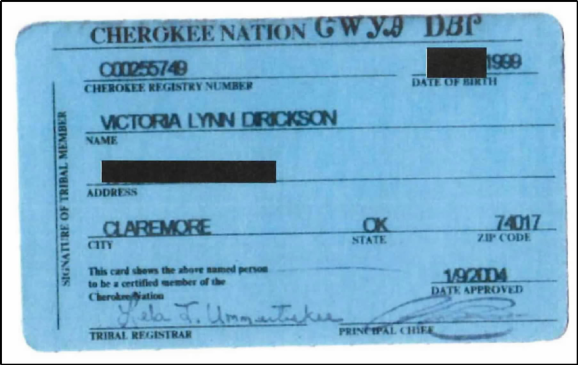
According to the court, the “Cherokee Nation registration card did not contain a seal. It therefore cannot be self-authenticating under Rule 902. Even if it had contained a seal, the document would still not be self-authenticating because tribal governments are not listed among those entities whose seals satisfy Rule 902.”
-CM
https://www.ca10.uscourts.gov/sites/ca10/files/opinions/010110943123.pdf