
The Significance of the Amendments to the Rule of Evidence Covering Summaries, Charts, and Calculations
In December 2024, Federal Rule of Evidence 1006 was amended as follows:
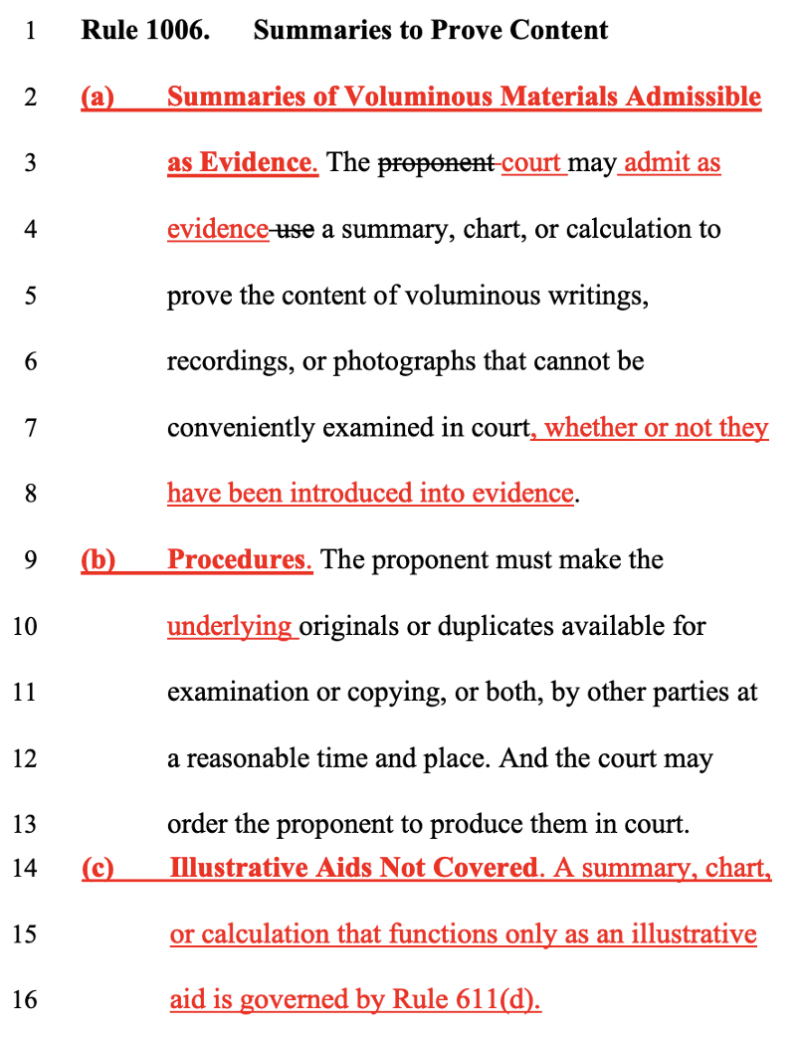
So, what’s the significance of this amendment?
We can explore the significance by looking at a few hypotheticals:
Hypothetical 1: A defendant allegedly makes a series of threatening phone calls to a victim over the course of six months and is charged with criminal harassment. The State subpoenas the defendant’s phone records for the full six months and receives hundreds of pages of records. Those records show the defendant making an average of two calls to the victim per day. The prosecution creates a chart, which solely displays the calls the defendant made to the victim. At trial, the prosecution displays the chart to the jury. Previously, some courts would give a limiting instruction to the jury that the chart is “not evidence.” As the amendment to Rule 1006(a) makes clear, a party may offer such a chart “as evidence,” meaning that the court shouldn’t give such a limiting instruction.
Hypothetical 2: A defendant allegedly makes a series of threatening phone calls to a victim over the course of six months and is charged with criminal harassment. The State subpoenas the defendant’s phone records for the full six months and receives hundreds of pages of records. Those records show the defendant making an average of two calls to the victim per day. The prosecution creates a chart, which solely displays the calls the defendant made to the victim. At trial, the prosecution wants to display the chart to the jury. The judge rules that the chart can’t be displayed unless/until the prosecution admits the underlying phone records into evidence. As the amendment to Rule 1006(a) makes clear, the chart can now be shown to the jury “whether or not the [underlying phone records] have been introduced into evidence.”
Hypothetical 3: A defendant allegedly makes a series of threatening phone calls to a victim over the course of six months and is charged with criminal harassment. The State subpoenas the defendant’s phone records for the full six months and receives hundreds of pages of records. Those records show the defendant making an average of two calls to the victim per day. The prosecution creates a chart, which solely displays the calls the defendant made to the victim. At trial, the prosecution wants to introduce the underlying phone records and then display their chart to the jury. The judge rules that the prosecution can’t display the chart after introducing the underlying records into evidence. The same amendment mentioned in Hypothetical 2 will now prevent a judge from rendering such a ruling. As the Committee Note to the Amendment states, “Summaries that are otherwise admissible under Rule 1006 are not rendered inadmissible because the underlying documents have been admitted, in whole or in part, into evidence.”
Hypothetical 4: A defendant allegedly makes a series of threatening phone calls to a victim over the course of six months and is charged with criminal harassment. The State subpoenas the defendant’s phone records for the full six months and receives hundreds of pages of records. Those records show the defendant making an average of two calls to the victim per day. The prosecution creates a chart, which solely displays the calls the defendant made to the victim. At trial, the prosecution wants to display the chart to the jury. The defense objects that the chart makes it look like the defendant is singling out the victim for calls when, in fact, the underlying records show that there are five other people the defendant called an average of two times a day. Because, as the amendment notes, such charts are now admitted “as evidence,” they are now clearly subjected to the Rule 403 balancing test. As the Committee Note to the Amendment states, “A summary admissible under Rule 1006 must also pass the balancing test of Rule 403. For example, if the summary does not accurately reflect the underlying voluminous evidence, or if it is argumentative, its probative value may be substantially outweighed by the risk of unfair prejudice or confusion.”
Hypothetical 5: A defendant is charged with murdering the victim on February 13, 2025. A medical examiner performs an autopsy at 8 a.m. on February 14, 2025 and concludes that the victim’s body was in full rigor. The defendant has an alibi that starts at 12:30 a.m. on February 14th. The medical examiner testifies that a body typically goes into full rigor about 8-12 hours after death, likely meaning the victim died before midnight. The prosecution wants to display a diagram to the jury showing the stages of rigor mortis. As the amendment adding subsection (c) makes clear, this type of illustrative aid is not covered by Rule 1006, but instead is covered by new Rule 611(d).
-CM