
10th Circuit Reverses Second Degree Murder Conviction Based on Expert Improperly Testifying That Defendant’s Conduct Was the “Ultimate Expression of Recklessness”
In a post last week, I lamented about never seeing a case in which a court reversed a conviction based on a violation of Rule 704(b). Well, here we are a week later, and I’ve finally found one. The opinion, issued a day after my post, is United States v. Maryboy, 2025 WL 1522549 (10th Cir. 2025).
In Maryboy,
On April 13, 2018, Perry Maryboy shot and killed Antonio Montowine as they stood outside their vehicles parked alongside county road 443 somewhere near Bluff, Utah. The parties presented rival accounts at trial. Maryboy claimed that he accidentally killed Montowine when his firearm shot prematurely as he extended his arm upward to fire a warning shot. The government claimed that Maryboy had acted intentionally and deliberately when he fired “a kill shot to the back of Mr. Montowine’s head.”…Alternatively, the government argued that even if Maryboy fired a warning shot, he would have acted extremely recklessly, meaning that the jury could still find malice aforethought for that conduct, and thus second-degree murder.
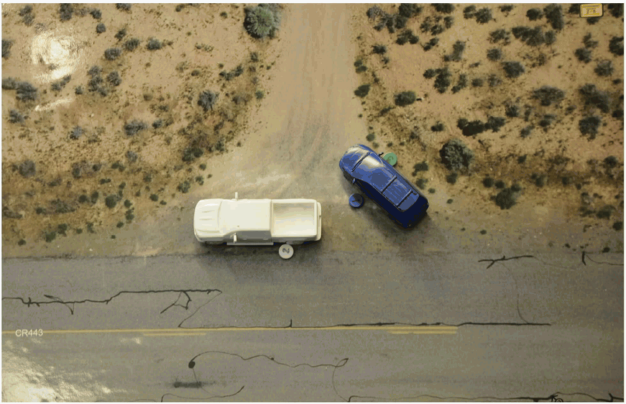
Demonstrative exhibit 2-3F displayed the scene of the shooting:
At trial, the prosecution
elicited from former FBI Special Agent James Olson, its firearms expert, what he described as four cardinal rules of gun safety—keep your finger off the trigger, treat every gun like it’s loaded, keep the muzzle pointed in a safe direction, and be aware of your target and what lies beyond your target.
He also testified in response to three hypothetical scenarios posed by the prosecutor. The third hypothetical tracked the facts here. It involved a man standing behind a truck who, in the process of firing a warning shot, accidentally shoots another person in the head from about 6–8 feet away as that person stood facing the open driver’s door to a van and away from the shooter; and the van containing a woman and her son inside. The government used Exhibit 2-3F…to illustrate this hypothetical. The prosecutor first asked whether those hypothetical facts would be consistent with the person’s being shot in the back of the head (yes). He next asked whether such a shooter would have violated any of the previously mentioned cardinal rules of gun safety (yes, all four).
During his testimony, Agent Olson used the term “reckless” several times. First, on direct examination, while explaining how Maryboy had violated the second cardinal rule of gun safety, Agent Olson testified that “it was [ ] at least cavalier, if not gross — grossly negligent reckless to point a loaded weapon at another person.”…Second, on redirect, while explaining how Maryboy had violated the fourth cardinal rule, Agent Olson testified that “[i]f this is my target and what is beyond that [are the occupants of the van], that is reckless.”…Third, still on redirect, the government asked, “You just used the term reckless. That scenario that we just went through, how reckless is that act?”…Maryboy “object[ed] to the form of the question.”…After the court overruled the objection, Agent Olson answered, “Any time that you handle a weapon in an unsafe manner it could take another human life. And so to me that’s the ultimate expression of recklessness.”…The government followed up by asking, “How would you compare that scenario to being extremely reckless? Using extremely reckless as a point of reference, how would you compare that scenario that you just described to that standard?”…Again, Maryboy “object[ed] to the form of that question.”…This time, the court sustained the objection, and the government rephrased: “Do you understand — you understand in your experience of what is extremely reckless?…Just using your own understanding…how does that scenario compare with your experience?”…Again, Maryboy objected to the form, and again the court sustained the objection. On recross, Maryboy asked, “Is it reckless to want to protect yourself from another individual who you believe has the manner and possibly the means to kill you?”…Agent Olson answered, “No.”…
After he was convicted, Maryboy appealed, claiming that Agent Olson’s testimony violated Federal Rule of Evidence 704(b), which states that
In a criminal case, an expert witness must not state an opinion about whether the defendant did or did not have a mental state or condition that constitutes an element of the crime charged or of a defense. Those matters are for the trier of fact alone.
The Tenth Circuit agreed that Agent Olson’s testimony violated Rule 704(b), concluding that “[b]y stating that the hypothetical-person’s conduct was the ‘ultimate expression of recklessness’ because it could ‘take another human life,’ Agent Olson opined that Maryboy had the requisite mental state for second-degree murder. This was error under Rule 704(b).”
Then, even though Maryboy failed to preserve the issue for appellate review, the Tenth Circuit reversed based on a finding of plain error, concluding that
Because Rule 704(b) bars Agent Olson’s testimony opining on extreme recklessness,…and because the testimony might well have produced a verdict of second-degree murder and not involuntary manslaughter, we see a reasonable probability that, but for the impermissible testimony, the jury would have convicted Maryboy of the lesser-included offense instead of second-degree murder. So Maryboy satisfies the third prong of plain-error review.
-CM