
D.C. Court of Appeals Finds Prosecutor Mischaracterized What the Scales of Justice Mean
You’re probably familiar with the concept of the scales of justice, and you’ve probably seen them in real life, or at least some representation of them in an image.
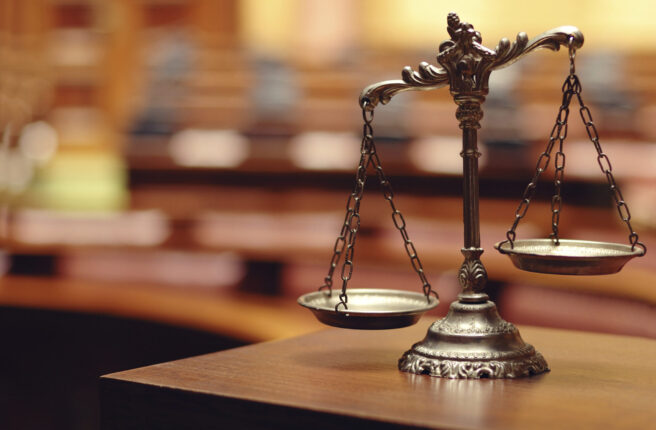
Symbol of law and justice in the empty courtroom, law and justice concept.
So, what do the scales of justice actually mean, and when does a prosecutor commit misconduct in her characterization of them? That was the question addressed by the D.C. Court of Appeals in its recent opinion in Proctor v. United States, 2025 WL 2670802 (D.C. App. 2025).
In Proctor, Gary Proctor was charged with first-degree murder. At trial,
The government, when describing the jury’s duty to weigh the evidence, referred to the scales of justice. Specifically, the prosecutor argued to the jury that it would know that the government had met its burden when the scale “look[ed] like a seesaw,” one “with maybe a ten-year-old on one-end and a two-year-old on the other.”
On appeal, the court found that this was error, albeit harmless, ruling as follows:
The prosecutor’s statement mischaracterized the scales of justice displayed on the courtroom wall, implying that, rather than representing fairness and impartiality, they weighed the government’s proof against that of the defendant, and that the defendant’s case was weaker. The prosecutor’s comments were patently improper. Even so, no substantial prejudice occurred here. Rather, the trial court repeatedly instructed the jury that Mr. Proctor bore no burden to “produce any evidence at all,” admonished them that it was their “duty to accept the law as [the trial court] instruct[ed] [them],” and reminded them that the “statements and the arguments of the lawyers are not evidence.” Further, the prosecutors themselves stated that they bore the burden of proof, and defense counsel in his own argument emphasized the same point. “Given the clarity of these instructions and the ease with which any reasonable person could understand them, [we] think it apropos to invoke here Justice Holmes’ observation for the Court…that it would be absurd to upset a verdict upon a speculation that the jury did not do their duty and follow the instructions of the court.”…Moreover, here “the prosecution case was a formidable one.”…Viewing the prosecutor’s statements, as we must, in the context of the entire case, there is no risk of substantial prejudice.