
The Significance of the Amendment to the Rule Covering Impeachment Via Prior Inconsistent Statements
In December 2024, Federal Rule of Evidence 613(b) was amended as follows:
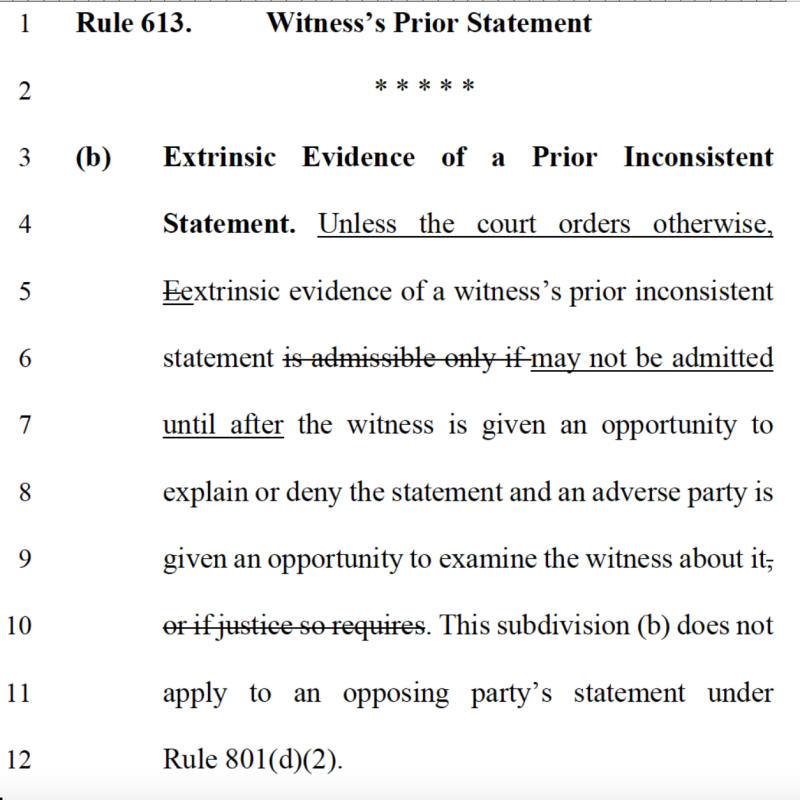
So, what’s the significance of this amendment?
We can explore the significance by looking at two hypotheticals:
Hypothetical 1: The defendant is on trial for a murder in Manhattan. At trial, the defense calls an alibi witness who testifies that she was watching the movie Wicked with the defendant in Brooklyn at the time of the murder. Under the old rule, the prosecution could decide not to initially question the alibi witness about a text message she sent to a friend a week after the murder that she had been at a new bistro on the night of the murder. Instead, the prosecution could wait, call the friend as part of its rebuttal case, and ask her about the text message, as long as the defense had the opportunity to recall the alibi witness and ask her to explain or deny sending the text message.
Hypothetical 2: The defendant is on trial for a murder in Manhattan. At trial, the defense calls an alibi witness who testifies that she was watching the movie Wicked with the defendant in Brooklyn at the time of the murder. Under the old rule, the prosecution could move to have the text message marked as an exhibit and display it to the jury before questioning the alibi witness about it.
The amended rule now makes clear that both of these are improper. Instead, the proper procedure would be for the prosecution to first ask the alibi witness about the text message. If the alibi witness gives an answer such as, “I must have been mistaken when I sent that text message,” the prosecution could then have the text message marked as an exhibit and displayed to the jury.
On the other hand, assume that the alibi witness responds, “My friend asked me what I did last Tuesday. I initially thought that was the night I went to the bistro, which is why I texted that. But then, I realized that was on Wednesday and that I saw Wicked with the defendant on Tuesday when I found the ticket stub for the movie in my pocket when I was doing laundry.” In this case, the judge might deem the text message inadmissible as an exhibit.
The new rule does allow the court to rule otherwise. The Committee Note gives two examples. The first is when the impeaching party didn’t learn about the prior inconsistent statement until after the witness testifies. Imagine that the alibi witness testifies on day 3 of trial, with the friend seeing news coverage of the trial that night and coming forward with the text message to the prosecution the following day. If the alibi witness is unavailable to testify for a few days, the text message might be admissible before the witness is recalled.
The committee comment also notes that the judge can rule otherwise in the event of inadvertence. Imagine that the alibi witness is the last witness on day 3 of trial, and the prosecution rushes through cross-examination, later telling the judge that she forgot to ask about the text message. If the alibi witness is unavailable for a few days, the judge could allow the prosecution to introduce the text message before the alibi witness is recalled.
-CM