
The Significance of the Amendment to the Rule Regarding Statements Against Interest
An amendment to Federal Rule of Evidence 804(b)(3) took effect in December 2024. With this image, we can see the change that was made to this hearsay exception for statements against interest:
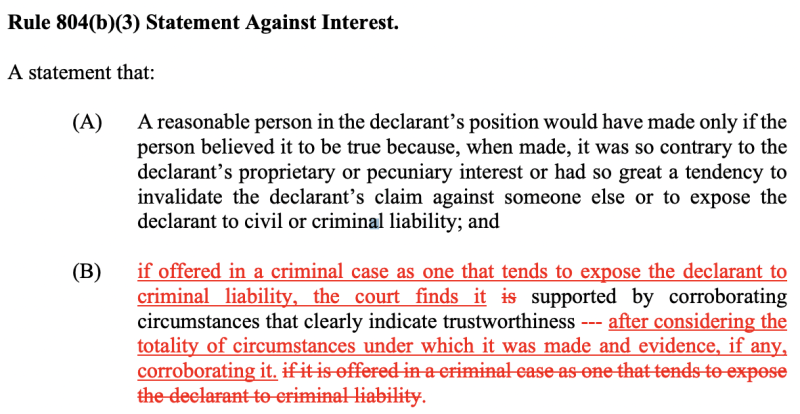
So, what does this change mean, and what prompted it?
Before the amendment, there was a split among jurisdictions over whether courts could only consider the inherent (un)trustworthiness of the statement at issue under Rule 804(b)(3)(B) or whether courts could also consider independent evidence of the statement’s (un)trustworthiness. As this amendment makes clear, courts can now consider both. In certain situations, this will allow statements against interest that were previously inadmissible to be admissible. And, in other situations, this will allow parties to exclude statements against interest that were previously admissible. These two hypothetical help explain what I mean:
Hypothetical 1: The defendant is the head of a gang and charged with murdering a member of a rival gang at his home. Mere days before the defendant’s trial is about to start, an associate in the defendant’s gang, who has a prior perjury conviction, goes to the police and confesses that he’s the one who committed the crime. When the defense ultimately calls the associate at trial, he pleads the Fifth. The defense then moves to introduce the associate’s confession into evidence as a statement against interest under Rule 804(b)(3). Under a jurisdiction that solely considered the inherent trustworthiness of the statement, the confession would almost certainly be deemed inadmissible. The nature of the associate’s relationship with the defendant and the timing of his confession make it seem like his confession was a lie that is being used to try to sow the seeds of doubt with the jury.
Now, however, under the amended rule, it’s clear that the court can also consider independent evidence in assessing the trustworthiness of the confession. So, assume that (1) neighbors say that, shortly before hearing a gunshot coming from the victim’s house, they saw someone entering the house: a redheaded man who was about 6’4”, matching the associate’s physical characteristics; (2) the associate wears size 15 shoes and there was a muddy shoeprint from a size 15 shoe in the victim’s front yard; and (3) multiple witnesses saw a shouting match between the associate and the victim the day before the murder. Now, despite the inherent untrustworthiness of the associate’s confession, you could see the court deeming it admissible under Rule 804(b)(3). So, in certain cases, the new version of the rule will allow in more evidence.
Hypothetical 2: On the other hand, assume that a defendant is charged with murdering a victim at her house. The morning after the murder, a woman with no criminal record, no clear connection with the defendant, and a stable job goes to the local police station. She says she saw a local news segment about the defendant’s arrest and confesses that she is the one who committed the murder and needs to bear her soul now that she’s found religion again. The police officers write off this confession as a lie because they think they’ve arrested the right person. At trial, when the defense calls the confesser, she pleads the Fifth and refuses to testify. In a jurisdiction that used to only consider the inherent trustworthiness of the statement, this statement would likely be admissible under Rule 804(b)(3). The confessor voluntarily made her statement against interest right after the arrest was reported, has no clear motive to lie, and appears to be a trustworthy person.
Again, though, under the amended Rule, courts can clearly consider independent evidence. Assume that (1) neighbors say that, shortly before hearing a gunshot coming from the victim’s house, they saw a woman enter the home: a tall woman with jet black hair, whereas the confessor is 4’11” with blonde hair; (2) there’s a muddy shoeprint in the victim’s yard from a size 7 shoe while the confesser wears a size 4 shoe; and (3) several witnesses saw the confessor at O’Malley’s Pub at the time of the murder. Now, despite the inherent trustworthiness of this other woman’s confession, you could see the court deeming it admissible under Rule 804(b)(3) because it contradicts crime scene evidence and accounts, and the testimony about her presence at the pub rules her out as the shooter. So, in certain cases, the new version of the rule will allow in less evidence.
-CM