
Fourth Circuit Advises District Court to Appoint a Court Expert in “MOKE” v. “MOKE” Trademark Case
Federal Rule of Evidence 706(a) provides that
On a party’s motion or on its own, the court may order the parties to show cause why expert witnesses should not be appointed and may ask the parties to submit nominations. The court may appoint any expert that the parties agree on and any of its own choosing. But the court may only appoint someone who consents to act.
A common refrain among courts is that trial judges have broad discretion over whether to appoint court experts under Rule 706(a), see, e.g., Stevenson v. Windmoeller & Hoelscher Corp., 39 F.4th 466, 470 (7th Cir. 2022), with judges rarely using that discretion to appoint such experts.
I’ve never seen a circuit court advise a district court to exercise its authority under Rule 706(a) before reading the Fourth Circuit’s recent opinion in Moke America LLC v. Moke International Limited, 2025 WL 97411 (4th Cir. 2025).
The Fourth Circuit’s opinion lays out the facts as follows:
The parties to these cross-appeals from the Eastern District of Virginia — on one side, Moke America LLC, and on the other, related entities Moke International Limited and Moke USA, LLC — are competing for the United States trademark rights to the “MOKE” mark adorning the similar low-speed, open-air vehicles that they each sell. Below, for example, is an image of one of their vehicles provided by Moke International and Moke USA to the district court.
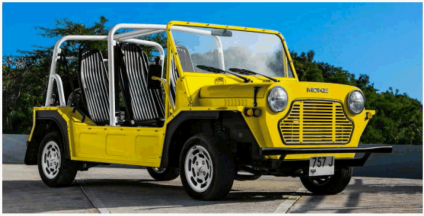
Although the parties are adversaries, their cross-appeals equally contest the district court’s primary finding: that MOKE is a generic term for the parties’ vehicles, meaning that it cannot be a trademark and cannot be owned by either party or anyone else. The court rendered the genericness finding in its Memorandum Opinion of May 3, 2023, setting forth findings of fact and conclusions of law following a truncated bench trial and multiple rounds of post-trial briefing. See Moke Am. LLC v. Am. Custom Golf Cars, Inc., 671 F. Supp. 3d 670 (E.D. Va. 2023) (the “Opinion”). Upon consideration of the genericness finding, we are unable to either affirm or outright reverse it. Simply put, because the issue of genericness emerged only after the trial’s conclusion — and because neither party took the position that MOKE is a generic term or seriously endeavored to prove otherwise — there is a dearth of relevant evidence in the record. Accordingly, we vacate and remand for further proceedings.
In addition to is remand, the Fourth Circuit added the following guidance to the district court:
Because the existing evidentiary record is inadequate to that task, we vacate and remand for further proceedings in which the parties will continue to bear the burden of proving that the MOKE mark is not generic. In light of the absence of any party claiming genericness, we note that it might be helpful to the district court to, e.g., appoint a disinterested expert witness. See Fed. R. Evid. 706. We further note that, if on remand the parties yet again fail to prove non-genericness by a preponderance of the evidence, the court should consider whether it is appropriate to adhere to its finding that MOKE is a generic term, or to stop short of such a finding and thus leave genericness an open question.
-CM