
Court of Appeals of Alaska Finds State Rule of Completeness Trumps the Rule Against Hearsay
Federal Rule of Evidence 106 used to state that
If a party introduces all or part of a statement, an adverse party may require the introduction, at that time, of any other part — or any other statement — that in fairness ought to be considered at the same time. The adverse party may do so over a hearsay objection.
As I noted in a prior post, the rule was amended, effective December 1, 2023, so that it now states that
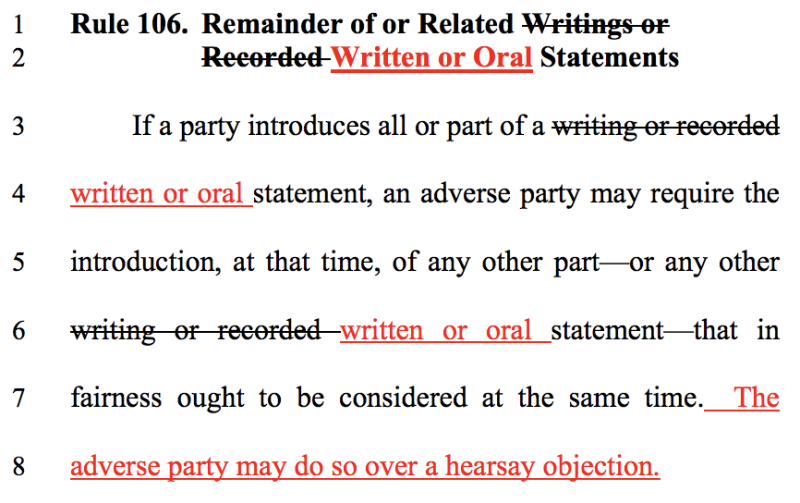
As this last part of the new rule makes clear, the 2023 amendment allows for the admission of statements under this “rule of completeness” even if they constitute hearsay, resolving a prior circuit split. So, assume that Dana texts Felicia, “I killed Victoria last week. She was coming at me with a knife, and I shot her.” If the prosecution called Felicia to testify about Dana’s first line of the text message, the defense could introduce the second line even though it would ordinarily be inadmissible hearsay.
The question now becomes whether states will amend their existing rules to conform with the amended federal rule and/or whether state courts will interpret existing state versions of Rule 106 to conform with the amended federal rule. The first example we have is out of Alaska.
In Steven v. State, 2023 WL 7395907 (Alaska App. 2023), Charlie Willie Steven was convicted of second-degree sexual assault for engaging in sexual penetration with M.F. while knowing she was incapacitated.
In the State’s redacted version of [a] telephone conversation, Steven acknowledged that he had sex with M.F. when she was not sober, and he asked M.F. to forgive him. But in the portions kept from the jury, Steven asserted that, when he asked M.F. that day if she would have sex with him, she “kept saying ya.” This statement placed Steven’s request for forgiveness in context and potentially undermined the State’s proof that M.F. was actually incapacitated or that Steven knew that M.F. was incapacitated.
According to the Court of Appeals of Alaska, even though the portions kept from the jury were inadmissible hearsay, they should have been admissible under Alaska Rule of Evidence. Citing both the federal amendment and prior precedent, the court found that Alaska’s “rule of completeness” allows for the admission of statements that would otherwise constitute inadmissible hearsay.
-CM