
Court of Appeals of Iowa Creates Objective Juror Test for When Racist Jurors Comments Require a New Trial
In Pena-Rodriguez v. Colorado, the Supreme Court held
that where a juror makes a clear statement that indicates he or she relied on racial stereotypes or animus to convict a criminal defendant, the Sixth Amendment requires that the no-impeachment rule give way in order to permit the trial court to consider the evidence of the juror’s statement and any resulting denial of the jury trial guarantee.
In State v. Spates, 2020 WL 6156739 (Iowa App. 2020), an African-American defendant was convicted of murder and related crimes, and it was later discovered that jurors made the following statements during deliberations:
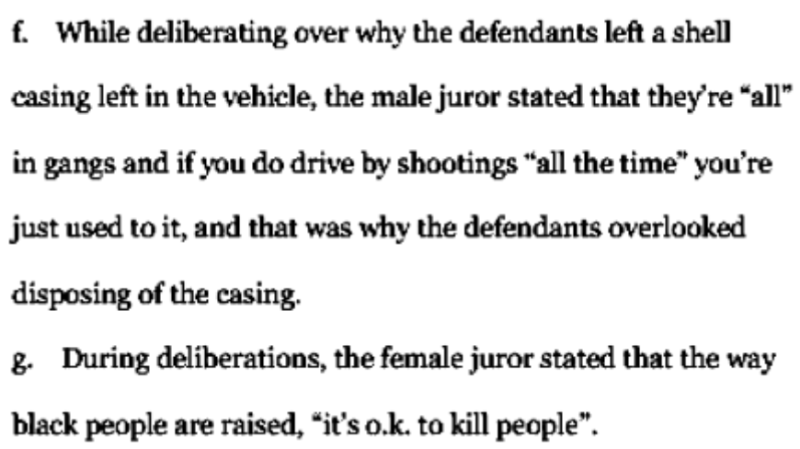
The district court denied the defendant’s motion for a new trial, finding that these statements did not trigger the Constitutional exception contained in Pena-Rodriguez v. Colorado. So, how did the appellate curt rule?
In Spates, the Court of Appeals of Iowa noted that the district court had denied the defendant a new trial because “[e]very juror confirmed that his/her verdict was unaffected by the defendant’s race.” The Court of of Appeals, however, found that this subjective analysis was improper and held that the questions of
whether to receive juror testimony and whether to grant a new trial—should be based on objective circumstances, e.g., what was said; how and when it was said; what was said and done before and after; whether and how the statements relate to evidence in the case; whether and how the statements relate to the issues the jury will decide when reaching a verdict. Conversely, neither determination should depend on the jurors’ subjective evaluations of their own motives—or the motives of other jurors—in voting to convict.
The Court of Appeals then remanded so that the district court could apply this objective test to the juror statements.
I absolutely agree with the Court of Appeals that the test should be objective rather than subjective (“I made racist comments, but race didn’t impact my verdict.”). But I also think this case is a no-brainer. In Pena-Rodriguez v. Colorado, the Supreme Court created the Constitutional exception when jurors submitted affidavits stating that another juror made statements such as, (1) “I think he did it because he’s Mexican and Mexican men take whatever they want;” (2) in his experience, “nine times out of ten Mexican men were guilty of being aggressive toward women and young girls.” Now, Pena-Rodriguez was just about the admissibility of those affidavits, but it seems clear from that the Court’s opinion that a new trial was required. And, when you compare the jury’s statements in Pena-Rodriguez to the jury’s statements in Spates, it seems clear that a new trial s required in the Spates case as well.
-CM
https://www.iowacourts.gov/courtcases/10415/embed/CourtAppealsOpinion