
My Second Post on the Amendment to Federal Rule of Evidence 807, the Residual Hearsay Exception
As noted in a prior post, there is a proposed amendment to Federal Rule of Evidence 807 that would take effect in December 2019. Here’s the beginning of the amended Rule:
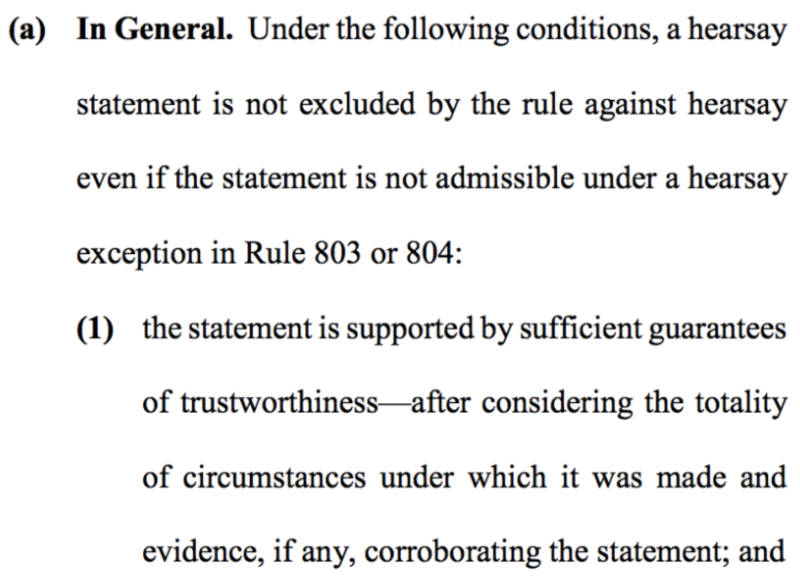
As you can see, the amended Rule specifically tells judges to consider evidence corroborating a hearsay statement offered under the residual exception. So, what does this mean?
According to the Advisory Committee,
Courts are in dispute about whether to consider corroborating evidence in determining whether a statement is trustworthy. The Committee determined that an amendment would be useful to provide uniformity in the approach to evaluating trustworthiness under the residual exception — and substantively, that amendment should specifically allow the court to consider corroborating evidence, because corroboration provides a guarantee of trustworthiness. Thus, trustworthiness can best be defined in the rule as requiring an evaluation of two factors: 1) circumstantial guarantees surrounding the making of the statement, and 2) corroborating evidence. Adding a requirement that the court consider corroboration — or the lack thereof — is an improvement to the rule independent of any decision to expand the residual exception.
So, let’s use a hypothetical to demonstrate the significance of this change:
Defendant is on trial for murder. Defendant seeks to call Nurse to testify that. a week after the stabbing and a week before his death, Victim said that Alternate Suspect stabbed him. The court determines that Victim’s statement does not qualify as a dying declaration because he did not believe his death to be imminent when he made it. There is evidence that (1) Victim was fatally stabbed with a 15 inch knife; (2) Alternate Suspect owns a 15 inch Bowie knife; (3) Witness saw Alternate Suspect on Victim’s street on the night of the murder; and (4) Victim and Alternate Suspect hated each other.
The old version of Rule 807 didn’t specify whether courts could use corroborating evidence such as (1)-(4) is determining whether a statement like Victim’s statement is sufficiently trustworthy to be admissible. As a result, courts split over whether they could use such corroborating evidence. Conversely, the amended Rule specifically tells courts to consider such corroborating evidence. Based on fact patterns like the one above, I think this makes a great deal of sense.
-CM
s