
What Comes Next in the Adnan Syed Case?
So, after yesterday’s opinion by the Court of Appeals of Maryland denying Adnan Syed a new trial, what’s his next option? The next option is a motion for reconsideration under Maryland Rule 8-605. Such a motion must be filed within 30 days of the court’s opinion, and, simply put, it asks the Court of Appeals to reconsider its opinion…with the goal of having the court issue a new or amended opinion. There are six possible grounds for a motion for reconsideration:
(1) whether the Court’s opinion or order did not address a material factual or legal matter raised in the lower court and argued by a party in its submission to the Court, and if not raised or argued, a brief statement as to why it was not raised or argued;
(2) whether a material change in the law relevant to the appeal occurred after the case was submitted and was not addressed in the Court’s opinion or order;
(3) whether the court’s opinion determined the outcome of the appeal on an issue not raised in the briefs or proceedings below;
(4) whether there is a significant consequence of the decision that was not addressed in the opinion;
(5) if the motion or response is filed in the Court of Appeals, whether and how the Court’s opinion or order is in material conflict with a decision of the United States Supreme Court or a decision of the Court of Appeals; or
(6) if the motion or response is filed in the Court of Special Appeals, whether and how the Court’s opinion or order is in material conflict with a decision of the United States Supreme Court or the Court of Appeals or a reported opinion of the Court of Special Appeals.
A motion for reconsideration is a huge long shot…because you’re trying to get the court to admit they made an error. That said, there is one possible ground for such a motion in this case that makes a good deal of sense and another that at least has a chance of succeeding.
(4) whether there is a significant consequence of the decision that was not addressed in the opinion
It seems pretty clear that there is a significant consequence of the decision of the Court of Appeals of Maryland that was not addressed in its opinion. That consequence is the potential of a few more years of Adnan’s postconviction proceeding, entailing costs for the State, the defense, and the courts. Pursuant to Section 7-104 of the Maryland Code of Criminal Procedure,
The court may reopen a postconviction proceeding that was previously concluded if the court determines that the action is in the interests of justice
The Court of Appeals of Maryland has found that ineffective assistance of postconviction counsel is grounds for reopening a postconviction proceeding. Gray v. State, 879 A.2d 1064 (Md. 2005). It’s crystal clear what’s going to happen if the Court of Appeals doesn’t grant a defense motion to reconsider (and the United States Supreme Court doesn’t agree to hear the case):

What’s going to happen is that the defense is going to file a motion to reopen Adnan’s postconviction proceeding based on a claim of ineffective assistance of postconviction counsel. And the defense is going to have a really good argument. After all, both Judge Welch and the Court of Appeals found that the crux of the State’s case against Adnan at trial was the Leakin Park pings:
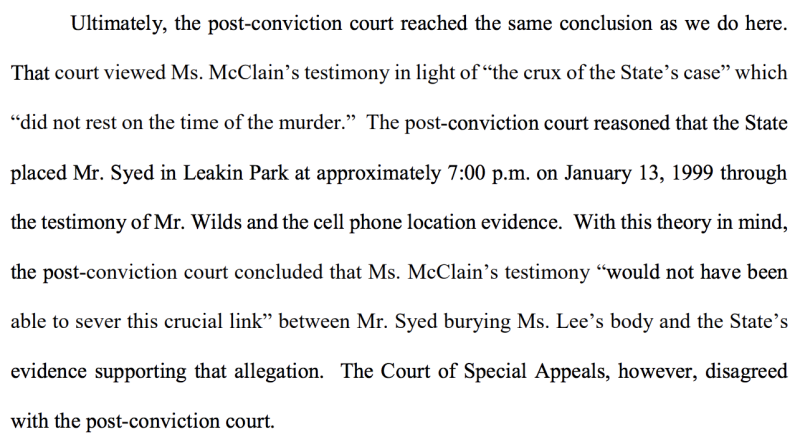
Excerpt from the Court of Appeals’s opinion
In turn, this finding led Judge Welch to conclude that Adnan had received the ineffective assistance of trial counsel based upon his trial attorney’s failure to cross-examine the State’s cell tower expert with the AT&T disclaimer. Neither the Court of Special Appeals nor the Court of Appeals addressed the substance of this ruling because they both held that Adnan had waived this issue when his postconviction counsel failed to include it in his first PCR petition.
And it’s that very finding (plus the finding that the Leakin Park pings were the “crux” of the State’s case against Adnan) that makes a claim of ineffective assistance of postconviction counsel so viable: (1) we have a undisturbed substantive ruling after an evidentiary hearing that Adnan received ineffective assistance of counsel in connection with the AT&T disclaimer (which went to the “crux” of the State’s case); and (2) we have a ruling that Adnan waived this claim because it wasn’t included by his postconviction counsel in his first PCR proceeding (despite the claim going to the crux of the State’s case).
Now, it’s possible that the Court of Appeals of Maryland views this claim as less of a slam dunk than me…but that just means that resolution of this issue would likely take even longer and might even require a new evidentiary hearing.
This would be the argument for the Court of Appeals to grant the defense’s motion to reconsider and either resolve this cell tower issue now or remand it to the Court of Special Appeals to resolve it. Both courts have the power to excuse waiver, and simply resolving the issue now could prevent years of additional litigation and costs to the courts, the State, and the defense.
(5) if the motion or response is filed in the Court of Appeals, whether and how the Court’s opinion or order is in material conflict with a decision of the United States Supreme Court or a decision of the Court of Appeals
As noted above, there was a split in Adnan’s appeal, with the Court of Special Appeals on one side and Judge Welch and the Court of Appeals majority on the other. The Court of Special Appeals held that the “crux” of the State’s case against Adnan was the murder itself; Judge Welch and the Court of Appeals held that the “crux” was instead evidence connected to the Leakin Park pings.
This latter conclusion seems in direct conflict with the Supreme Court’s 2016 opinion in Wearry v. Cain. I wrote about this case in more detail in a prior blog post. The gist of Wearry v. Cain is that there was an alleged Brady violation, with the State having (1) weak evidence that tied the defendant to the actual murder; and (2) stronger evidence tying the defendant to the aftermath of the murder. In finding a Brady violation, the Wearry majority noted that
all of the evidence the dissent cites suggests, at most, that someone in Wearry’s group of friends may have committed the crime, and that Wearry may have been involved in events related to the murder after it occurred. Perhaps, on the basis of this evidence, Louisiana might have charged Wearry as an accessory after the fact….But Louisiana instead charged Wearry with capital murder, and the only evidence directly tying him to that crime was Scott’s dubious testimony, corroborated by the similarly suspect testimony of Brown.
Arguably, the Court of Appeals majority did the same thing by finding that failure to contact Asia McClain was not prejudicial because the “crux” of the State’s case was the Leakin Park pings.
Conclusion
Maryland Rule 8-605(f) tells us that
A motion for reconsideration shall be granted only with the consent of at least half the judges who concurred in the opinion. If a motion for reconsideration is granted, the Court may make a final disposition of the appeal without reargument, restore the appeal to the calendar for argument, or make other orders, including modification or clarification of its opinion, as the Court finds appropriate.
I think it’s exceedingly unlikely the Court of Appeals grants a defense motion to reconsider, but I think ground (4) is likelier to succeed than ground (5) (the defense can argue both).
And then, in the event the court denies the motion for reconsideration, it’s highly likely that the defense will first file a petition for writ of certiorari with the United States Supreme Court, relying heavily on Wearry v. Cain and other pertinent cases. This petition will almost certainly be denied. Second, the defense will likely file a motion to reopen based on a claim on ineffective assistance of postconviction counsel, with this motion almost certainly succeeding. And then, we’ll have litigation stretching into 2020 and 2021, which is why the Court of Appeals should grant a motion for reconsideration. But it probably won’t.
-CM