
The New Route for Adnan Syed Getting a New Trial
On Friday, the Court of Appeals of Maryland issued a 4-3 opinion denying Adnan Syed a new trial. I titled my first post on the opinion “Justice Delayed” because I regard this as a speed bump* on the route to a new trial rather than a road block. In this post, I will lay out my complete reasoning for why I believe that Adnan will eventually get a new trial.
Section 7-103(a) of the Maryland Code of Criminal Procedure states that
For each trial or sentence, a person may file only one petition for relief under this title.
For Adnan, this was the petition for postconviction relief that he filed on May 28, 2010. That said, Section 7-104 of the Maryland Rules of Criminal Procedure states that
The court may reopen a postconviction proceeding that was previously concluded if the court determines that the action is in the interests of justice.
We’ve already seen Section 7-104 in action in Adnan’s postconviction proceeding. On May 18, 2015, the Court of Special Appeals of Maryland remanded Adnan’s case down to the Circuit Court so that Adnan could file a motion to reopen based on the allegation that trial prosecutor Kevin Urick had dissuaded prospective alibi witness Asia McClain from testifying at Adnan’s first postconviction proceeding.
The defense subsequently filed a motion to reopen the alibi issue and a supplement to the motion to reopen asking the Circuit Court to consider a new claim that was not included in Adnan’s first petition for postconviction relief: that trial counsel was ineffective based on failing to use the AT&T disclaimer to cross-examine the State’s cell tower expert. Judge Welch of the Circuit Court subsequently granted the motion to reopen on both the alibi and cell tower issues.
Then, after a five day evidentiary hearing, Judge Welch ruled that:
(1) Adnan had not waived his cell tower claim and had proven ineffective assistance of counsel (deficient performance and prejudice) in connection with the cell tower claim; and
(2) Adnan had established the deficient performance prong of the ineffective assistance/alibi claim but had not proven the prejudice prong.
Subsequently, the Court of Special Appeals ruled that:
(1) Adnan had waived his cell tower claim by not including it in his first petition for postconviction relief (and did not otherwise address the substance of Judge Welch’s cell tower ruling); and
(2) Adnan had proven ineffective assistance of counsel (deficient performance and prejudice) in connection with the alibi claim.
Finally, the Court of Appeals ruled that:
(1) Adnan had waived his cell tower claim by not including it in his first petition for postconviction relief (and did not otherwise address the substance of Judge Welch’s cell tower ruling); and
(2) Adnan had established the deficient performance prong of the ineffective assistance/alibi claim but had not proven the prejudice prong.
As I noted yesterday, this means that the next steps for Adnan are (1) a motion for reconsideration with the Court of Appeals; and (2) a petition for writ of certiorari with the United States Supreme Court, neither of which are likely to be successful.
That then takes us to the third step. As noted, under Section 7-104 of the Maryland Rules of Criminal Procedure, a defendant can file a motion to reopen a postconviction proceeding. One clearly recognized ground for reopening a postconviction proceeding in Maryland is ineffective assistance of postconviction counsel. Indeed, the Court of Special Appeals in Adnan’s case cited Stovall v. State, 800 A.2d 31, 34 (Md.App. 2002) for the proposition “that a defendant may petition to reopen a post[-]conviction proceeding if post[-]conviction counsel was ineffective.”
Stovall v. State was the Maryland case recognizing a claim of ineffective assistance of postconviction counsel, and its test is pretty straightforward:
We hold that a post conviction petitioner (1) is entitled to the effective assistance of post conviction counsel, and (2) has a right to reopen a post conviction proceeding by asserting facts that-if proven to be true at a subsequent hearing-establish that post conviction relief would have been granted but for the ineffective assistance of the petitioner’s post conviction counsel.
What this means is that, for Adnan to be able to reopen his postconviction proceeding and win on a claim of ineffective assistance of postconviction of counsel, he must prove four elements:
(1) his trial counsel rendered deficient performance in connection with the AT&T disclaimer
(2) this deficient performance was prejudicial, i.e., undermines our confidence in the jury’s verdict;
(3) postconviction counsel rendered deficient performance in connection with the cell tower claim by not including it in the first petition for postconviction relief; and
(4) this deficient performance was prejudicial, i.e., Adnan would have won a new trial on the cell tower claim if it had been included in his first petition for postconviction relief.
The judge deciding whether these elements have been proven would usually be Judge Welch or his successor:
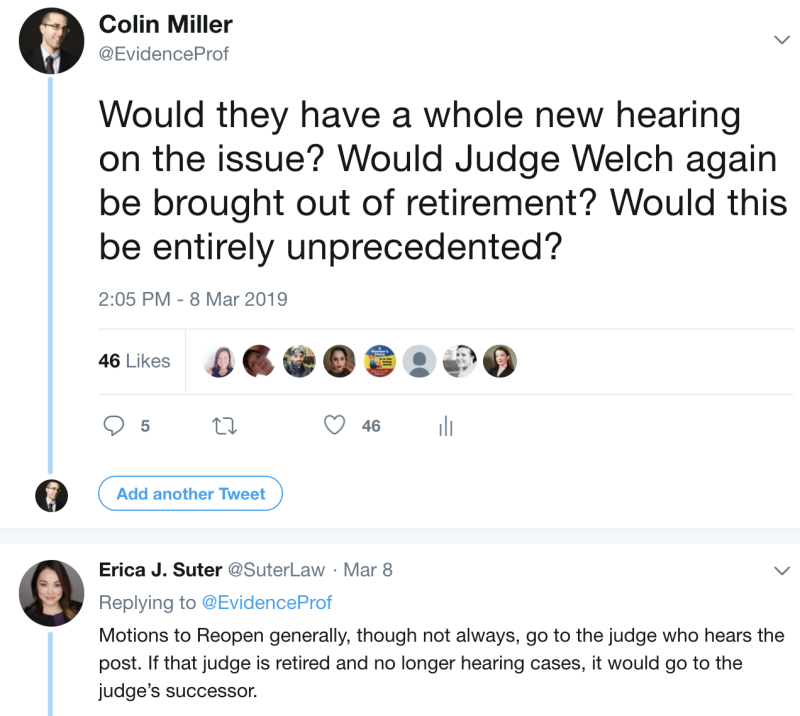
Simply put, elements 1, 2, and 4 should be slam dunks for Adnan. For elements 1 & 2, as noted, after a five day hearing, Judge Welch already concluded that failure to use the AT&T disclaimer was ineffective assistance of trial counsel (deficient performance and prejudice). And, as noted, neither the Court of Special Appeals nor the Court of Appeals disturbed these findings on appeal.
Indeed, Friday’s ruling by the Court of Appeals only strengthened Judge Welch’s findings by agreeing with him that the “crux” of the State’s case centered around the Leakin Park pings:
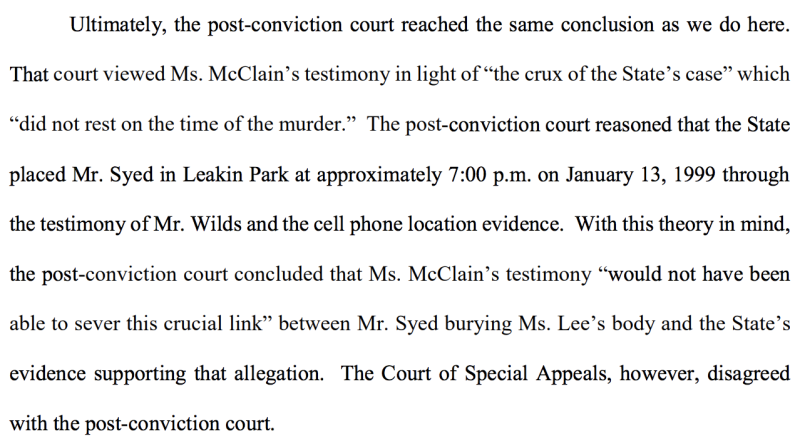
With confirmation that the “crux” of the State’s case was the Leakin Park pings, this makes it even clearer that the failure to use the AT&T disclaimer was (1) deficient performance (“How could you not use evidence that would have undermined the ‘crux’ of the State’s case?”); and (2) prejudicial (“The disclaimer would have undermined the ‘crux’ of the State’s case.”). Moreover, the broad theme of the Court of Appeals’s opinion was deference to Judge Welch, who of course found (1) and (2) in his opinion.
Then… a finding of (1) and (2) also means a finding of (4). Clearly, if Adnan had included the cell tower claim in his first petition for postconviction relief, he would won a new trial because he would have proven ineffective assistance of trial counsel. Again, this finding is bolstered by the Court of Appeals’s ruling and specifically its finding that it was deficient performance not to contact Asia. It seems clear from that court’s ruling that the failure to undermine the Leakin Park pings was prejudicial, and the finding of deficient performance in connection with Asia would also allow for a cumulative prejudice analysis.
This leaves only (3) as a question mark: Was it deficient performance to fail to include the cell tower claim in the first petition for postconviction relief? There doesn’t appear to be any Maryland precedent directly on point, but the opinion of the Court of Special Appeals of Maryland in Stovall did cite to the opinion of the Supreme Court of Nevada in Crump v. Warden, Nevada State Prison, 934 P.2d 247 (Nev. 1997). In Crump, the defendant brought a claim of ineffective assistance of postconviction counsel, alleging that his postconviction counsel “failed to raise all available issues in his first petition and that this constitutes ineffective assistance of counsel.”
The Supreme Court of Nevada acknowledged that this was a possible winning claim and “remand[ed] this matter to the district court for an evidentiary hearing to determine whether [counsel]’s omissions constitute ineffective assistance of counsel.”
In Adnan’s case, however, it seems like we already have findings by Judge Welch on this issue:
The disclaimer and the subject page were found in trial counsel’s file, and the State disclosed these documents as part of pretrial discovery and conveyed its intention to introduce these records at trial.
More importantly, Petitioner was never advised that trial counsel may have been ineffective for her alleged failure to challenge the State’s cell tower expert at trial with the disclaimer in prior proceedings.
In fact, Petitioner’s counsel for the postconviction proceedings did not advise Petitioner about the issue until shortly before August 24, 2015, when counsel consulted with a cell tower expert about the potential ramifications of the disclaimer.1
Since Petitioner did not know about the potential implications of trial counsel’s failure to challenge the cell tower evidence, he could not have knowingly waived his right to raise the allegation.
The record also shows that at Petitioner never completed his high school education.
Requiring a layman who lacks a complete high school education to understand the intricacies of cellular network design and the legal ramifications of trial counsel’s failures to challenge the evidence would be inconsistent with the spirit of the Sixth Amendment.
Moreover, Adnan’s postconviction counsel has ostensibly indicated that he would encourage and support a claim of ineffective assistance of postconviction counsel:
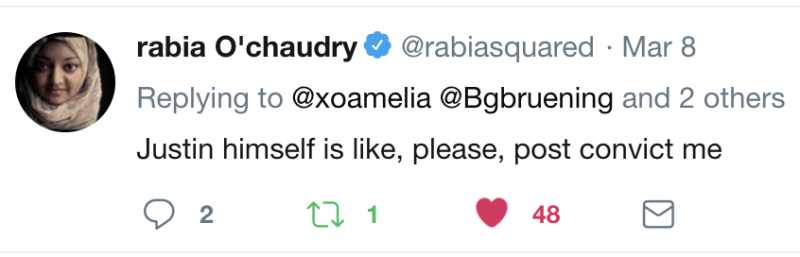
Therefore, it seems like there’s a really good chance that Adnan could establish element (3).
Now, none of this is to say that anything is guaranteed, as shown by Friday’s ruling. But Friday’s ruling also makes clear that the Court of Appeals of Maryland denied Adnan relief on the alibi issue because (1) the “crux” of the State’s case was the Leakin Park pings; and (2) Adnan have waived the winning but complicated claim that was directly related to those pings because his postconviction counsel didn’t inform him of this claim until 2015. That ruling thus provides a pretty clear roadmap to relief. Stay tuned…
______________________
*Albeit a lengthy and costly speed bump.
-CM