
My Second Post on the Oral Arguments in the Adnan Syed Case
Yesterday, there were oral arguments in the Adnan Syed case in the Court of Appeals of Maryland (Maryland’s highest court). The primary focus during those arguments was on the issue of whether Adnan received ineffective assistance of counsel based on his trial counsel’s failure to contact prospective alibi witness Asia McClain. As I noted yesterday, there are two prongs that a defendant must prove to establish a claim of ineffective assistance of counsel: (1) trial counsel rendered deficient performanceprejudicial, i.e, undermines confidence in the jury’s verdict. Yesterday’s post dealt with the prejudice prong. This post will start to deal with the deficient performance prong.
During oral arguments, the attorney for the State — Thiru Vignarajah — placed huge emphasis on a Supreme Court opinion to support his argument, but it wasn’t Cullen v. Pinholster, the opinion I expected. Instead, it was Burt v. Titlow.
First, here is the reason I was surprised. In her dissenting opinion in support of the State, Court of Special Appeals Judge Kathryn Graeff placed heavy emphasis on Cullen v. Pinholster, and the State in turn placed Pinholster at the center of its briefs to the Court of Appeals. But it was Burt that took center stage at oral arguments.
Second, what are the facts of Burt? Vonlee Nicole Titlow and her aunt, Billie Rogers, allegedly “murdered Billie’s husband Don by pouring vodka down his throat and smothering him with a pillow.” Subsequently, Titlow and her first attorney, Richard Lustig, secured a plea deal pursuant to which she would plead guilty to manslaughter and receive a 7-15 year sentence in exchange for her testimony against Rogers.
Subsequently, however, Titlow retained a new lawyer, Frederick Toca, and demanded a lower sentence under the plea bargain. When the prosecutor refused to agree to a lower sentence, Titlow withdrew her plea, stood trial, and was convicted.

Vonlee Nicole Titlow
Third, what was the claim of ineffective assistance of counsel in the case? Titlow claimed
that Toca advised withdrawal of the guilty plea without taking time to learn more about the case, thereby failing to realize the strength of the State’s evidence and providing ineffective assistance of counsel. Rejecting that claim, the Michigan Court of Appeals found that Toca acted reasonably in light of his client’s protestations of innocence. That court found that [Titlow]’s decision to hire Toca was “set in motion” by [Titlow]’s “statement to a sheriff’s deputy that [Titlowt] did not commit the offense.”…Applying the standard set forth by our decision in Strickland, which requires that defense counsel satisfy “an objective standard of reasonableness,”…the Michigan Court of Appeals concluded that “[w]hen a defendant proclaims…innocence…, it is not objectively unreasonable to recommend that the defendant refrain from pleading guilty — no matter how ‘good’ the deal may appear.”
Titlow subsequently appealed this state court ruling in federal court under the infamous Antiterrorism and Effective Death Penalty Act of 1996 (AEDPA).
Fourth, why was the State extensively citing this opinion during opening arguments? Here is the opening paragraph of the Supreme Court’s opinion:
When a state prisoner asks a federal court to set aside a sentence due to ineffective assistance of counsel during plea bargaining, our cases require that the federal court use a “‘doubly deferential'” standard of review that gives both the state court and the defense attorney the benefit of the doubt. Cullen v. Pinholster…In this case, the Sixth Circuit failed to apply that doubly deferential standard by refusing to credit a state court’s reasonable factual finding and by assuming that counsel was ineffective where the record was silent. Because the Antiterrorism and Effective Death Penalty Act of 1996 (AEDPA)…and Strickland v. Washington…do not permit federal judges to so casually second-guess the decisions of their state-court colleagues or defense attorneys, the Sixth Circuit’s decision must be reversed (emphasis added).
The State focused on the highlighted sentence from this paragraph, noting that the record in this case is similarly silent about whether trial counsel Cristina Gutierrez contacted prospective alibi witness Asia McClain. According to the State, then, the “silent record” in Adnan’s case also means that he can’t establish that he received the ineffective assistance of counsel.
But this first paragraph from Burt also reveals the fatal flaw with the State’s reliance on both Burt and Cullen v. Pinholster. As you can see from the above quote, the Burt Court found that the “silent record” meant that Titlow couldn’t satisfy the “doubly deferential” standard of review that applied to both the state court’s ruling and defense attorney’s actions. As support for this claim, the Court cited to its own prior opinion in Cullen v. Pinholster, which I previously discussed in this blog post.
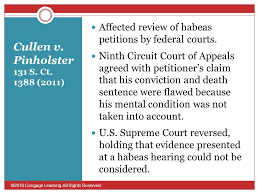
Cullen v. Pinholster was another case in which a defendant asked a federal court to review a state court‘s rejection of a claim of ineffective assistance of counsel under the AEDPA. And, as in Burt, the Court denied the appeal by applying the “doubly deferential” standard. Notably, the United States Court of Appeals for the Ninth Circuit actually ruled in favor of the defendant, finding his case “materially indistinguishable” form two prior Supreme Court cases: Williams v. Taylor and Rompilla v. Beard. But the Cullen Court turned this argument aside, concluding that “this Court did not apply AEDPA deference to the question of prejudice in those cases; each of them lack the important ‘doubly deferential’ standard of Strickland and AEDPA.”
Simply put, this is HUGE. In Cullen, the Supreme Court recognized that there are two separate strands of ineffective assistance of counsel precedent: (1) standard ineffective assistance of counsel cases; and (2) AEDPA ineffective assistance of counsel cases involving the “doubly deferential” standard. This is HUGE because Adnan’s case is NOT an AEDPA case. He is arguing in Maryland state court that he received the ineffective assistance of counsel; he is NOT arguing in federal court that the Maryland state courts improperly denied his claim of ineffective assistance of counsel. Therefore, Burt and Cullen should have little to no bearing on his case; indeed, the Cullen Court impliedly acknowledged that it might have granted the defendant relief if it were not an AEDPA case.
Fifth, there’s an interesting interplay between Burt and Adnan’s case that seemingly helps Adnan. Why did the Michigan Court of Appeals rule against Titlow? That court concluded that “[w]hen a defendant proclaims…innocence…, it is not objectively unreasonable to recommend that the defendant refrain from pleading guilty — no matter how ‘good’ the deal may appear.” This is interesting because we have something similar in Adnan’s case. You might recall that Adnan had three claims of ineffective assistance in this case, which related to trial counsel’s (1) failure to contact Asia McClain; (2) failure to use the AT&T disclaimer to cross-examine the State’s cell tower expert; AND (3) failure to ask about a plea deal.
In rejecting this third claim, the Court of Special Appeals of Maryland noted that Adnan has maintained his innocence all these years, which meant that it was not unreasonable for trial counsel to fail to ask about a plea deal. Is it a per se rule that counsel can never render ineffective assistance of counsel in connection with a plea deal when a client maintains his innocence? No, but that’s the presumption, and the defendant in Burt wasn’t able to overcome it based on the silent record.
This ties into the supposed dispute between the State and the defense in the Adnan Syed case, with the State claiming that the defense is arguing that failure to contact an alibi witness is per se unreasonable and the defense responding that it’s not asking for a per se rule. I read the defense as making something like the converse of the Burt approach:* When a defendant informs trial counsel about a prospective alibi witness, the presumption is that trial counsel has a duty to contact that witness. This isn’t an irrebuttable presumption, but it’s the baseline presumption and it will stand in the absence of contrary evidence by the State. It will also stand in the face of a “silent record.”

This takes us to the sixth and final point, which is that the defense argued rather convincingly in this case that this is not a “silent record” case. Instead, (1) Adnan has testified that he told his trial counsel about Asia McClain and asked her to contact Asia and check for security camera footage at the library; (2) we have defense notes indicating that trial counsel was made aware of Asia McClain, the general timeframe of her alibi, the existence of two other possible alibi witnesses, and the existence of possible security camera footage from the library; (3) we have a finding (accepted by the State during oral arguments) that trial counsel did not contact Asia McClain; (4) Adnan has testified that trial counsel told him that she looked into Asia McClain and the security cameras and that “nothing came of it;” and (5) Adnan has testified that, after Rabia gave him Asia’s initial affidavit, he contacted trial counsel, who admitted that she neither contacted Asia McClain nor looked for the security camera footage.
Simply put, that’s not a silent record. If you believe (1)-(6), you believe that trial counsel was told about Asia McClain, failed to contact her, told her client that nothing came of her alibi, and later admitted that she failed to contact her. Now, you might or might not believe some or all of (1)-(6), but that’s a separate issue from the issue of whether the record is silent. It’s not. And that’s another reason why in Burt is irrelevant.
_______________________
*I also think that this is the position advanced in the amici curiae (friend of the court) brief in this case written by Steven Klepper (@MdAppeal).