
My First Take on the State’s New Brief in the Adnan Syed Case
Today, the State filed its Reply Brief of Petitioner/Cross-Respondent in the Adnan Syed case. This will likely the penultimate brief in this case before oral arguments are held in the Court of Appeals of Maryland on November 29th. In this post, I will quickly address the State’s claim that the defense is trying to pull a bait-and-switch on the court.
According to the State:
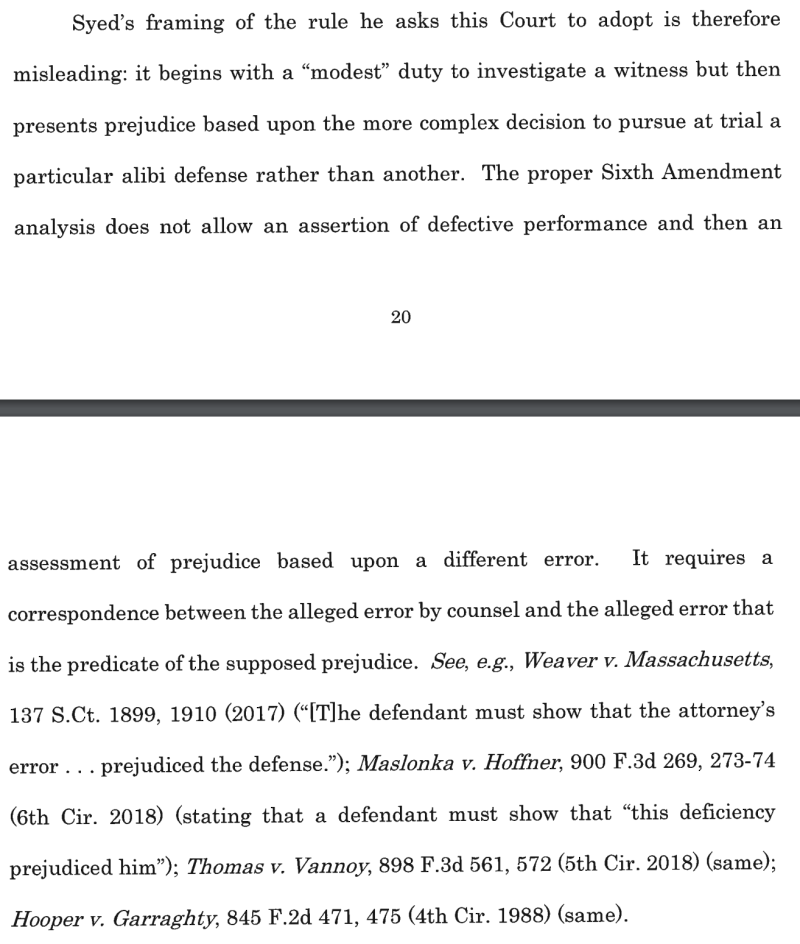
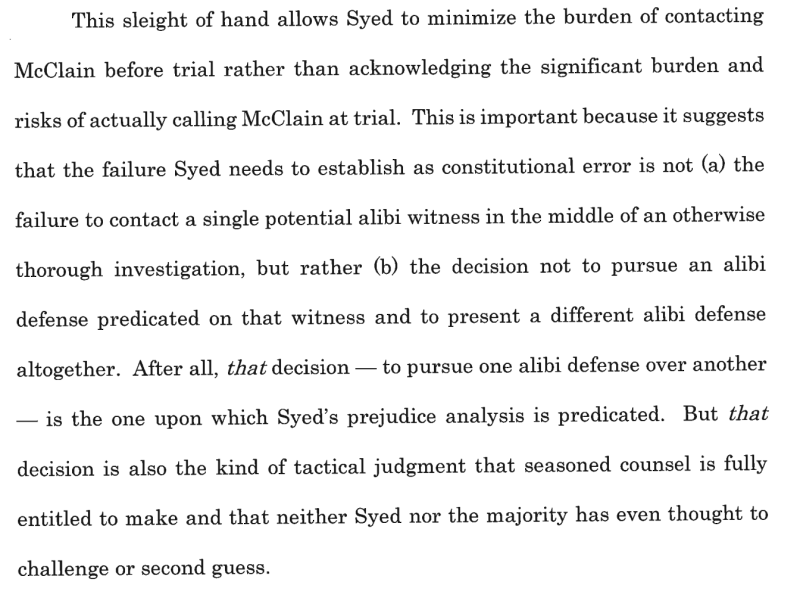
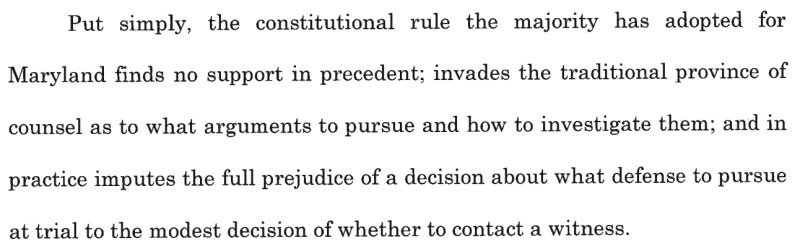
The State’s argument is easy enough to explain: There are two prongs to an ineffective assistance of counsel claim: (1) the deficient performance prong; and (2) the prejudice prong. The State is claiming that (1) the defense’s bait is to claim that Cristina Gutierrez was deficient because she merely had to pick up the phone and call alibi witness Asia McClain; and (2) the defense‘s switch is then to claim that Adnan Syed was prejudiced based upon Gutierrez’s failure to use Asia McClain as an alibi witness at trial. In other words, the State is claiming that contacting Asia McClain wouldn’t have necessarily led to Gutierrez calling her at trial.
But, just as the State’s argument is easy enough to explain, it is easy enough to refute. And that’s because what the State claims was a bait-and-switch is exactly how every court had handled an ineffective assistance claim based on failure to contact an alibi witness. For example consider, Griffin v. Warden, Maryland Correctional Adjustment Center, 970 F.2d 1355 (4th Cir. 1992), a case originating out of the Baltimore City Circuit Court (like the Adnan Syed case). This is the case in which defense counsel failed to contact alibi witnesses in a Rite-Aid robbery case.
After finding deficient performance in failure to contact, the Fourth Circuit proceeded to find prejudice because the eyewitness testimony in the case was “precisely the sort of evidence that an alibi defense refutes best.” In other words, the Fourth Circuit assumed that if trial counsel had contacted these alibi witnesses, he would have called them at trial. And this is the exact same reasoning that every court addressing this issue has used.
The State makes the unsupported assertion that the defense’s reasoning “finds no support in the precedent.” And yet, the defense has cited double digit cases using this exact reasoning, which, of course, makes complete sense because if you have a good alibi witness, you call her. Conversely, the State cites no precedent where a court has used different reasoning…and that’s because no such precedent exists. As the defense has repeatedly argued, when trial attorneys fail to contact alibi witnesses, courts always find prejudice because our confidence in the jury’s verdict is undermined.
I’m nearly certain that the justices of the Court of Appeals will ask the State for any precedent for its many assertions about ineffective assistance and alibi witnesses…and I’ve yet to see the State cite a single case that fills the bill.
-CM