
Legal Bombshell: My First Take on Adnan’s Appellate Brief
Today, Justin Brown filed the defense’s Brief of Appellee/Cross-Appellant in the Adnan Syed case. As was the case with the State’s Brief of Appellant, I will do a series of posts about this brief.
This first post deals with what I see as the biggest legal bombshell in the defense brief. Let’s start with the basics. Judge Welch found that Adnan received the ineffective assistance of counsel because (1) his trial counsel unreasonably failed to use the AT&T disclaimer to cross-examine the State’s cell tower expert; and (2) this error was prejudicial, i.e., undermined Judge Welch’s confidence in the jury’s verdict.
In it’s Brief of Appellant, the State’s very first argument regarding prejudice went as follows:
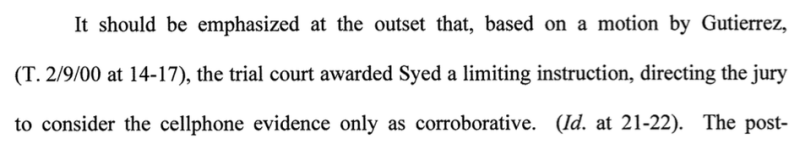
This argument is correct. Here is some of the pertinent discussion of the issue between the judge and prosecutor Kevin Urick at trial:
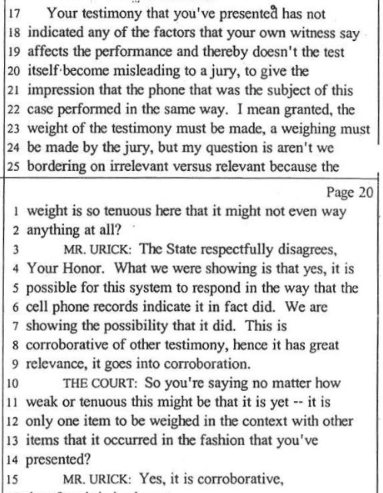
Based upon this colloquy, the judge asked both the prosecution and defense to craft their preferred versions of a limiting instruction that she would give to the jury at the close of the case:
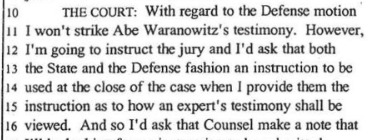
So, what’s a limiting instruction? Maryland Rule of Evidence 5-105 states that
When evidence is admitted that is admissible as to one party or for one purpose but not admissible as to another party or for another purpose, the court, upon request, shall restrict the evidence to its proper scope and instruct the jury accordingly.
In this case, then, a limiting instruction would have communicated to the jury that the testimony of the State’s cell tower expert was only admissible to corroborate Jay and not admissible as independent evidence regarding (1) the (possible) location of Adnan’s cell phone; and/or (2) Adnan’s guilt. Cf. State v. Bethea, 585 A.2d 1235, 1238 (Conn.App. 1991) (“[T]he court must give limiting instructions to explain that the evidence is not offered to prove the truth of the matter asserted but only to corroborate and accredit the prior testimony of the victim.”).
This then takes us to the bombshell in the Brief of Appellee/Cross-Appellant: The jury at Adnan’s trial was never given such a limiting instruction:
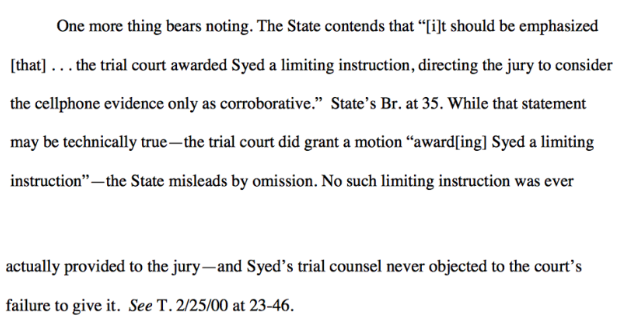
Simply put, this is huge. The judge explicitly recognized that the cell tower expert’s testimony about the location of Adnan’s cell phone was tenuous and had the capacity to mislead the jury; therefore, she allowed the State to admit it with the understanding that the jury would be specifically instructed that the testimony was only evidence to corroborate Jay and not independent evidence of Adnan’s guilt or the location of the phone.
But then…the judge never gave such an instruction, and the defense never objected to this failure.* Therefore, there is every reason to believe that the jury did consider the cell expert’s testimony as independent evidence of Adnan’s guilt and the location of his cell phone. Given this, it’s pretty hard to see the Court of Special Appeals reversing Judge Welch’s prejudice conclusion.
I also think, though, that this issue has strong bearing on the “unreasonable performance” prong of the ineffective assistance test. Given the importance of the cell tower pings, which Judge Welch determined to be “the crux” of the State’s case against Adnan, how in the world did trial counsel drop the ball on the limiting instruction? That instruction was as important as the AT&T disclaimer, if not more important, and yet trial counsel somehow failed to make sure it was given at the close of the case.
The best analogy I can draw is to a case out of the Fourth Circuit (the federal circuit that covers Maryland) that I use in my Criminal Adjudication class: United States v. Luck, 611 F.3d 183 (4th Cir. 2010), in which defense counsel failed to request an “informant instruction” regarding the unreliability of informant testimony. In finding ineffective assistance, the Fourth Circuit concluded that
there is no indication that failing to request the instruction had any root in trial strategy. Luck’s counsel cross-examined both Thompkins and Johnson about the consideration they received from the government for their investigation and testimony. In general, Luck’s counsel’s defense strategy seems to be focused on discrediting the government’s witnesses, rather than offering his own explanation of the events. Thus, were we to hold that failing to complete the strategy and request an informant instruction was a tactical decision by counsel, we would “conjure up [a] tactical decision[ ] an attorney could have made, but plainly did not.” Griffin v. Warden, 970 F.2d 1355, 1358 (4th Cir.1992)
_____________________
*I don’t know whether the defense ever submitted her preferred version of the limiting instruction.
-CM