
The State Missed a Hugely Important Case in its Brief in the Adnan Syed Case
In my opinion, the State’s best chance at winning it’s appeal on the ineffective assistance/cell tower issue is the argument that Adnan waived his claim on this issue by not bringing it within the 10 year statute of limitations. In its Brief of Appellant, however, the State has ignored a hugely important opinion of the Court of Appeals of Maryland on the issue.
In his opinion granting Adnan a new trial, Judge Welch found that Adnan had not waived his ineffective assistance/cell tower claim by applying the opinion of the Court of Appeals of Maryland Curtis v. State, 284 Md. 132 (1978). In Curtis, Maryland’s highest court held that (1) fundamental rights require “knowing and intelligent waiver;” (2) the right to counsel is a fundamental right; and (3) Curtis did not knowingly and intelligently waive his claim of ineffective assistance of counsel.
In its brief, the State raises a number of arguments to try to distinguish Adnan’s case from Curtis, including:
1. Curtis claimed total abandonment by counsel while Adnan was not entirely abandoned and only claims specific errors;
2. Curtis was decided when a defendant could bring unlimited postconviction petitions whereas Adnan’s trial and appeals took place after defendants were limited to one PCR petition in 1995;
3. Curtis had a 72 IQ and a 7th grade education whereas Adnan was a high school senior who had done relatively well in school; and
4. The issue that could have been waived in Curtis required a colloquy in open court, unlike the cell tower issue in Adnan’s case.
Moreover, the State repeatedly makes the claim that the “knowing and intelligent” waiver conclusion from Curtis has not been applied in another ineffective assistance of counsel case in the thirty-nine years since it was decided:
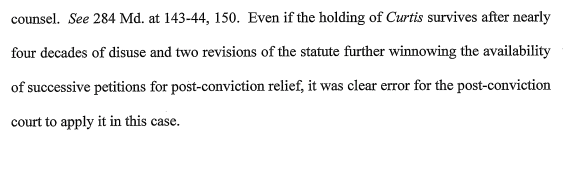
In its analysis, however, the State missed a key case: State v. Adams, 958 A.2d 295 (Md. 2008). I talked about it in this post. In Adams, the defendant failed to make an ineffective assistance of counsel claim in his PCR petition, but he was subsequently allowed to bring his ineffective assistance claim because he had not “knowingly and intelligently” waived that claim under Curtis. Moreover,
1. Adams did not claim total abandonment by counsel; instead, he claimed ineffective assistance based on failure to challenge a jury instruction;
2. Adams was decided (in 2008) after defendants were limited to one PCR petition;
3. The court made no mention of Adams’ education level or IQ in reaching its decision; and
4. The issue that could have been waived in Adams did not require a colloquy in open court.
In other words, Adams both (1) refutes the State’s claim that Curtis hasn’t subsequently been applied to ineffective assistance claims; and (2) provides a factual context that is very similar to the factual context in the Adnan Syed case. It will be interesting to see the extent to which the defense uses Adams in its brief and the extent to which it is discussed during oral argument.
-CM