
The State’s Response to Motion for Release in the Adnan Syed Case is Fundamentally Flawed
Today, the State filed its Response to Motion for Release in the Adnan Syed case. As Justin Fenton notes, the Motion makes clear that Charlton Howard, a retired NCIS special agent, has taken over for Thiru Vignarajah. Unfortunately for the State, a one minute glance at the Response makes clear that it is fundamentally flawed.
Adnan’s Motion for Release Pending Appeal was primarily premised upon evidence that has destroyed the “crux” of the State’s case, such as the AT&T disclaimer, Jay’s criminal history and Intercept interview, and the lividity evidence. In turn, the heart of the the State’s response is as follows:
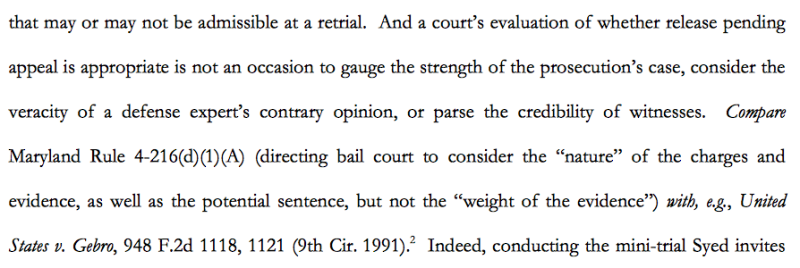
In other words, according to the State, the judge is only supposed to assess the nature of the charges and the potential sentence and isn’t supposed to assess the weight of the evidence under Maryland Rule 4-216(d)(1)(A). First, the State’s citation is incorrect. There is no Maryland Rule 4-216(d)(1)(A). Ostensibly, the State was trying to cite to Maryland Rule 4-216(e)(1)(A). Second, here is what that Rule states:

So, in determining whether to release a defendant, the judge is supposed to assess not only the “nature and circumstances of the offense charged” and the “potential sentence upon conviction,” but also “the nature of the evidence against the defendant.” (emphasis added). This is the exact same thing as assessing the “weight of the evidence against the defendant.” [Edited to add: The two phrases are interchangeable in the bail context. See, e.g., United States v. Burdette, 813 F.Supp.2d 1, 4 (D.D.C. 2011) (“Furthermore, the weight of the government’s evidence against defendant is strong. And given the nature of that evidence, the Court finds that defendant’s release would pose a significant danger to a particularly vulnerable segment of the community—children.”).].
-CM