
Contrary to the State’s Claim, Adnan Does Not Remain a Convicted Murderer & Kidnapper
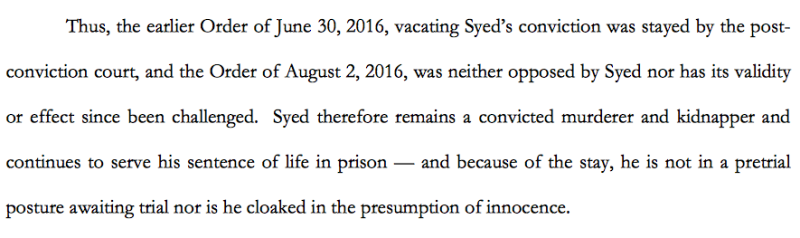
This is one of the more troubling contentions in the State’s Response to Motion for Release in the Adnan Syed case, and the State backs the contention up with no citations to any statutes or case law.* Perhaps this is because it is clear that Adnan’s convictions have been vacated and that he is cloaked in the presumption of innocence.
Let’s start with the basics. On June 30, 2016, Judge Welch entered an order vacating Adnan’s convictions and granting Adnan a new trial based upon his corresponding opinion concluding that Adnan received Constitutionally ineffective assistance of trial. Pursuant to Maryland Code of Criminal Procedure Section 7-109(b)(2),
(2) If the Attorney General or a State’s Attorney states an intention to file an application for an appeal under this section, the court may:
(i) stay the order; and
(ii) set bail for the petitioner.
Thereafter,
on July 21, 2016, the State notified the Court of its intention to file an application for leave to appeal and requested, pursuant to Section 7-109(b)(2) of the Criminal Procedure Article of the Maryland Code, that the Court “stay its order vacating Petitioner’s convictions and granting Petitioner’s request for a new trial, pending further resolution of these matters by the Court of Special Appeals.”
Subsequently,
On August 2, 2016 (the day after the State filed its application for leave to appeal), the post-conviction court granted the State’s request for a stay.
In its Response, the State is contending that this stay means that Adnan remains a convicted murderer and kidnapper. This fundamentally misunderstands the effect of a judicial stay. In Weston Builders & Developers, Inc. v. McBerry, LLC, 891 A.2d 430, 442 (Md.App. 2006), the Court of Special Appeals of Maryland noted that
Most emphatically for present purposes, a “stay” does not trigger a universal freeze of the status quo.
A judgment, the enforcement of which may be subjected to a stay, is a court decision in favor of a party, generally the plaintiff, entitling that party to a very particular form of relief, such as a money judgment, the foreclosure of a mortgage, the appointment of a trustee to make a judicial sale. The prevailing party, in order to enjoy the benefit of that judgment, sometimes requires some further order of the court, by way of directing a clerk or a trustee or a sheriff to enforce or execute on the judgment. Such officially ordered actions are the subject matter of stays of enforcement of or execution upon a judgment.
Furthermore, that same court concluded in Nnoli v. Nnoli, 646 A.2d 1021, 1024 (Md.App. 1994), that a “stay does not necessarily suspend every aspect of the pending suit.”
This is where Section 7-109(b)(2) comes into play. Judge Welch (1) vacated Adnan’s convictions; and (2) granted him a new trial. The “stay” that Judge Welch entered does not alter his order vacating Adnan’s convictions; it merely suspends the order granting him a new trial.
As an analogy, consider a typical breach of contract case: Pam sues Dana for breach of contract, and the jury finds that Dana breached the contract and awards Pam $50,000 in damages. In response, Dana appeals and successfully asks the court to stay execution of the damages award pending her appeal. The “stay” does not disturb the jury’s decision that Dana breached the contract; instead, it just delays Dana’s obligation to pay damages until after the resolution of her appeal.
Moreover, as noted in Nnoli, a “stay does not necessarily suspend every aspect of the pending suit.” This is clearly the case with the stay of Judge Welch’s order. Like Dana in the breach of contract case, the State has used a “stay” to delay its obligations pending appeal, such as its compliance with the requirement that it provide Adnan with a speedy (re)trial.
That said, the “stay” did not suspend every aspect of the case. One of the consequences of a court vacating a defendant’s conviction(s) is that the defendant is eligible for bail. And, as Section 7-109(b)(2) makes clear, a “stay” does not suspend this eligibility because it specifically says that, after entering a “stay,” the court may “set bail for the petitioner.”
This, of course, would be impossible if the “stay” disturbed Judge Welch’s order vacating Adnan’s convictions. If, as the State claims, “Syed remains a convicted murder and kidnapper,” he would not be eligible for bail. But he’s no longer a convicted murderer and kidnapper. The “stay” only alters the State’s obligations in connection with a new trial. It does not alter the order vacating Adnan’s convictions and his concomitant eligibility for bail.
______________________
*Indeed, the Response cites no Maryland case law at all.
-CM