
Maryland State’s Attorneys Pound the Table in Amici Brief in Adnan Syed Case
On September 15th, the National Association of Criminal Defense Lawyers and the Maryland Criminal Defense Attorneys’ Association filed an amici curiae (friend of the court) brief written by Steven M. Klepper in the Adnan Syed case. The brief cited
-Statistics on the percentage of cases in which the Court of Special Appeals (COSA) granted Applications for Leave to Appeal (ALAs) (0-5% annually);
-A Maryland Appellate Practice Manual on how COSA should assess ALAs (Sandler & Levy, APPELLATE PRACTICE FOR THE MARYLAND LAWYER: STATE AND FEDERAL 307 (4th ed. 2014));
-A law review article by a Ninth Circuit Judge on the difficulty of getting federal habeas relief if an appeal fails at the state level (Hon. Alex Kozinski, Criminal Law 2.0, 44 GEO. L.J. ANN. REV. CRIM. PROC. iii, xli (2015));
-Five opinions by the Court of Appeals of Maryland and COSA (State v. Adams-Bey, __ Md. __ (2016), slip op. at 7–12; Jones v. State, 445 Md. 324, 358 (2015); State v. Potter, No. 1309/13 (Md. Ct. Spec. App. Aug. 4, 2016); Stachowski v State, 416 Md. 276, 298 (2010); In re Maria C., 294 Md. 538, 538–41 (1982); and
-Two rules to explain how COSA should treat the State’s § 7-109 application (Fed. R. App. P. 22(b)(3); Rule 8-204(b)(3)).
Today, various Maryland State’s Attorneys filed an amici curiae brief in support of the State’s Application for Leave to Appeal. So, what did they cite in their brief?
Nothing. No statistics. No practice manuals. No law review articles. No court opinions. No rules to explain how COSA should treat the State’s § 7-109 application.
Instead, the brief makes two arguments. The first is that COSA should grant leave to appeal because of the “crushing” evidence of Adnan’s guilt. According to the brief, one part of this “crushing” evidence was the fact that
Of course, the problem with this argument is that it bolsters Adnan’s claim that trial counsel’s failure to use the AT&T disclaimer was prejudicial and requires a new trial. And that’s because the other evidence cited in the brief isn’t nearly as strong as the State’s Attorneys claim it to be. For instance, according to the brief, another part of this “crushing” evidence was that, among the witnesses who place Adnan and Jay together on January 13th,
What the State’s Attorneys ostensibly don’t realize is that this “fact” very much hurts the State’s case. Jenn said that she saw Adnan when he dropped Jay off at the parking lot of the night of January 13th, followed by Jay disposing of the items used in the burial. Jay, meanwhile says that Adnan dropped him off at his house without Jenn present, with Jay not disposing of the items used in the burial until the next day. That’s a huge contradiction and unlikely to be one that was innocently made.
This, of course, was Judge Welch’s point in saying that the Leakin Park pings were the crux of the State’s case: It was the only part of Jay’s story that was corroborated rather than contradicted.
The brief‘s second argument is that Judge Welch “twist[ed] procedural rules” and “misappl[ied] substantive” law, impliedly due to Serial and its aftermath. According to the brief,
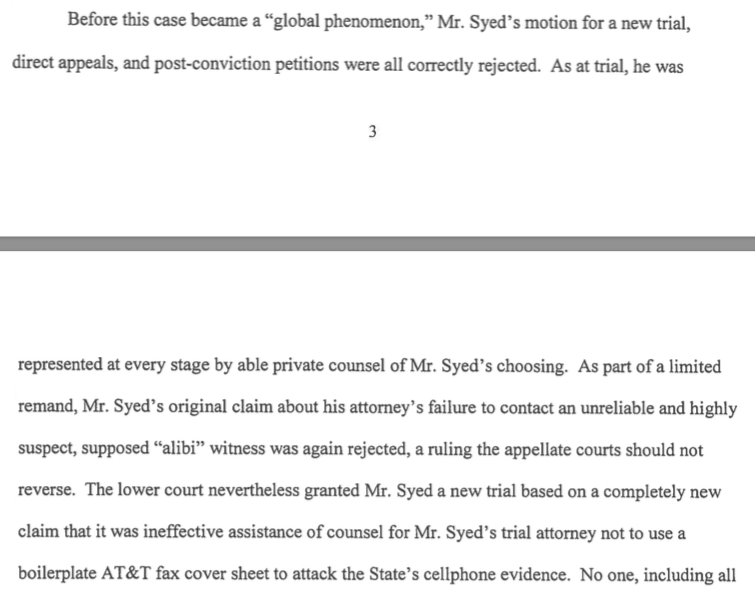
First, this is factually incorrect. Adnan was represented by a public defender at sentencing. Second, it seems disingenuous to imply that Judge Welch was swayed by Serial when he said in his opinion that he never listened to it. Third, the State’s Attorney seem to ignore that something huge has changed between Adnan’s prior appeals and his current appeal: An alibi witness has said that she was dissuaded from testifying by one of their brethren, which is the reason that Adnan’s postconviction proceeding was reopened.
The State’s Attorneys, however, claim that
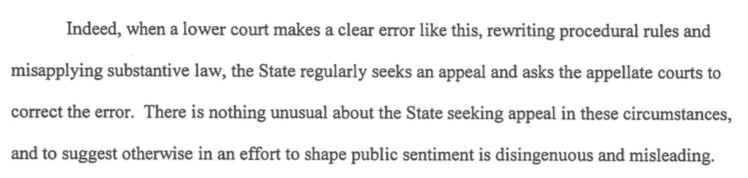
This, however, is a straw man. The NACDL brief did not claim that it was unusual for the State to file an ALA; it claimed that it was unusual for COSA to grant such an ALA. And it supported that claim with statistics. Conversely, the brief by the State’s Attorneys cites no statistics nor any precedent. It’s yet another example of the defense in this case pounding the law and the State pounding the table.
-CM