
What Can The Far Side and a Jigsaw Puzzle Teach Us About Guilt Beyond a Reasonable Doubt?
Here’s a hypothetical I just created to teach my Criminal Law students about proper and improper prosecutorial descriptions of the concept of guilt beyond a reasonable doubt:
Hypothetical
Jamario Hill is charged with first-degree burglary. During closing argument, the prosecutor told the jury that the burden of proof is “proof beyond a reasonable doubt, not all possible doubt, not all imaginary doubt. It’s what is reasonable.” In her rebuttal, the prosecutor responded to what she described as defense counsel’s attempt to “pick apart little pieces of evidence” to establish reasonable doubt by showing a single-panel cartoon from The Far Side, a popular and syndicated comic.
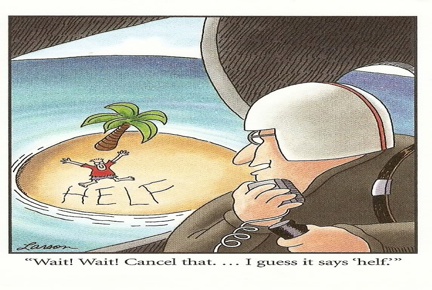
The prosecutor argued that “[j]ust because there is a small line that doesn’t connect does not mean that that person is asking for helf. That’s not reasonable doubt.”
Defense counsel objected, citing to a recent case in which the prosecutor did a presentation with a jigsaw puzzle during closing arguments.
“The…presentation consisted of eight puzzle pieces forming a picture of the Statue of Liberty. The first six pieces came onto the screen sequentially, leaving two additional pieces missing. The prosecutor argued it was possible to know what was depicted ‘beyond a reasonable doubt’ even without the missing pieces. The prosecutor then added the two missing pieces to show the picture was in fact the Statue of Liberty.”
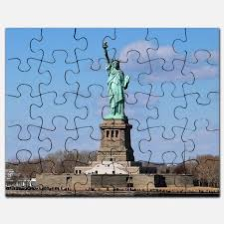
In that case, the court found this argument constituted prosecutorial misconduct. How should the court rule in this case? See People v. Hill, 2012 WL 1374690 (2012).
-CM