
Justice Department Announces Plan to End its Use of Private Prisons
In a memo issued today by Deputy Attorney General Sally Yates, the Justice Department plans to end its use of private/contract prisons. According to the memo,
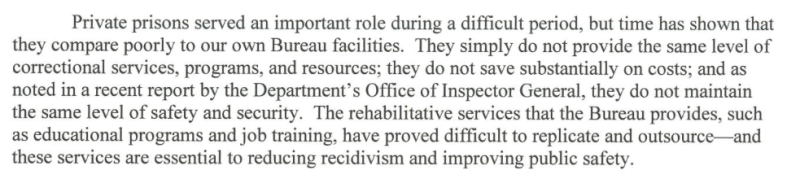
The Justice Department reached this conclusion largely as a result of a report released last week by the inspector general. According to that report,
In a majority of the categories we examined, we found that contract prisons incurred more safety and security incidents per capita than comparable BOP institutions and that the BOP could improve its contract monitoring efforts in several areas. Our analysis of data on safety and security indicators found that contract prisons had more incidents per capita than BOP institutions in three-quarters of the categories we examined. While the contract prisons had fewer positive inmate drug tests and sexual misconduct allegations than BOP institutions, they had more frequent incidents of contraband finds, assaults, uses of force, lockdowns, guilty findings on inmate discipline charges, and selected categories of grievances. Neither we nor the BOP know the extent to which demographic factors play a role in these differences; but, in order to ensure that federal inmates are housed in safe and secure facilities, the BOP should evaluate why contract prisons had more safety and security incidents in these categories and identify possible approaches for corrective action.
The corrective action that the Justice Department ended up taking was ending its use of
13 privately run facilities, housing a little more than 22,000 inmates, in the federal Bureau of Prisons system. The facilities were meant mainly to house inmates who are mostly low security, “criminal alien” men with 90 months or less time remaining on their sentences, according to a recent Department of Justice Inspector General report. Yates said the Justice Department would review the contracts for those facilities as they come up for renewal, as all will do in the next five years. She said they would then be reduced or allowed to expire, though none would be terminated prematurely.
This is a result to be championed for reasons that go beyond the specific issues at these private prisons, and that’s because of the issues inherent in the very idea of a private prison:
Because the detention of undocumented immigrants is so lucrative for private prisons, the industry has spent millions of dollars lobbying for harsher enforcement of immigration laws. Private prison lobbyists have focused on persuading Congress to maintain a federal quota that requires the detention of a certain number of immigrants at all times. These lobbyists have also spent millions on the state level to encourage legislators to pass draconian immigration laws that ensnare more immigrants and send them into the federal detention system. Of the 36 co-sponsors of Arizona’s unconstitutional 2010 immigration law, for instance, 30 had received campaign contributions from private prison companies and lobbyists.
At the same time, this change in federal policy addresses just the tip of the iceberg.
The vast majority of the incarcerated in America are housed in state prisons — rather than federal ones — and Yates’ memo does not apply to any of those, even the ones that are privately run. Nor does it apply to Immigration and Customs Enforcement and U.S. Marshals Service detainees, who are technically in the federal system but not under the purview of the federal Bureau of Prisons.
-CM