
Was Judge Welch Correct That the Brady Right is Not a Fundamental Right?
In Judge’s Welch’s opinion granting Adnan a new trial, he noted the dichotomy between fundamental and non-fundamental rights:
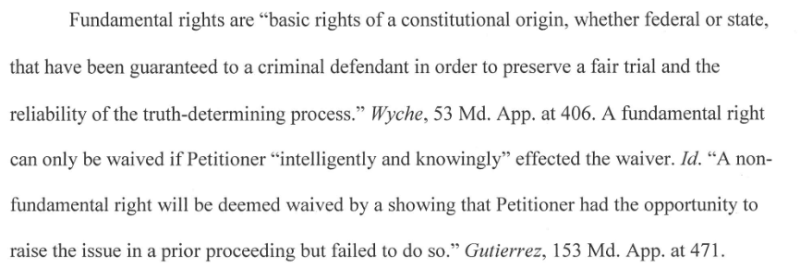
Because Maryland has found that the right to the effective assistance of counsel is “fundamental,” Judge Welch was able to find that Adnan’s prior failure to raise the AT&T disclaimer issue was not waived because Adnan did not “intelligently and knowingly” fail to raise the issue in his first PCR petition. Conversely, because Judge Welch concluded that an alleged Brady violation does not relate to a fundamental right, he also concluded that Adnan had waived his Brady claim because he had the opportunity to raise the claim in his first PCR petitionBrady claim. But is this conclusion correct?
In his opinion, Judge Welch acknowledged that “Maryland appellate courts have not explicitly identified the underlying basis of a Brady claim as a fundamental right.” As such, he cited to the one Maryland appellate court opinion that discussed the issue in dicta.
In Conyers v. State, 790 A.2d 15 (Md. 2002), Clarence Conyers filed a PCR petition challenging his capital murder conviction; the petition did not contain a Brady claim. At trial, Conyers had been convicted largely based on the testimony of Charles Johnson a jailhouse snitch. At the PCR hearing, Detective Phillip Marr testified
about his 23 November 1994 meeting with Johnson. On this occasion,…Detective Marll indicated that…Johnson had queried the detectives about a possible deal. When Detective Marll informed Johnson that the police did not have the authority to commit to a deal, but would refer his inquiry to the State’s Attorney’s office, Johnson declined to sign his written statement, electing instead merely to initial the pages. Detective Marll also revealed, for the first time, that several statements Johnson provided the police during the 1994 meeting either were disproved subsequently by the police or were found by them to be unverifiable.
Thereafter, Conyers moved to supplement his PCR petition to include a Brady claim. The State countered that Conyers had waived this Brady claim by not including it in his first PCR petition. The Court of Appeals of Maryland disagreed, finding that Conyers’s “Brady claims relating to the testimony and examination of Charles Johnson did not arise until the post conviction evidentiary hearing, at which point Petitioner properly raised these issues.” In doing so, the court cited to several Maryland waiver cases that dealt with non-fundamental rights.
The question, of course, is whether the court was (1) implying that an alleged Brady violation does not relate to a fundamental right; or (2) saying that, even under the more difficult waiver test, Conyers still didn’t waive his Brady claim, thus leaving for another day the question of whether a Brady violation relates to a fundamental right.
Judge Welch obviously went with option 1, despite noting that
A Brady violation relates to the right to a fair trial. The right to a fair trial is rooted in the Sixth Amendment and the Due Process Clause of the Fourteenth Amendment of the United States Constitution, both of which form the foundation of our criminal justice system.
Immediately after this language, however, Judge Welch cited the authority that allowed him to conclude that an alleged Brady violation does not relate to a fundamental right:
The application of the “intelligent and knowing” standard, however, does not necessarily apply to an asserted right originating from a Constitutional guarantee. See Wyche, 53 Md.App. at 406.
Here is page 406 of the opinion in Wyche:
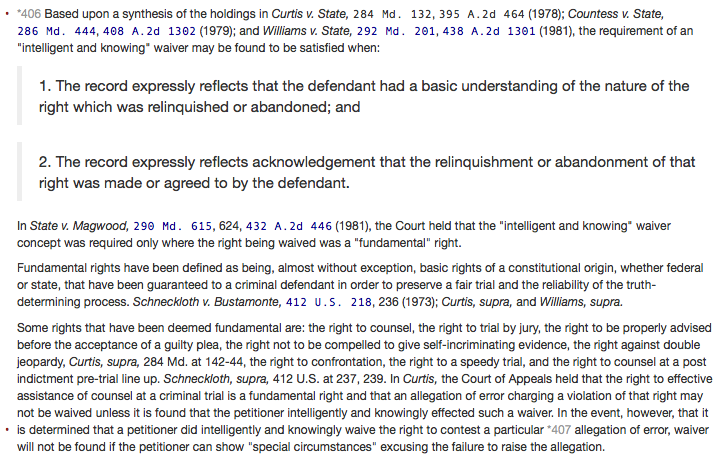
I don’t read this language the same way as Judge Welch. It seems to me that the Wyche court said that fundamental rights are, “almost without exception, basic rights of a constitutional origin” and then gave a non-exhaustive list of examples. I don’t read the Wyche opinion as saying that there are any “basic rights of a constitutional origin” that are non-fundamental.
Moreover, I don’t see how the Brady right could be seen as anything other than a right guaranteed “to preserve a fair trial and the reliability of the truth-determining process.” Brady violations consist of the State failed to turn over material exculpatory evidence like an alternate suspect confessing of someone else’s DNA being found on the victim’s body. Isn’t the right to a new trial based on such non-disclosure guaranteed to preserve a fair trial and the reliability of the truth-determining process? This is a question that the Court of Special Appeal might soon have to answer.
-CM