
The State is Between Scylla and Charybdis in Appealing Judge Welch’s Ruling
In Greek mythology, Scylla and Charybdis were a pair of monsters who lived on opposite ends of the Strait of Messina between Italy and Sicily Scylla was originally a sea nymph who was loved by the sea god Poseidon*. Out of jealousy, Poseidon’s wife Amphitrite poisoned the waters in which Scylla bathed. This turned Scylla into a six-headed beast with three rows of sharp teeth in each head. When ships passed close by her, she struck out to grab and eat unwary sailors.
Charybdis was also a sea nymph, as well as the daughter of Poseidon. Zeus* transformed her into a dangerous whirlpool across the strait from Scylla. Ships sailing the strait were almost certain to be destroyed by one of the monsters.
The legend of the two monsters gave birth to the phrase “between Scylla and Charybdis,” meaning a situation in which one has to choose between two equally unattractive options.
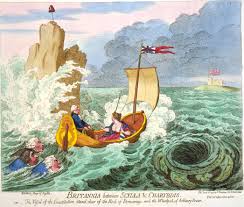
Based on the opinion of the Fourth Circuit in Elmore v. Ozmint, 661 F.3d 783 (4th Cir. 2011), I’m more convinced than ever that the State will be between Scylla and Charybdis if it attempts to appeal Judge Welch’s opinion granting Adnan a new trial.
An ineffective assistance of counsel claim requires the defendant to prove (1) unreasonable performance; and (2) prejudice, i.e., that reasonable performance by trial counsel would have created the reasonable probability of a different outcome at trial. With regard to trial counsel’s failure to contact Asia McClain, Judge Welch found that Adnan proved unreasonable performance but failed to prove prejudice because the crux of the State’s case was the confluence between Jay’s burial story and the Leakin Park pings.
In turn, Judge Welch found that trial counsel was unreasonable in failing to cross-examine the State’s cell tower expert with the AT&T disclaimer and that this failure was prejudicial because, again, the Leakin Park pings were part of the crux of the State’s case. As I noted on Monday’s episode of Undisclosed, these twin conclusions make it exceedingly difficult for the State to claim on appeal that trial counsel’s failure to cross-examine the State’s cell tower expert with the AT&T disclaimer was not prejudicial. The problem with this strategy is that a winning argument on this point means that the Leakin Park pings were not the crux of the State’s case, which would imply that failure to contact Asia McClain was (or at least could be) prejudicial.
As Elmore makes clear, however, the State might have to argue on appeal that the Leakin Park pings were not part of the crux of the State’s case. In Elmore, Edward Lee Elmore was charged with the murder of Dorothy Edwards, an elderly woman who had sporadically employed him. Elmore was initially convicted in 1982, but his conviction was reversed because “the trial judge had improperly entered the jury room during the sentencing phase of the trial, without counsel for either the State or the defense.” This reversal gave Elmore’s attorneys “a rare second chance to contest the State’s case—along with near-perfect knowledge of what that case would be.”
According to this Fourth Circuit, this first trial revealed that most of the State’s case — “James Gilliam’s account of Elmore’s spontaneous jailhouse confession and Elmore’s guilty demeanor and lack of a corroborated alibi for Saturday night” — was weak. Instead, the crux of the State’s case was forensic evidence, such as pubic hairs allegedly recovered from the victim’s bed.
This meant everything to the Fourth Circuit. As the court noted, in many cases, defense counsel might act reasonably in failing to rigorously cross-examine State experts, which could “risk ‘making a central issue out of [the forensic] evidence.'” In other cases, defense counsel might simply “ma[k]e an informed decision to pursue another strategy.” In this case, however,
forensic evidence was always and obviously vital to the State’s case, which otherwise relied on James Gilliam’s account of Elmore’s spontaneous jailhouse confession and Elmore’s guilty demeanor and lack of a corroborated alibi for Saturday night. As such, the defense did not risk “making a central issue out of [the forensic] evidence,” because the State was already certain to do so….Rather, the circumstances necessitated that the defense work to engender doubt about the forensic evidence. Elmore’s lawyers attempted as much in their cross-examinations of the State’s witnesses, but, because the lawyers had twice squandered opportunities to investigate the forensic evidence (prior to the 1982 and 1984 trials), they were unarmed for the battle.
As such, the Fourth Circuit easily unreasonable performance by Elmore’s trial counsel.
It’s hard to ignore the parallels between Elmore and Adnan’s case. Like Elmore’s trial counsel, Gutierrez got to see the bulk of the State’s case against Adnan at a first trial. Indeed, the first trial ended in a mistrial after trial counsel told the judge she hadn’t looked at the State’s cell tower exhibit because she didn’t care about it. According to Judge Welch, it should have been clear that most of the State’s case against Adnan was weak, with the incoming Leakin Park pings forming part of the crux of the case against him. Trial counsel was armed with the AT&T disclaimer, which stated that incoming pings are unreliable for determining location status.
In another case in which the cell tower pings weren’t as important, trial counsel’s failure to use the disclaimer might have been excused. The State will undoubtedly be able to find cases where courts rejected claims of ineffective assistance based on failure to rigorously cross-examine State’s experts. But Elmore, a case from the Fourth Circuit (the circuit that includes Maryland), makes clear that trial counsel’s obligations to cross-examine the State’s experts under the reasonableness prong of the IAC test are directly tied to the importance of that expert testimony at trial. If the Leakin Park pings were part of the crux of the State’s case against Adnan, Elmore almost certainly stands for the conclusion that trial counsel was unreasonable in failing to use the AT&T disclaimer. Conversely, if the Leakin Park pings were not part of the crux of the State’s case against Adnan, the failure to contact Asia McClain was almost certainly prejudicial.
-CM