
Does Judge Welch’s Opinion Leave the State With Any Workable Theory of Adnan’s Guilt?
“Had trial counsel investigated the potential alibi witness, she could have undermined a theory premised upon inconsistent facts. The potential alibi witness, however, would not have undermined the crux of the State’s case: that Petitioner buried the victim’s body in Leakin Park at approximately 7:00 P.M. on January 13, 1999.” Excerpt from Judge Martin P. Welch’s opinion granting Adnan Syed a new trial.
In yesterday’s episode of Undisclosed, I repeated the claim I made in a blog post last week: Pursuant to the Supreme Court’s recent opinion in Wearry v. Cain, evidence “that [the defendant] may have been involved in events related to the murder after it occurred” might support a conviction for being an accessory after the fact but cannot support a conviction for murder. Therefore, evidence of what Adnan may have been doing at approximately 7:00 P.M. cannot support his conviction for murder, and there are good reasons to believe that the Court of Special Appeals of Maryland (COSA) will use Wearry to find that failure to contact Asia McClain was prejudicial, assuming that there is even an appeal.*
Apart from Wearry, however, in this post I will really dig into Judge Welch’s opinion and show how it demonstrates that Asia wouldn’t merely have undermined the theory presented by the State at trial; she would have undermined any theory that the State could have presented at trial.
1. The 2:36 P.M. call was the “come and get me” call
This was the theory that the State presented at trial, and it was the theory that Asia undermined, according to Judge Welch. Clearly, if Adnan was talking to Asia at the library adjacent to Woodlawn High School until 2:40 P.M., there is no way that he could have called Jay from the Best Buy a mile away from the school at 2:36 P.M. Indeed, if Adnan was talking to Asia at the library until 2:40 P.M., there is no way that he could have called Jay from anywhere at 2:36 P.M.
2. The 3:15 P.M. call was the “come and get me” call
In footnote 9 of his opinion, Judge Welch flatly refuted the State’s contention that it could have used the 3:15 P.M. call on Adnan’s call log as the “come and get me” call:
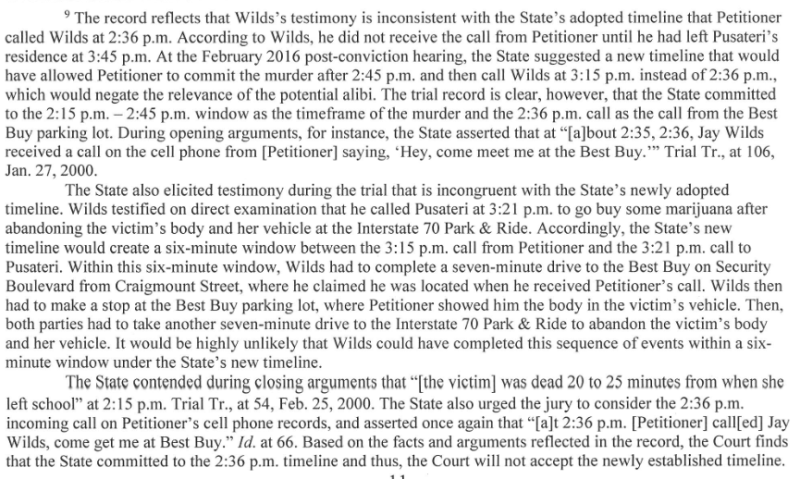
Although Judge Welch didn’t note it in his footnote, a State pivot to a 3:15 P.M. “come and get me” call would have created the same issue with regard to “The Nisha Call.”
3. Any call after 3:15 P.M. was the “come and get me” call
Obviously, if a 3:15 P.M. “come and get me” call wouldn’t work given Jay’s narrative about the 3:21 P.M. Jenn Call and 3:32 P.M. Nisha call, a “come and get me” call after 3:15 P.M. would be even more problematic. Moreover, the State’s whole theory of the crime was that Adnan loaned Jay his car and cell phone so that Adnan could call Jay on his cell phone after he had killed Hae so that Jay could pick him up. After the 3:15 P.M. call on Adnan’s call log, the next incoming call was at 4:27 P.M., which simply doesn’t make any sense at all as a “come and get me” call.
4. There was a non-cell phone “come and get me” call between 2:36 P.M. and 3:15 P.M.
There were no incoming calls to Adnan’s cell phone between 2:36 P.M. and 3:15 P.M. Therefore, if there was a “come and get me” call in this time frame, it couldn’t have been made to Adnan’s cell phone. Therefore, under this theory, for the jury to convict, it would have needed to believe that (1) the State’s theory about Adnan loaning Jay his cell phone to make a “come and get me” call was wrong; and (2) Jay was mistaken/lying when he said that he received the “come and get me” call on Adnan’s cell phone…while he was driving Adnan’s car.
Moreover, let’s narrow the 2:36-3:15 P.M. window a bit more. If Asia saw Adnan until 2:40 P.M., what’s the earliest that Adnan could have called Jay from Best Buy after getting a ride from Hae and fatally strangling her? Maybe 2:50 P.M. On the other end, what’s the latest that Adnan could have called Jay to allow for enough time for all of the intervening events before the call to Jenn at 3:21 P.M.? Maybe 3:05 P.M.
So, is that our window? If there was indeed a “come in get me” call that wasn’t made to Adnan’s cell phone, it would have occurred in the fifteen minutes between 2:50 and 3:05 P.M. Could the jury have reached this conclusion and convicted Adnan of murder?
Well, what about Becky? She testified that she saw Hae heading to the door that led to her car in the seconds after school, with Hae saying that “she had to leave” because “she had to be somewhere after school.” And what about Inez, who was not discredited at the time of trial? She testified that she saw Hae between 2:15 and 2:20 P.M. as she was leaving school to pick up her cousin(s). If Hae did indeed leave school between 2:15 and 2:20 P.M., how could Adnan have killed her if he was at the library next to the school until at least 2:40 P.M.?
I suppose the State would say that the jury could have credited Debbie, who testified that she saw Hae, still at school, at 3:00 P.M. Could the jury have credited Debbie and found Adnan guilty based upon her timeline? I see at least two problems. First, if Hae is still at Woodlawn at 3:00 P.M., how in the world is Adnan making a “come and get me” call by 3:05 P.M.? Again, that’s pretty much the latest time for a “come and get me” call to make sense given the 3:21 P.M. call to Jenn, and, under Debbie’s timeline, Hae probably hadn’t even left Woodlawn by 3:05 P.M.
Second, Judge Welch’s opinion reminded me that the State actually claimed at trial that Hae’s family was notified at about 3:00 P.M. that Hae hadn’t picked up her cousin(s) (page 11):

This would mean that Hae was supposed to pick up her cousin(s) at or before 3:00 P.M., which would mean that Hae was already late picking up her cousin(s) when Debbie saw her. Therefore, to believe in Adnan’s guilt, the jury would have needed to believe that Hae, despite already being late to pick up her cousin(s), gave Adnan a ride to Best Buy.
5. There was no “come and get me” call
Given the issues with 1-4, this is seemingly the only option that would have been available to the jury if Asia had testified at trial: believe that (1) the State’s entire theory of the case (phone loan) was wrong and that Jay was lying or mistaken about there being a “come and get me” call; (2) Becky and Inez were mistaken about Hae leaving school in a hurry between 2:15 and 2:20 P.M.; and either (3) Debbie was mistaken about seeing Hae at 3:00 P.M.; or (4) Debbie saw Hae at 3:00 P.M., with Hae subsequently giving Adnan a ride to Best Buy despite already being late to pick up her cousin(s).
________________________
*As Erica Suter has noted, there’s a decent chance that COSA does not even allow the State to appeal Judge Welch’s finding that trial counsel was ineffective based on failing to cross-examine the State’s cell tower expert via the AT&T disclaimer. If COSA does allow the State to appeal, the defense would then cross-appeal and ask COSA to find that trial counsel’s failure to contact Asia McClain was prejudicial.
-CM