
Wrap-Up of Adnan’s Reopened PCR Proceedings: Addendum
While writing my post yesterday, I realized that Griffin v. Warden, Maryland Correctional Adjustment Center, 970 F.2d 1355 (4th Cir. 1992) is not only a very helpful case for Adnan under the “unreasonable performance” prong of the ineffective assistance of counsel test. It’s also exceedingly helpful under the “prejudice” prong.
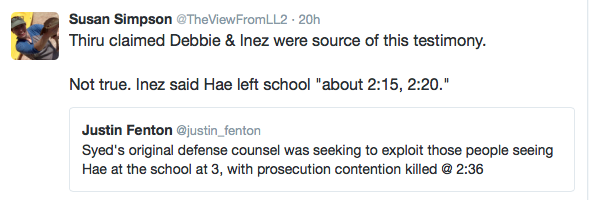
The Deputy Attorney General’s strategy during closing argument was to try to claim that Asia “was not a weapon for defense but weakness bc it helped corroborate State’s timeline.” Not the State’s actual trial timeline, but the hypothetical timeline that the State could have advanced if it claimed that Debbie actually saw Hae at 3:00 P.M.*
Of course, as noted by Susan Simpson, the Deputy AG was mistaken in that he thought Inez Butler also claimed she saw Hae at 3:00 P.M. when she in fact testified that she saw Hae leaving school in a hurry between 2:15 and 2:20 P.M. Indeed, Inez’s testimony is likely why the State claimed at trial that the 2:36 P.M. call was the Best Buy call at trial and read Debbie out of the timeline.** Under this actual timeline, Asia’s testimony that she left Adnan behind at the library at 2:40 P.M. (or even 2:35 or 2:30 P.M.) would have been hugely valuable given that the jury was led to believe that Hae left Woodlawn soon after 2:20 P.M. at the latest.
That said, Debbie did testify that she saw Hae at 3:00 P.M., which you could conceivably argue placed Adnan in a position to abduct her (without anyone noticing) as Hae left school if Adnan were outside the library at 2:40ish. The problem for the State is that the Griffin case pretty clearly states that this type of possibility does not preclude a finding of prejudice.
In Griffin, the exact time of the Rite-Aid robbery was uncertain. The State argued that the robbery had been completed by 3:45 P.M. while one of the security guard testified that the robbers entered the Rite-Aid at 3:45 P.M. and did not leave until 10-15 minutes later.** Given that the defendant’s alibi consisted of arriving at a house that was only 3 or 3-4 miles away from the Rite-Aid at 4:00 P.M., the PCR court denied the defendant relief.
As noted in Brief of Appellees, 1992 WL 12125964 (4th Cir. 1992),
With regard to the testimony of Joseph Williams and Beatrix Williams, the post conviction court likewise found that the testimony did not establish an alibi. Given that the crime occurred at 3:45 p.m., and that the Williamses testified that Griffin arrived at 4:00 p.m., the post conviction court ruled that the evidence did not establish an alibi inasmuch as the Rite Aid was only three miles from Mrs. Williams’s house. (J.A. 183).
Indeed, one could claim that such testimony could have hurt the defendant because it would explain why he was in the area, with a 4:00 P.M. arrival following the 3 mile drive from the Rite-Aid robbery at 3:45 P.M.
In Griffin, however, the Fourth Circuit turned this argument aside, ruling as follows:
Joseph “Eddie” Williams and his mother, Beatrice Williams, both testified that Griffin arrived at their house at 4 p.m. on the date of the robbery, where he remained, watching sports and eating chicken, until nightfall. The state court concluded that this evidence did not establish an alibi because it “[did] not cover the period in question.” The court’s conclusion is strained, at best. The Williams’ house is three to four miles from the site of the robbery. Griffin testified that it takes twenty to twenty-five minutes to drive that distance because of numerous stoplights. Finally, the court ignored the trial testimony of one of the Rite Aid security guards, who testified that the robbers entered the store at 3:45 p.m. and did not leave until ten to fifteen minutes later.
In other words, it doesn’t matter that the uncontacted alibi witnesses were unhelpful and possibly even harmful under one possible timeline; the defendant could, and did, establish prejudice because these witnesses could have rebutted an equally plausible timeline. In other words, an uncertain crime timeline helps, rather than hurts the defendant, which was the same point made by the Court of Appeals of Maryland in In re Parris W., 770 A.2d 202 (Md. 2001):
Given the distance between Ms. Cary’s home and the place where Morton was assaulted, and given the uncertainty surrounding the time of the assault, Ms. Cary’s testimony alone may have been enough to create reasonable doubt in the mind of the hearing judge had she been available to testify.
Simply put, “may have” is good enough to establish prejudice.
On the other hand, guess what’s not good enough to defeat a claim of “unreasonable performance” or prejudice? Prior convictions. At the PCR proceedings, the Deputy AG asked David Irwin whether he would contact an alibi witness despite finding “out the alibi witness has five convictions for making false statements?” The response, of course, was “yes.”
Interestingly, the State of Maryland made a similar argument in Griffin. This was based upon trial counsel’s claim “that he did not want to use the alibi witnesses other than his mother because they had prior records.” The Fourth Circuit easily rejected this argument, finding that (1) such a conclusion could not have been drawn without first contacting these witnesses; and (2) the jury could have believed these witnesses and not the security guards, who claimed that the defendant robbed them.
Given this conclusion, I’m thinking that Asia is a pretty good alibi witness, especially when her credibility is being matched up against Jay’s credibility.
_______________________
*As Hae was on her way to see Don and/or telling “Takera” that she didn’t have time to give anyone a ride.
**The same goes for Becky’s testimony about Hae leaving school minutes after it ended to go somewhere else.
***It is unclear if this was the same security guard who picked one of the defendant’s alibi witness out of a photo array as one of the robbers.
-CM