
It Comes Down To This: Gutierrez’s Failure to Contact Asia McClain & Ineffective Assistance
There have been 12 episodes of the first season of Serial, 17 episodes and 16 Addenda of Undisclosed, 32 first season episodes of the Truth & Justice Podcast, and several other podcasts related to the Adnan Syed case, including Crime Writers On and Serially Obsessed. In the end, though, everything seemingly comes down to something that Sarah Koenig said in the very first episode of her groundbreaking podcast:
So I put that question to a few defense attorneys. And they said, well, alibi witnesses can be tricky, especially if it’s just one person. Because then it becomes one person’s word over another. A single witness like that can backfire under cross-examination. Or they might take the jury’s focus away from the weaknesses in the state’s case.
So there are conceivable strategic reasons why Christina Gutierrez might not have wanted to put Asia McClain on the stand. But what is inconceivable, they all said, is to not ever contact Asia McClain, to never make the call, never check it out, never find out if her story helps or hurts your case. That makes no sense whatsoever. That is not a strategy. That is a screw-up.
That’s it. That’s the case. The Attorney General’s Office has indicated that it intends to call “attorney William R. ‘Billy’ Martin as an expert who will rebut Syed’s claims that he received ineffective counsel when his trial attorney did not call an alibi witness.”
But that’s not the issue. The issue isn’t Gutierrez’s decision not to call Asia McClain. It can’t be. The issue is Gutierrez’s decision not to contact Asia McClain.
You can find any number of cases in which an appellate judge found that defense counsel gave effective assistance by contacting an alibi witnesses and thereafter making the strategic decision not to call that alibi witness at trial. For instance, here is pertinent language from the opinion of the Supreme Court of Illinois in People v. Thompkins:
The defendant also argues that trial counsel was ineffective for failing to present alibi testimony from Barbara Thompkins, the defendant’s wife. In an affidavit submitted with the post-conviction petition, Barbara states that the defendant “must have been home after 9:00 in the evening of December 22, 1980,” because that was the time when she would normally leave for work and the defendant drove her to work that night. In her affidavit, however, Barbara acknowledges that defense counsel spoke to her generally about testifying in this case. If Barbara related the possible alibi to defense counsel, then, as Strickland instructs, we should defer to counsel’s decision not to present her testimony.
In other words, when defense counsel contacts a prospective alibi witness and decides not to call her, the presumption is that defense counsel had strategic reasons not to call the witness and thus acted reasonably.
Conversely, when defense counsel does not contact a prospective alibi witness, the inverse is true. It has to be. Just last week, I wrote about a more recent Illinois case in which the judge found that the defense counsel was ineffective. Here is the pertinent portion:
Whether or not trial counsel would have called these witnesses to testify is irrelevant given that he never ascertained what they would say; due, in part, to his inability to interview them.
Readers of this blog should be familiar with this language. It’s similar to language I have found in cases across the country, without exception. Those cases include the opinion of the Court of Appeals of Maryland in In re Parris W., 770 A.2d 202 (Md. 2001), and the Fourth Circuit in Griffin v. Warden, Maryland Correctional Adjustment Center, 970 F.2d 1355 (4th Cir. 1992).
In Griffin, which involved the same courts handling Adnan’s trial and appeal, the Fourth Circuit cited Grooms v. Solem, 923 F.2d 88, 90 (8th Cir. 1991), for the proposition that “[o]nce a defendant identifies potential alibi witnesses, it is unreasonable not to make some effort to contact them to ascertain whether their testimony would aid the defense.” As a result, the Fourth Circuit ruled as follows:
David did not even talk to Staples, let alone make some strategic decision not to call him. Strickland and its progeny certainly teach indulgence of the on-the-spot decisions of defense attorneys. On the other hand, courts should not conjure up tactical decisions an attorney could have made, but plainly did not. The illogic of this “approach” is pellucidly depicted by this case, where the attorney’s incompetent performance deprived him of the opportunity to even make a tactical decision about putting Staples on the stand.
I expect Billy Martin to testify about all of the potential pitfalls with calling alibi witnesses and why he might not have called Asia McClain as an alibi witness if he were Adnan’s attorney at trial. As was noted in the recent Illinois case, however, such testimony is ” irrelevant.”
Such strategic decisions can’t be made until defense counsel has had somebody on their team contact the alibi witness to assess their credibility and viability. So, unless Martin testifies that he would have refrained from having anyone on his team contact the only alibi witness who covered the time frame for the murder laid out by the prosecution in its opening statement at Adnan’s first trial, his testimony about trial strategy will be “irrelevant.”
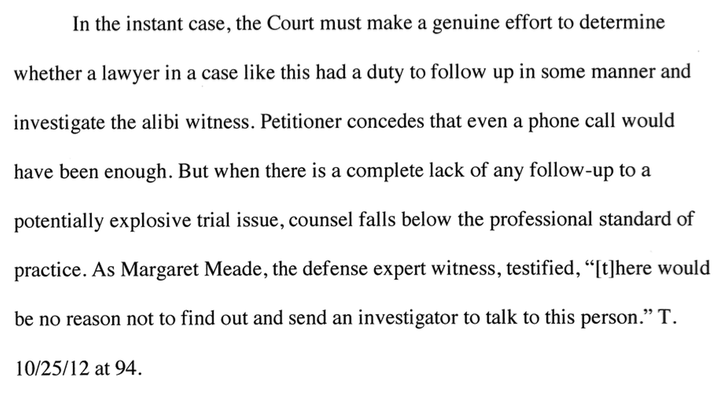
In fact, such testimony could be worse than “irrelevant” for the State because it could underscore just how easily Gutierrez could have discharged with her obligation to render effective assistance. Adnan’s attorney laid this out in his Application for Leave to Appeal:
-CM